ServiceTitan Pricing in 2026: $245–$500/Tech + Setup

ServiceTitan pricing: reported $29,400–$60,000 yearly for 10 technicians
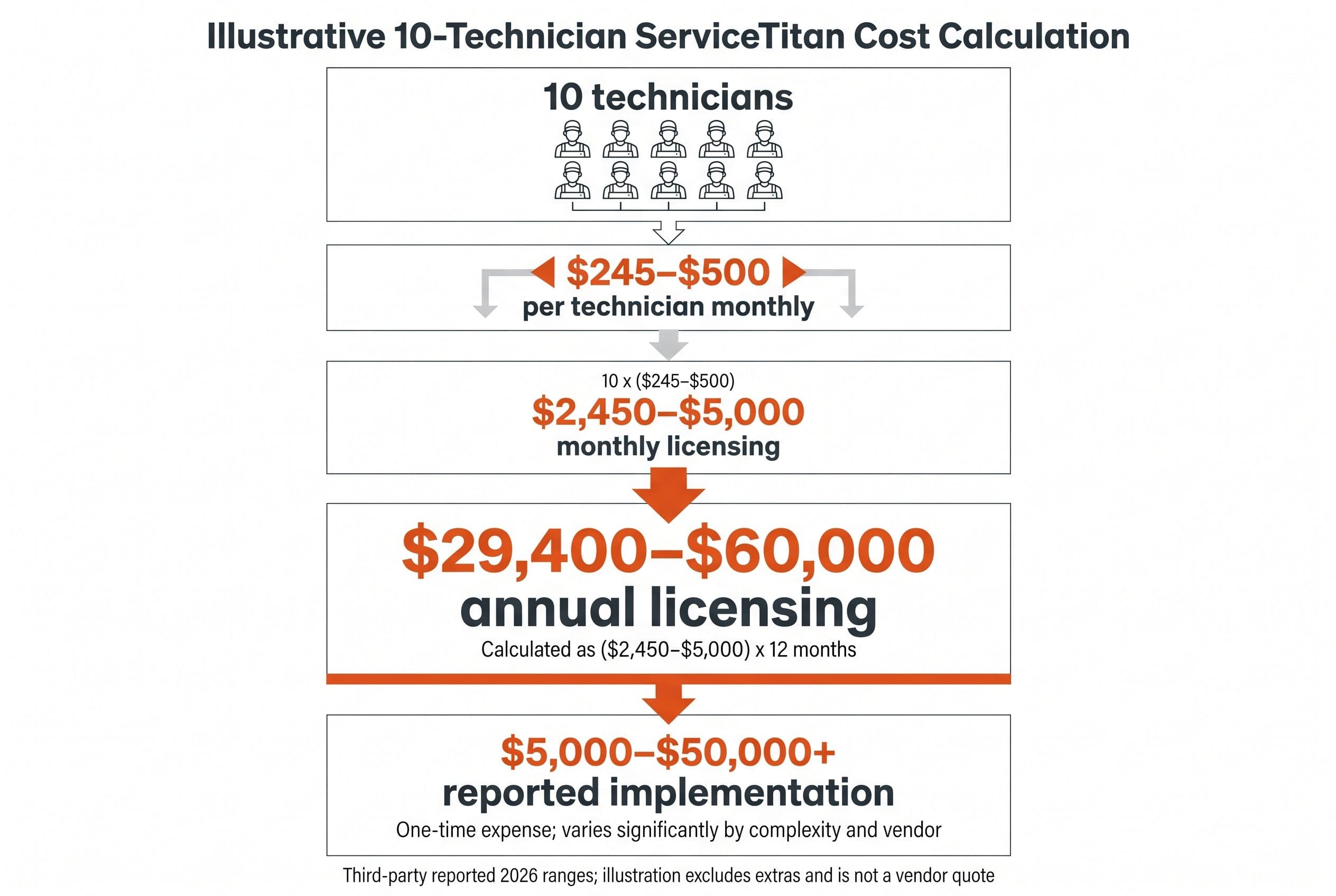
For an illustrative 10-technician business, reported ServiceTitan pricing works out to $2,450–$5,000 monthly before implementation and extras. That's $29,400–$60,000 annually. I'd start there—not with a demo booking.
These aren't official quotes. Projul's 2026 pricing analysis and ITQlick's 2026 pricing breakdown report these approximate ranges:
| Reported package | Per technician, monthly | Illustrative 10-tech monthly bill | Illustrative annual licensing |
|---|---|---|---|
| Starter | $245–$300 | $2,450–$3,000 | $29,400–$36,000 |
| Essentials | $300–$400 | $3,000–$4,000 | $36,000–$48,000 |
| The Works | $400–$500 | $4,000–$5,000 | $48,000–$60,000 |
Projul and ITQlick also report implementation fees ranging from $5,000 to $50,000+. Combining the endpoints produces an illustrative first-year envelope of $34,400–$110,000+, excluding extras. That's arithmetic across reported ranges, not a prediction of your quote.
I wouldn't treat those package names, rates, or implementation fees as contract terms. Some reporting comes from competing vendors. Your written proposal needs to settle what's included, who's billable, and what happens at renewal.
For comparison, my fixed-price builds range from $2,500–$20,000 before AI features, depending on scope. That's not a promise to recreate ServiceTitan. It's the cost of a defined application, not an entire field-service platform.
I have a concrete example of the narrower replacement math. I built a custom power dialer in React that replaced a Kixie contract costing about $30,000 a year. The build cost $10,000—a third of the annual licensing—so it paid for itself in about four months on licensing-replacement math.
It supported unlimited users, up to 10 outbound lines at once, custom lead lists, SMS templates, voicemail drops, analytics, and Zapier webhooks. Built in weeks. Owned outright, with zero monthly licensing fees.
By zero monthly licensing fees, I mean software licensing for the custom dialer—not free calls, SMS, or hosting. I'd still account for any telecom, carrier, and infrastructure charges separately.
That project is why I take replacing a dialer subscription seriously. It isn't evidence that an HVAC business can replace every ServiceTitan feature for the same price. The transferable lesson is to price the workflow you need, not a clone of the vendor.
The bill moves with technicians, package scope, and rollout
When I review service titan cost, I separate three things: the billing unit, the work the package actually covers, and the work required to get your business onto it.
The billing unit comes first. Searches for “servicetitan per user cost” can hide a bad assumption: a technician and an office user aren't necessarily the same billing category. I'd want the proposal to define billable users, minimum commitments, seasonal staffing, and inactive accounts.
At a constant per-technician rate, adding technicians increases the base bill even if your office workflow hasn't changed. That's seat creep. Per-seat licensing ties spending to headcount rather than directly to the value of the next feature you need.
Package scope comes next. A lower servicetitan monthly cost doesn't help if the quote leaves out something dispatch needs every morning. I compare the written inclusions against actual tasks: booking, assigning work, updating job status, invoicing, reporting, and moving information into accounting.
I don't assume any specific feature is included or excluded based on a third-party pricing table. The proposal has to answer that.
Rollout is the third variable. Importing clean customer records is different from reconciling duplicates, preserving equipment history, and deciding which old job attachments matter. Your staff's training and checking time belongs in this calculation, too—even when it doesn't appear on a vendor invoice.
My wider breakdown of what custom software actually costs uses the same distinction: software cost isn't just the number beside “subscription” or “development.” It's everything required to make the system usable.
Separate the custom build from the bills that survive it
My ServiceTitan pricing comparison wouldn't put annual licensing beside a one-time build and declare victory. Owning code doesn't make hosting, messaging, maintenance, or migration disappear.
Here's how I'd break out a custom proposal:
| Cost bucket | What I'd define before quoting | How I'd treat it |
|---|---|---|
| Build | Screens, roles, business rules, acceptance tests | Fixed price for the agreed scope |
| Migration | Data sources, cleanup rules, attachments, import checks | Explicitly included scope or a separately quoted phase |
| Hosting | Application, database, storage, backups | Recurring infrastructure expense |
| APIs | Messaging, payments, accounting connections, access requirements | Usage charges and provider terms checked separately |
| Maintenance | Dependency updates, monitoring, fixes, operational support | Written responsibilities and a defined support arrangement |
I won't invent a monthly operating figure without the usage assumptions. A dispatch dashboard and a system sending appointment messages all day don't have the same running costs.
For example, I'd check Twilio's documentation for messaging requirements and model the expected usage separately from development. If invoices need to reach QuickBooks, I'd define what gets created, when it syncs, and who handles rejected records.
The development bands themselves aren't a secret:
| My build category | Fixed-price range | Delivery window | Possible field-service scope, subject to review |
|---|---|---|---|
| Simple | $2,500–$10,000 | 1–2 weeks | Focused dashboard or basic job-record app |
| Medium | $5,000–$15,000 | 2–4 weeks | Multiple features, user roles, integrations |
| Advanced | $10,000–$20,000 | 4–6 weeks | Real-time updates, complex rules, multi-tenancy |
AI features multiply the applicable range by 1.25, bringing the overall envelope to $2,500–$25,000. AI-assisted development isn't the same thing as adding AI features to your application. I'd skip AI features unless there's a specific task worth paying to automate.
Migration belongs inside the scope discussion, not in a surprise invoice after development. If the records aren't ready for a reliable quote, I'd narrow the first release or separate the migration phase before promising a total.
For a limited customer-facing workflow, I'd follow the approach in starting a client portal with its core screens. A focused portal may solve the problem without forcing dispatch, accounting, and every technician to change systems.
A technician's weak signal can change the whole quote
Here's the scope question I'd ask before drawing a dispatch board: Does the app have to work without a reliable connection?
A browser app that reads and saves live records is one kind of build. An app that must keep working offline, store changes locally, and reconcile them later is another. That difference matters more than whether you prefer a blue or green calendar.
For HVAC field service software, I'd define the behavior around the job itself:
- Can a technician open today's assignments without a connection?
- Must equipment history remain available offline?
- Can photos wait to upload until service returns?
- What happens when dispatch and a technician edit the same job?
- Can an invoice wait, or must payment happen on-site immediately?
Those aren't decorative features. They change data storage, conflict handling, testing, and support.
I'd also put a representative data export through a trial import before scheduling the switch. Customer names alone aren't enough if the business depends on service addresses, equipment records, attachments, and job history.
An export button isn't an exit plan. I want to know which relationships survive the export and which have to be rebuilt.
If your business depends on deeply connected workflows and reliable offline behavior that the current system already handles, don't hire me to replace it just because the subscription looks expensive. Keeping it can be the better deal.
Three screens can be affordable; “everything it does” isn't scope
To make a custom alternative cheaper, I'd reduce the replacement boundary—not pretend the difficult work takes no time.
A first release might cover a dispatcher assigning jobs, a technician updating job status, and an office manager reviewing completed work. That's an illustrative starting point, not a claim that three screens cover your business.
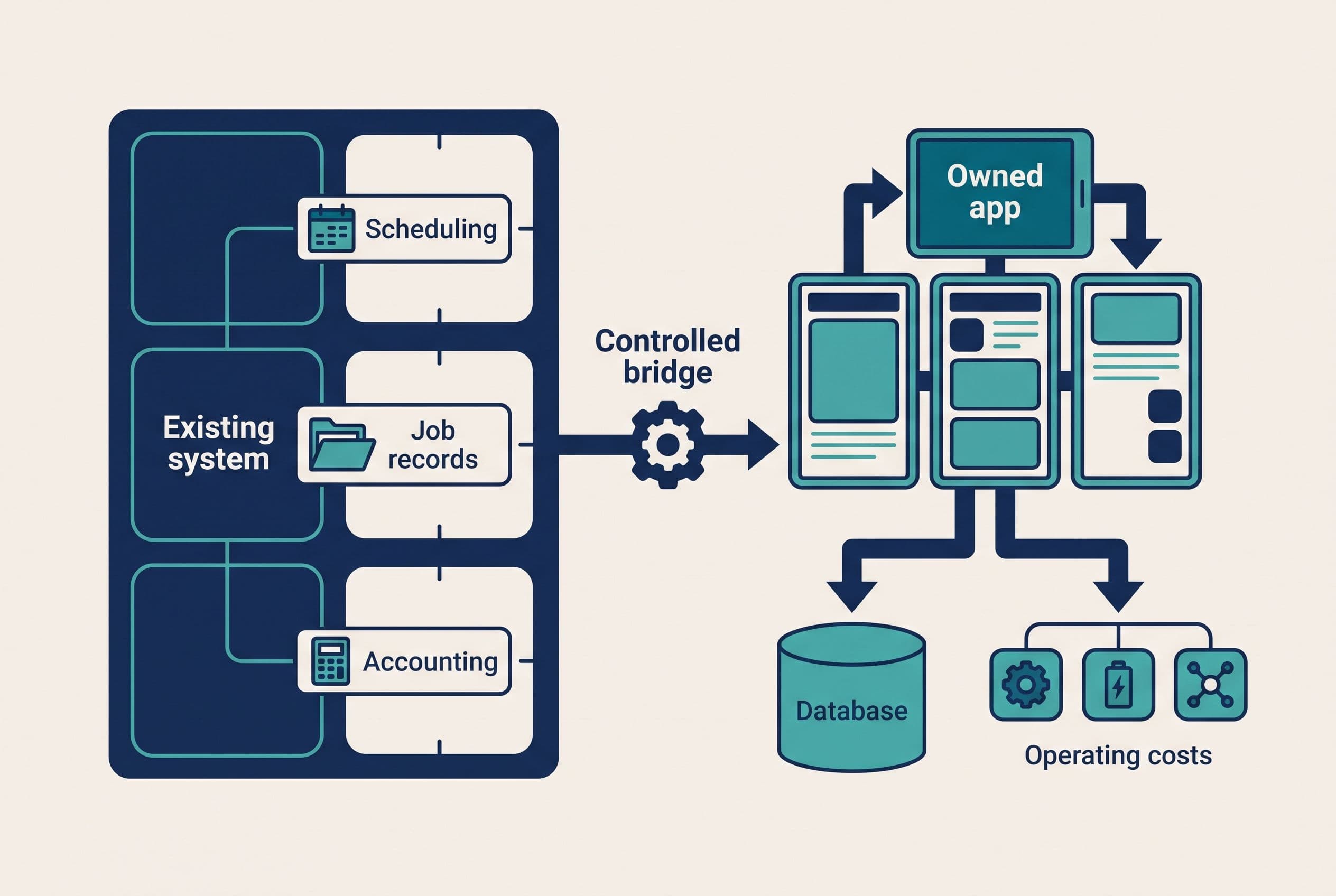
I can build an interface around that workflow using Next.js and Postgres. The important decision isn't the stack, though. It's which system owns each record and which operations must remain in the existing product.
If duplicate entry is the main complaint, replacing field service management software may be unnecessary. The approach in connecting systems instead of entering the same order repeatedly can leave the working parts alone.
Here's what keeps the scope controlled:
- One agreed workflow for the first release.
- A clear source of truth for customers, jobs, and invoices.
- Known user roles rather than permissions invented during testing.
- A sample export and confirmed API access before development.
- A list of features explicitly staying in the current system.
What makes it blow up? Recreating every report, importing every historical exception, and discovering halfway through that an essential integration isn't accessible under the current contract. API rate limits and access restrictions belong in the initial check.
I use AI-assisted development to ship production software in weeks instead of quarters. It doesn't make unspecified business rules free.
For an agreed build, I plan your involvement around a scoping call, a short weekly review, and a final test pass. You also need someone who can supply representative records and settle workflow decisions. Dirty data can demand more of your team's time; I'd rather say that before the quote.
The quote is fixed. Overruns on the agreed scope are my problem, not yours. Scope changes get agreed separately, and the code lives in your own repo from day one. I'd spell out the assignment of ownership of the custom code and deliverables as they're built in the contract—third-party libraries and services keep their own licenses and terms. I'd also make client-controlled hosting and service accounts part of the handoff requirements, alongside source control and documentation so another developer can take over.
Compare three years without pretending custom runs for free
For a 10-technician business, my illustrative three-year ServiceTitan pricing calculation is:
10 technicians × $245–$500 × 36 months = $88,200–$180,000 in licensing.
Adding the reported implementation range produces $93,200–$230,000+ before extras. This assumes unchanged rates, unchanged headcount, and one implementation charge. It isn't a forecast.
For an existing customer, I'd exclude implementation fees already paid from the forward-looking decision. That money is gone. Upcoming renewal commitments, switching costs, and future bills are what matter now.
Custom needs a different equation:
Fixed build + migration not included in that build + hosting + API usage + maintenance + transition costs.
I haven't filled in fictional operating costs to manufacture a payback date. Nor would I count an entire subscription as savings if you still need to keep it after the custom app ships.
| Path | What the money buys | Where I'd be cautious |
|---|---|---|
| Keep ServiceTitan | Existing workflows without a replacement project | Renewal terms, unused capabilities, staffing-driven cost increases |
| Connect a focused custom tool | Relief from one expensive bottleneck | The existing subscription may remain fully payable |
| Replace a defined workflow | Code ownership and control over that workflow | Migration, support, and missing edge cases |
| Commission a broader agency build | Potentially wider project staffing and scope | Higher scope burden and open-ended billing |
For an outside benchmark, Modall's 2026 cost guide puts a custom field-service MVP at $30,000–$50,000 over two to three months. That's their published market benchmark, not my pricing—and “MVP” alone doesn't make two proposals comparable.
I dislike hourly billing that rewards slow work. I also dislike pretending a focused fixed-price app is equivalent to a whole commercial platform. Both make the buyer's comparison worse.
My three-year build-versus-buy comparison and exit checklist covers the same accounting problem: compare future costs for equivalent work, including the cost of leaving.
This week's move: start with the bill, not a replacement spec
My answer to HVAC software pricing isn't “custom always wins.” I'd keep ServiceTitan when its connected workflows earn their cost, the team uses them, and switching would create more work than it removes.
I'd consider custom when a narrow, well-understood workflow drives a large avoidable bill—or when a small addition can fix disappointing software without ripping everything out. My ServiceTitan alternatives breakdown is useful for distinguishing those paths before treating replacement as the default.
The dishonest version of a pricing calculator hides the answer to harvest your email. Mine doesn't. The free project estimator shows the range on screen before asking who you are; a range is still not a fixed quote until the scope is checked.
This week, pull your current ServiceTitan bill and use it to price the smallest replaceable workflow in the ninety-second free project estimator: range first, form second, fixed quote back inside a business day.
Want a real number for your own project?
Answer a few questions and get an instant price range and timeline. No call required, no obligation.
Get your instant estimateTalk through your software project with MattFrequently asked questions
- How much does ServiceTitan cost per month in 2026?
- Projul and ITQlick report approximate 2026 rates of $245–$500 per technician monthly across packages. For an illustrative 10-technician business, I'd budget $2,450–$5,000 monthly in base licensing before extras, then verify the actual terms in a written quote.
- What is ServiceTitan's implementation fee?
- Third-party 2026 reporting from Projul and ITQlick puts implementation at $5,000–$50,000+. I'd ask the vendor to itemize migration, configuration, training, and anything billed separately rather than assume that range describes your rollout.
- Is ServiceTitan pricing per user or per technician?
- The supplied third-party pricing reports describe per-technician rates. I wouldn't assume office staff, seasonal technicians, and inactive accounts are treated identically; your proposal should define every billable category and minimum commitment.
- Is custom software cheaper than ServiceTitan?
- It can be cheaper for a defined workflow, but not automatically for a full platform replacement. My fixed-price builds range from $2,500–$20,000 before AI features, with delivery windows of 1–6 weeks depending on scope. I'd compare avoidable subscription costs against the build, migration, hosting, APIs, maintenance, and transition work.
- When should an HVAC business keep ServiceTitan?
- I'd keep it when the business relies on connected workflows that would be expensive or disruptive to recreate. A focused integration or custom screen may fix the problem without replacing the platform, but I wouldn't count subscription savings unless that work actually removes a payable charge.
What would software built for your business look like?
Replacing a subscription, fixing software that fell short, or adding AI to your workflow? Talk through the scope with Matt.
Part of these guides
Matt Brody
Founder, BuiltInWeeks
I build custom software for small and mid-sized businesses — the kind you own outright instead of renting by the seat. Fixed price, delivered in weeks, source code handed over at the end.
More about how I workKeep reading

CRM Software for Startups: Build or Buy? $0–$25K, Compared
Every startup needs a CRM eventually, but the decision isn't just 'which SaaS.' It's whether to rent someone else's workflow or build the one that fits yours. Here's the real cost breakdown and when each path makes sense.
Read more
Aircall Alternative for Small Sales Team: Porting Checks
I'd pick the replacement only after checking whether your numbers, routing, and sales workflow can move safely. Here's the checklist I'd use before authorizing a port—and the three-year math that decides whether custom software belongs on your shortlist.
Read more
Custom Client Portal: Build These 3 Core Screens First
I'd build around three client screens before buying another subscription: project status, files and approvals, and billing links. Here's the checklist I use to decide whether a service business should build, extend what it has, or keep renting.
Read more