Integrated Business Management Software: Dental Costs

$5,000–$15,000 for an operations layer—not a new clinical system
I'd budget $5,000–$15,000 and 2–4 weeks for a scoped dental operations app with integrations and user roles. That's my medium-build range at BuiltInWeeks, not a quote to replace charting, imaging, insurance claims and every other function in your practice management system.
That distinction matters. Integrated business management software can mean one dashboard connecting your existing systems, or it can mean rebuilding the software your entire practice runs on. Those aren't remotely the same job.
For a U.S. dental practice, I'd start with the expensive gap: duplicate entry, disconnected management reports, or a paid add-on that still leaves your office manager doing reconciliation by hand. I'd keep the clinical system unless there's a defensible reason to replace it.
Here's my published build pricing:
| Build category | Fixed-price range | Delivery window | Possible dental operations scope |
|---|---|---|---|
| Simple | $2,500–$10,000 | 1–2 weeks | Focused dashboard using an approved export |
| Medium | $5,000–$15,000 | 2–4 weeks | Multiple workflows, integrations and user roles |
| Advanced | $10,000–$20,000 | 4–6 weeks | Real-time updates, complex rules or multi-tenancy |
AI features multiply the applicable range by 1.25; my overall build envelope is $2,500–$25,000. I wouldn't add AI to a reconciliation screen that needs ordinary, testable rules.
Those windows depend on a buildable scope and available access. Waiting for a PMS vendor to approve an integration isn't development time I can wish away.
For the wider budgeting framework, I break down what custom software actually costs separately. Here, I'm keeping the arithmetic specific to dental operations.
The integration lesson I'd borrow—and the dental claim I won't make
I built an automated SEO blog platform that connects keyword research, drafting, multi-model review, publishing and distribution. Claude writes against a custom voice profile; Grok, Gemini and ChatGPT review the draft, and Claude implements a change when any two agree. A Zapier integration pushes posts to Facebook and the Google Business profile.
That's a real, anonymized project—not a dental deployment.
It publishes without a content team behind it and includes its own analytics. The useful lesson for dental practice management integration is structural: connecting the handoffs can be the product. You don't necessarily need to replace every tool doing a specialized job.
The payback comparison for that platform would be its build and operating costs against the cost of producing and distributing the content another way. I haven't supplied those financial inputs, so I won't invent a dollar saving or a break-even month. It also isn't evidence of dental or HIPAA implementation experience.
For your practice, I'd apply the same workflow-first approach while treating patient information as a separate security and contractual responsibility. A successful publishing integration doesn't prove a patient-data integration is ready to ship.
API access, patient data and write-back move the quote
The biggest driver of dental practice software integration cost isn't the dashboard design. It's whether your PMS gives us a supported way to get the right data—and, if necessary, put changes back.
I scope three things before attaching a fixed price.
Access comes first. Is there a documented API, an approved export, or a partner-access requirement? Are API fees separate? Do API rate limits permit the update frequency you need? A vendor saying it “supports integrations” doesn't answer those questions.
Then I draw the write boundary. Reading yesterday's production totals is different from changing appointments or posting payment information. Write-back needs validation, duplicate prevention, failure handling and a clear rule for which system wins when records disagree.
Finally, I inspect the data being moved. Aggregate practice totals may be enough for management reporting. Patient-level workflows bring more sensitive fields, tighter permissions and a different review burden.
Next.js and Postgres are possible building blocks, not compliance certificates. I'd choose the deployment and service configuration around the information being processed, rather than pick a convenient stack and discover its restrictions later.
My approach to removing duplicate entry between business systems starts with the same question: which system owns each record? In dentistry, I also want to know whether the supposedly harmless description field contains patient information.
HIPAA changes more than the login screen
For HIPAA software requirements, I'd map where electronic protected health information goes, who can access it, and which vendors or contractors handle it. Where business associate agreements are required, those belong in the access and procurement work—not in a last-minute checklist.
I'd also scope access controls, auditability, backups, recovery testing and incident responsibilities with the practice's compliance lead. A SOC 2 report doesn't, by itself, settle HIPAA obligations.
If a proposed shortcut sends patient data through an unreviewed service, I'd skip it. A cheaper connector isn't cheaper if it creates an unacceptable exposure.
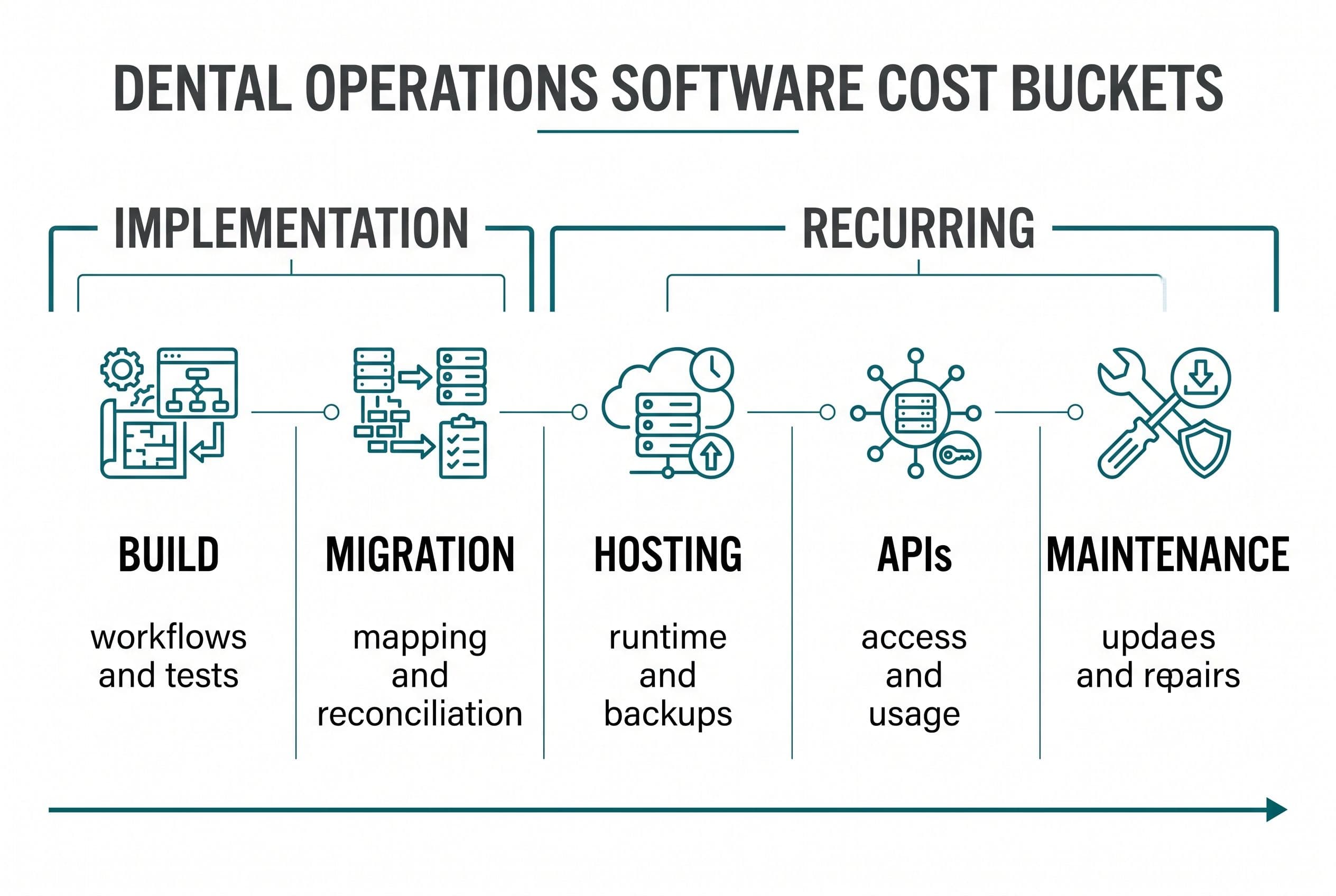
Five cost buckets belong in the dental software budget
I separate the implementation quote from recurring expenses. Otherwise, “fixed price” can hide a monthly bill nobody discussed.
| Cost bucket | What I'd scope | What can move it |
|---|---|---|
| Build | Screens, roles, integration logic, tests and handoff | Write-back, exception handling and workflow count |
| Migration | Field mapping, cleanup, test imports and reconciliation | Inconsistent identifiers, attachments and export quality |
| Hosting | Application runtime, database, backups and monitoring | Data volume, retention and required service configuration |
| APIs | PMS access and any external usage charges | Vendor access terms, transaction volume and messaging |
| Maintenance | Updates, dependency patches and connector repairs | Vendor changes, support coverage and response expectations |
My fixed build quote needs to say whether migration is included and exactly which records it covers. Hosting, APIs and maintenance need their own assumptions; I don't describe them as free because the application uses open-source components.
Dental software data migration isn't just importing a spreadsheet. I'd want representative exports, an explanation of identifiers and a way to compare source totals with imported totals. If the scope includes historical attachments or clinical records, that must be explicit.
For a small operations layer, moving every historical record may be unnecessary. I'd rather leave the authoritative history in the existing PMS and bring over only the approved fields the new workflow needs.
That can lower cost and exposure. It also makes the exit plan clearer: fewer copies to reconcile when something changes.
What three more years of the current stack cost
Before choosing custom dental operations software, I'd price doing nothing. Not just the subscription—the add-ons and the work still happening between them.
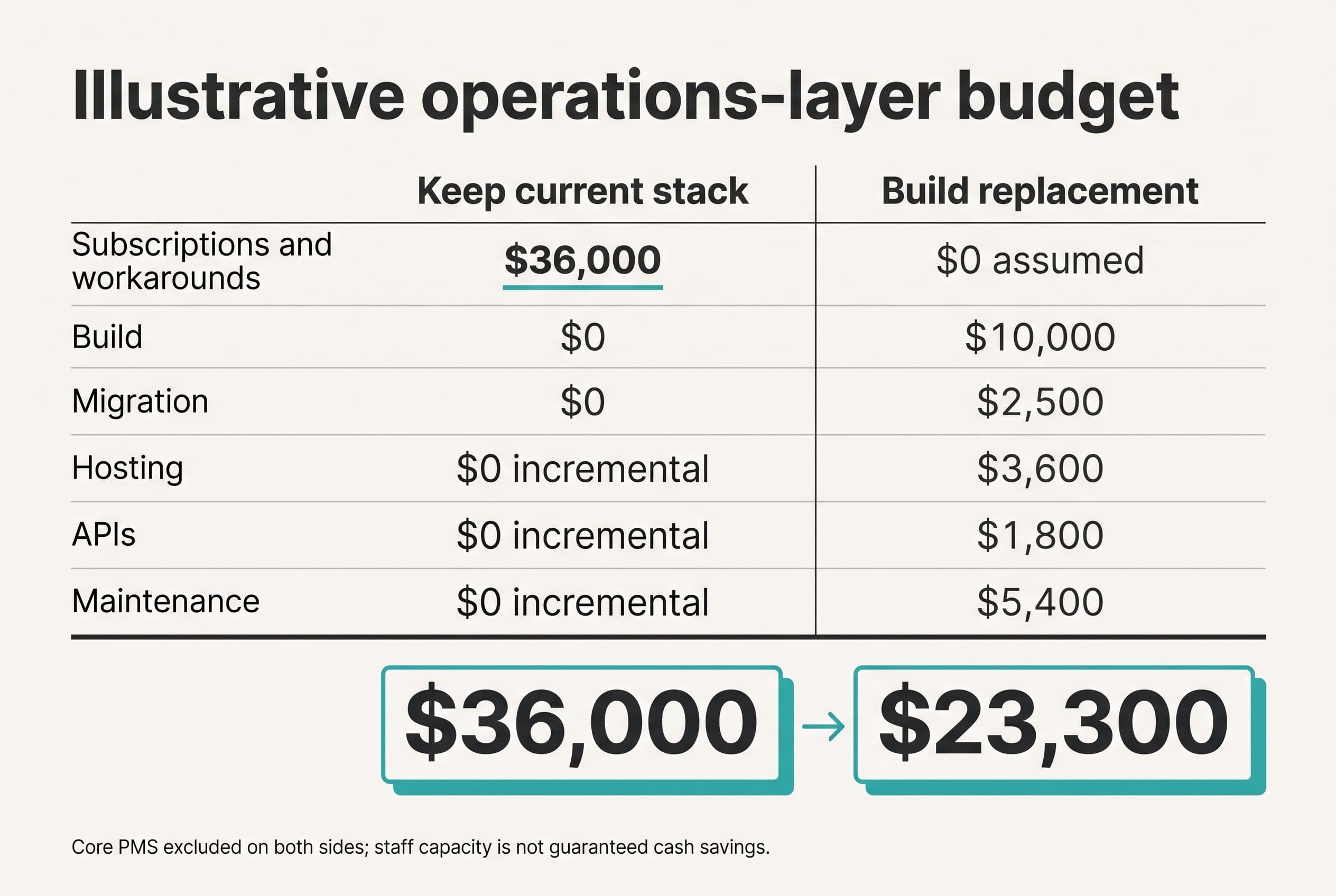
The following is illustrative arithmetic, not a client result, vendor quote or maintenance offer. Assume your practice keeps its core PMS, but could replace a separate operations subscription stack costing $600 per month. Also assume its workarounds consume $400 per month of staff capacity at your own loaded labor rate.
For comparison, assume a medium implementation totaling $12,500: $10,000 allocated to application and integration work, plus $2,500 allocated to migration. Those are budget allocations within one illustrative implementation, not separate advertised packages.
| Three-year cost | Keep the operations stack | Build the replacement layer |
|---|---|---|
| Replaceable subscriptions and add-ons | $21,600 | $0 |
| Existing workaround labor | $14,400 | $0 assumed after replacement |
| Application and integration build | $0 | $10,000 |
| Migration | $0 | $2,500 |
| Hosting allowance: $100/month | Included in subscription assumption | $3,600 |
| API allowance: $50/month | Included in subscription assumption | $1,800 |
| Maintenance allowance: $150/month | Included in subscription assumption | $5,400 |
| Three-year incremental total | $36,000 | $23,300 |
The core PMS stays on both sides, so I've excluded its unchanged cost. This is a comparison of the replaceable operations layer, not your whole practice software bill. The recurring allowances need actual provider and support quotes before approval.
Under those assumptions, the difference is $12,700 over three years. Monthly economic benefit is $1,000 of subscriptions and staff capacity minus $300 of new recurring expenses: $700. The $12,500 implementation pays back in roughly 18 months.
But recovered staff capacity isn't automatically cash in the bank. If I count only subscription savings, the monthly benefit falls to $300, and payback takes roughly 42 months—outside this three-year window.
The zero remaining-workaround assumption is also demanding. Any residual manual work, implementation time from your staff, subscription overlap or exit fee belongs back in the build column.
Keeping the SaaS wins when the bill is too small, the existing product already handles the workflow, or you can't leave its ecosystem without losing essential functions. Don't hire me to replace a working product merely because owning software sounds better.
That's why I use a three-year comparison with an exit checklist rather than compare one monthly invoice with one build quote. Dental software total cost of ownership includes what survives after go-live.
Dental subscription prices aren't the same as replaceable spend
Published dental software prices give us a starting point, not permission to count every subscription as savings.
For this 2026 comparison, Software Finder and Benco Dental list Open Dental at $199 per month per location for the first 12 months, then $149 per month, for up to three providers. They also list an eServices Bundle at $165 per month per location.
Using those supplied rates unchanged, I get:
| Open Dental component | Three-year arithmetic | Total |
|---|---|---|
| Base subscription | $199 × 12 + $149 × 24 | $5,964 |
| eServices Bundle | $165 × 36 | $5,940 |
| Combined | Base plus bundle | $11,904 |
Those totals exclude anything outside the listed prices, and I'd verify current terms before budgeting. More importantly, an operations dashboard doesn't replace Open Dental's clinical functions. Counting the whole $11,904 as avoided spending would be bad arithmetic.
FindEMR lists CareStack Essentials starting at $829 per month and Intelligence starting at $1,299 per month. Those are starting prices from a directory, not a quote for your practice or a feature-for-feature comparison with my work.
Here's how I'd compare the buying paths:
- Keep the PMS and its add-ons: least migration when the workflows already fit; subscriptions continue.
- Buy a broader dental suite: potentially fewer disconnected products; switching, training and data export still need scrutiny.
- Build an operations layer: control over a narrow workflow; you accept hosting, maintenance and integration responsibilities.
- Replace the full clinical platform: a much larger procurement and clinical scope than my operations-layer ranges describe.
I don't object to subscriptions that earn their keep. I object to per-seat licensing that punishes hiring while staff still copy the same information between screens.
The dental scope I'd ship before touching clinical records
For the common case, I'd start with read-only reporting or one administrative handoff. One source of truth. A defined exception queue. No clinical write-back just to make the demo look impressive.
Here's the sequence I'd use:
- Document the current workaround. What starts it, which fields move, who checks the result, and what happens when it fails?
- Prove access before promising automation. Confirm permissions, vendor terms, sample exports and any API costs.
- Build against approved test data. Use a staging environment and test missing fields, duplicate records and interrupted updates.
- Reconcile before switching. Compare the new output with the current process and investigate differences.
- Retire only what was actually replaced. Cancel an add-on after the replacement passes acceptance—not when the first screen looks finished.
I'd ask you for a scoping call, a short weekly review and a final test pass. I'd also need a named decision-maker and someone who can authorize vendor access. That's the planned involvement; a difficult export or compliance question can require more of your team's time.
What makes this cheaper? A supported export, read-only scope and an existing workflow everyone agrees on. What makes it blow up? Undocumented interfaces, conflicting patient identifiers and discovering halfway through that “reporting” actually means changing records in multiple systems.
Hourly billing rewards slow work. A months-long discovery phase that produces a slide deck doesn't fix that. I want the uncertain access questions identified before quoting a build, and a fixed scope once they're resolved.
Fixed price means overruns on the agreed scope are my problem, not yours. The code lives in your own repo from day one. The contract transfers ownership of the custom code and source on final payment; I retain only generic reusable components, and third-party libraries and services keep their own license terms.
With the source and handoff documentation, another developer can take over. That documentation should explain deployment, permissions, data mappings, recurring bills and connector failure handling—not just how to start the app.
Put $23,300 beside your own three-year operations bill
In the illustration, continuing costs $36,000 over three years; the replacement costs $23,300, including migration and recurring allowances. Without the assumed staff-capacity benefit, keeping the subscriptions costs only $21,600 and wins within that window.
That's the decision—not whether custom software sounds impressive.
Run your numbers through the free project estimator at free project estimator. In about ninety seconds, it'll do the same sum for your own build, with the range on screen before any form. If the arithmetic lands, the same form returns a fixed quote within one business day.
Want a real number for your own project?
Answer a few questions and get an instant price range and timeline. No call required, no obligation.
Get your instant estimateTalk through your software project with MattFrequently asked questions
- How much does dental practice software integration cost?
- I price scoped medium builds with integrations and user roles at $5,000–$15,000, delivered in 2–4 weeks once the required access is available. That isn't a price for replacing a complete clinical practice management system. API permissions, write-back requirements and migration quality determine whether your project fits that scope.
- Should a dental practice replace its PMS with custom software?
- I'd usually assess a narrow operations layer before replacing the clinical PMS. Keeping the existing product wins when it handles the workflow, its bill is modest or essential integrations would be difficult to replace. Only subscriptions you can actually cancel belong in the savings calculation.
- What should dental software total cost of ownership include?
- I include the build, data migration, hosting, API charges and maintenance over the same comparison period. I also count retained subscriptions, staff involvement, overlap during migration and remaining manual work. Recovered staff capacity should be shown separately from cash savings.
- What HIPAA software requirements matter for a dental integration?
- I'd start by mapping electronic protected health information, access permissions and every service that handles it. The scope should address applicable business associate agreements, access controls, auditability, backups and incident responsibilities with the practice's compliance lead. Choosing a framework or a vendor with a SOC 2 report doesn't settle those obligations.
What would software built for your business look like?
Replacing a subscription, fixing software that fell short, or adding AI to your workflow? Talk through the scope with Matt.
Part of these guides
Matt Brody
Founder, BuiltInWeeks
I build custom software for small and mid-sized businesses — the kind you own outright instead of renting by the seat. Fixed price, delivered in weeks, source code handed over at the end.
More about how I workKeep reading

Monday.com Alternative: ROI Math for Teams Over 15
At 20 paid seats, Monday.com Pro works out to $4,560 a year using the published annual-billing rate. I walk through a quote-to-job workflow, the three-year replacement math, and the migration work that decides whether owning the software is worth it.
Read more
Small Business Helpdesk Software: Build vs Zendesk
I'd buy Zendesk for standard support and build when resolving tickets means fighting your other systems. Here's the workflow, three-year arithmetic, and migration plan I'd use to make that decision.
Read more
ServiceTitan Pricing in 2026: $245–$500/Tech + Setup
For an illustrative 10-technician business, reported ServiceTitan rates work out to $29,400–$60,000 a year before implementation and extras. I separate that subscription math from the build, migration, hosting, API, and maintenance costs of owning a narrower replacement.
Read more