Field Service Management: Build vs Buy Costs by Team Size

The first comparison: $25,164 in licensing versus a scoped build
A $699 monthly subscription costs $25,164 over three years. That's before add-ons or the office hours spent working around it. Jobber's pricing supplied for this article, read September 2, 2026, lists a team plan at $699/month for 15 users.
I'd verify every vendor price below against your current quote or renewal page before making a decision. These are comparison inputs, not a promise that Jobber, Housecall Pro, or ServiceTitan will offer you those prices or terms.
My published fixed-price ranges are $2,500–$10,000 for a simple build, $5,000–$15,000 for a medium build, and $10,000–$20,000 for an advanced build. Delivery runs 1–2, 2–4, and 4–6 weeks respectively, depending on the agreed scope.
That doesn't mean I can replace an entire field service management platform for the price of a basic dashboard. It means a focused replacement might compete with your subscription bill. A full feature-for-feature clone is a different project.
My starting position: buy for a small crew with standard needs; compare ownership as paid seats and workarounds grow. Headcount starts the calculation. Workflow decides it.
For broader market context, Modall's 2026 pricing guide puts custom field service software at $30,000–$500,000+, with core scheduling and dispatch builds around $30,000–$50,000. Those are its market estimates, not my prices or a promise that the scopes match.
The useful comparison isn't “subscription versus developer invoice.” It's three years of usable software versus three years of usable software.
Three things that move a field service quote: seats, exceptions, and data
I don't start by counting screens. I start with what happens between an incoming job and a paid invoice.
The biggest cost drivers are:
- Dispatch exceptions: recurring visits, skills matching, overlapping appointments, emergency jobs, and jobs requiring multiple technicians.
- Field conditions: weak reception, photo uploads, customer signatures, device permissions, and whether work must continue offline.
- Data and integrations: customer history, equipment records, attachments, QuickBooks connections, and whether the existing system actually exports what you need.
A calendar isn't a dispatch system. A form isn't an offline field service management app.
My own experience with reducing a scattered process comes from a different setting. My wife and I homeschool our four kids, and we'd already taught two to read when our five-year-old was ready. The process worked, but it meant working through more than a thousand pages of books and workbooks.
I built a web app that distills that into 50 structured phonics lessons, designed for a parent and child together for about 15 minutes a day. It replaced a shelf of workbooks with one clear path, was built in weeks, and my family uses it every day.
That's a real family project, not a field-service client case study. I don't have a subscription saving or financial payback figure to attach to it.
The relevant lesson is scope: I built around a known process rather than reproducing every feature of a broad product category. That's how I'd approach software for field service, too—provided your process is understood well enough to define it.
If the real problem is retyping completed jobs into accounting, connecting the systems without triple entry may be the entire job. Replacing dispatch would just create extra work.
What staying put costs a 15-person team over three years
Here's the cost of doing nothing before I recommend changing anything.
This is illustrative arithmetic, not a client result or a quote. I use the supplied $699/month Jobber team-plan price as the subscription baseline. Every other operating figure below is an explicit planning assumption, not a published vendor price or my maintenance rate.
I assume unchanged headcount and pricing, no inflation, and no taxes. The replacement must cover the workflows this particular team uses—not everything the existing platform offers.
| Three-year line item | Keep the subscription | Scoped replacement |
|---|---|---|
| Existing subscription: $699 × 36 months | $25,164 | $0 after cutover |
| Add-ons: assumed $100 × 36 months | $3,600 | $0, assuming replaced |
| Custom build allocation | $0 | $12,500 |
| Migration allocation | $0 | $2,500 |
| Hosting reserve: assumed $100 × 36 months | Included in subscription | $3,600 |
| API reserve: assumed $50 × 36 months | Assumed covered above | $1,800 |
| Maintenance reserve: assumed $200 × 36 months | No separate reserve modeled | $7,200 |
| Modeled cash cost | $28,764 | $27,600 |
The build and migration allocations together represent one hypothetical $15,000 fixed scope within my medium-build range. They aren't two extra fees added after a quote. Hosting, APIs, and maintenance are owner-set reserves for this example; actual requirements need separate pricing.
The cash difference is only $1,164 over three years. That's not a strong replacement argument by itself. Subscription overlap during migration, a required feature we missed, or a larger support budget could erase it.
Now price the workaround. Assume the office spends four hours a week reconciling records, and you value that time at $40/hour. Over 156 weeks, that's $24,960 of staff capacity, bringing the subscription-plus-workaround total to $53,724.
That's not automatically payroll savings. I wouldn't credit the replacement with recovering those hours until its scope addresses the actual work and testing confirms the improvement. Any remaining manual work belongs on the replacement side of the ledger.
Keeping the SaaS wins when the bill is small, the workflow already fits, or the ecosystem is too expensive to leave. I wouldn't hire me to replace a product that's doing its job just because ownership sounds appealing.
For the wider decision, owning your software instead of renting it covers the trade beyond the monthly bill. The same three-year comparison and exit checks apply here, especially when migration isn't straightforward.

The field-service line items I won't bury in a quote
I separate the implementation from the cost of keeping it alive. Otherwise, a cheap proposal is just an incomplete proposal.
| Cost bucket | What I'd define before quoting | What can change the budget |
|---|---|---|
| Build | Dispatch, technician workflow, roles, reports, acceptance tests | Complex scheduling rules, offline work, multiple branches |
| Migration | Included records, attachments, mapping, trial import, reconciliation | Incomplete exports, duplicates, inaccessible history |
| Hosting | App runtime, database, storage, backups, monitoring | Photo volume, retention, availability requirements |
| APIs | Messaging, payments, maps, accounting connections | Usage, provider limits, required subscription tiers |
| Maintenance | Updates, fault handling, restore checks, support coverage | Response expectations and future changes |
For a focused CRUD app or basic dashboard, my simple range is $2,500–$10,000 in 1–2 weeks. A multi-feature app with integrations and user roles fits the medium category: $5,000–$15,000 in 2–4 weeks. Real-time features, multi-tenancy, or complex rules sit in the advanced category: $10,000–$20,000 in 4–6 weeks.
Those are scope categories, not a menu where every field-service requirement fits somewhere by default. If the requested replacement doesn't fit, I'd narrow it or recommend another route.
I'd usually keep QuickBooks as the accounting system rather than build a ledger. Stripe can handle payment infrastructure, while Twilio can support customer messaging. Their usage costs belong in the operating budget, not behind “integrations included.”
I also check API rate limits and webhooks before promising synchronization. A connection that technically exists may still require a higher vendor tier, periodic polling, or manual exception handling.
The same applies to cloud based field service management software: cloud hosting doesn't mean an absence of operating work. Someone still needs responsibility for backups, updates, and failures.
Buy, extend, or replace: my starting point by team size
These team-size bands are my decision heuristics, not research benchmarks. I count everyone who needs paid access, including dispatch and office staff—not just technicians.
| Team size | My starting choice | What would change my mind |
|---|---|---|
| 1–5 people | Buy an existing product | A narrow, expensive workflow gap that an integration can't fix |
| 6–15 people | Buy or extend | Add-ons, paid seats, and repeated office work make a focused build competitive |
| 16–30 people | Run the ownership calculation | Standard workflows and valuable existing integrations still favor renting |
| 31+ people | Compare modular replacement with the existing platform | Migration risk, branch complexity, and service requirements may outweigh savings |
For the smallest team, Jobber's supplied Core starting price is $49/month for one user. That's $1,764 over three years, assuming unchanged pricing. I can't defend a custom replacement on licensing savings alone at that level.
At larger sizes, plan caps matter. The supplied Jobber pricing lists additional users beyond a plan's cap at $29/month. My Jobber replacement considerations focus on whether the workflow and exit path justify leaving—not merely whether another invoice looks smaller.
Housecall Pro's supplied Basic starting price is $59/month for one user with annual billing, based on the supplied pricing information spanning 2025 and 2026. That's $2,124 over three years at an unchanged rate. I'd check the Housecall Pro replacement trade-offs against your actual renewal terms and required features.
At the higher end, Contractor Commerce's 2026 ServiceTitan pricing discussion reports technician-based pricing; the supplied research gives a contractor-reported range of $245–$500+ per technician per month. That's not an official quote. Implementation fees and contract commitments also need verification.
I'd treat leaving ServiceTitan as an operational migration, not just a seat-price calculation. If your business depends on its connected workflows, rebuilding the visible screens won't reproduce the whole system.
Per-seat licensing that punishes growth deserves scrutiny. But headcount isn't proof that custom wins. A large team using standard field service industry software well may be better off renting than a smaller team fighting it daily.
The no-signal driveway test can change the whole scope
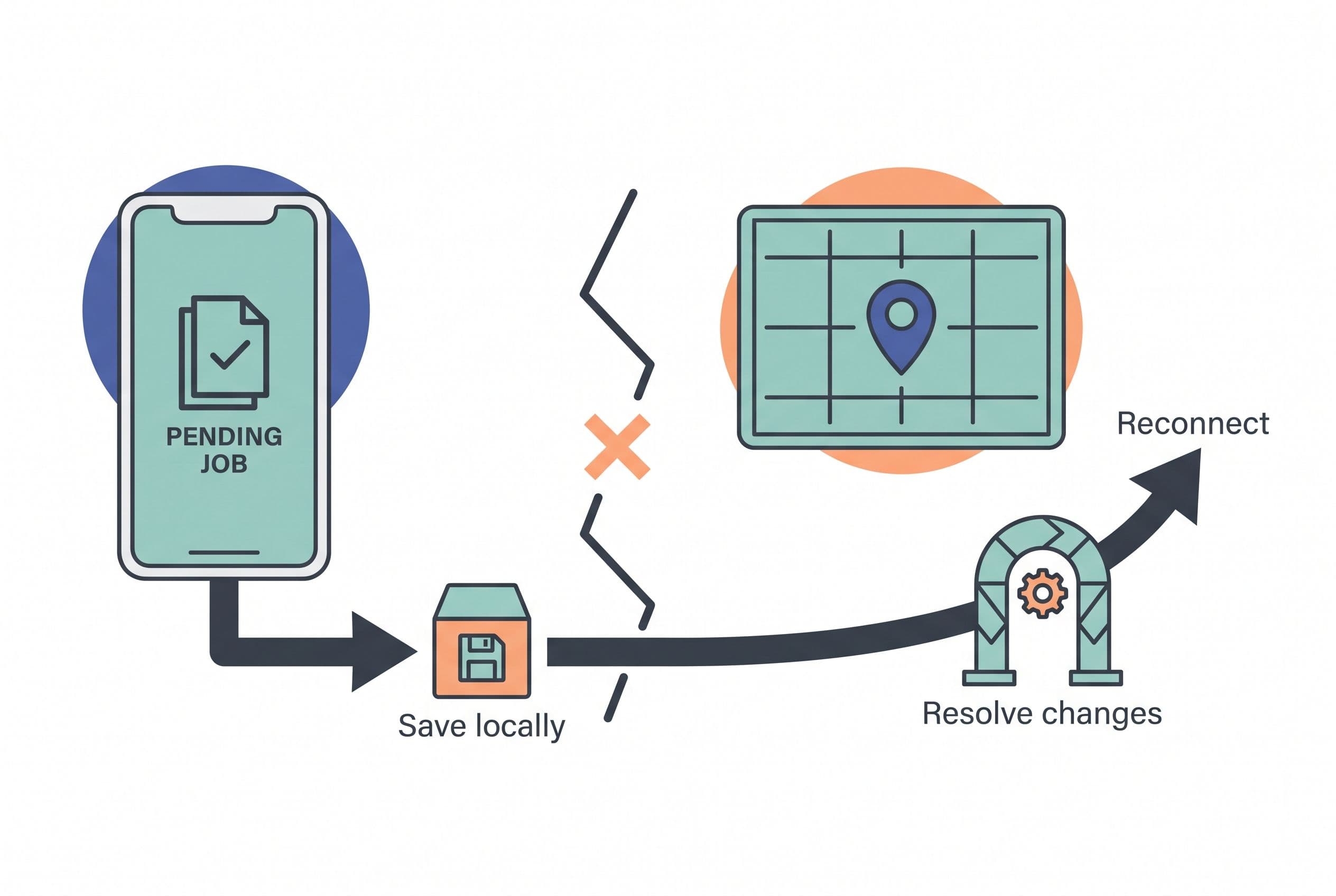
Before I quote field service management software, I want to know what the technician must do without reception.
Read the job address? Capture photos? Complete a checklist? Record a signature? Each answer changes how much work must live on the device and what happens when it reconnects.
Offline work introduces local storage, retry behavior, and conflict rules. If dispatch changes an appointment while the technician edits it offline, the system needs a defined answer—not whichever update arrives last by accident.
This is where I'd cut scope carefully. A mobile web app with a clear connection requirement may be enough. If reliable offline operation is mandatory, I'd price and test it explicitly rather than call a responsive website “mobile-ready.”
Other choices keep a build smaller:
- Keep accounting and payment infrastructure instead of reproducing them.
- Migrate active operational records and retain an accessible archive where appropriate.
- Start with the dispatch-to-completion workflow instead of every department.
- Use defined job statuses rather than unlimited workflow customization.
A customer portal can wait unless it removes a measurable bottleneck. If it belongs in the first release, I'd use a small set of core portal screens rather than let it become a second application.
The expensive version is a vague request to “make it like our current field service mgmt system, but better.” Hourly billing rewards slow work; a fixed quote requires decisions. Months of paid discovery ending in a slide deck don't solve that problem.
Turning your dispatch workflow into a fixed number
My preference is a focused replacement only when the three-year math and operating requirements support it. Otherwise, I'd keep the subscription or wire up the missing integration.
To quote a field service management build, I need the current bill, the paid-user count, sample exports, and the path a real job follows. I also need the exceptions: cancellations, repeat visits, reassignment, failed payments, and whatever forces someone back into a spreadsheet.
For your involvement, I plan around a scoping call, a short weekly review, and a final test pass. You'll also need to provide system access, sample data, and timely decisions. A messy migration needs more owner input; I won't pretend otherwise.
I use AI-assisted development to shorten implementation, not to skip testing. The agreed scope determines whether delivery belongs in the 1–2, 2–4, or 4–6 week range.
Fixed price means overruns on the agreed scope are my problem, not yours. New scope gets a separate decision before I build it.
The code lives in your own repo from day one. The contract transfers ownership of the custom code and source on final payment; I retain only generic reusable components, and third-party libraries and services keep their own license terms. The repo, handoff documentation, and ownership terms give another developer a path to take over. I wouldn't call that instant: they'll still need onboarding, access to third-party services, a working development setup, and time to understand the system.
That's the difference between owning a usable system and swapping one form of vendor lock-in for another.
Run the free project estimator at free project estimator: five questions, about ninety seconds, and your range appears on screen before any form asks who you are. If the number works, send it over to get a fixed quote inside one business day.
Want a real number for your own project?
Answer a few questions and get an instant price range and timeline. No call required, no obligation.
Get your instant estimateTalk through your software project with MattFrequently asked questions
- Should a small field service business build or buy software?
- I'd usually buy when the team is small and standard scheduling, invoicing, and technician workflows fit. A custom build becomes worth comparing when paid seats and workarounds create enough recurring cost to cover implementation and ongoing operation.
- How much does custom field service management software cost?
- My published ranges are $2,500–$10,000 for simple builds, $5,000–$15,000 for medium builds, and $10,000–$20,000 for advanced builds. A focused field-service workflow may fit those categories, but a full platform replacement isn't automatically within scope. Migration, hosting, APIs, and maintenance need explicit treatment in the comparison.
- At what team size should I replace field service software?
- I don't use a universal headcount cutoff. I compare three years of subscription charges, add-ons, and manual work against the replacement's full cost. Growing paid-user counts make that calculation more useful, but complex migration or valuable existing integrations can still favor keeping the product.
- Can a custom field service management app work offline?
- Yes, but I'd scope offline behavior explicitly rather than assume a mobile-friendly website provides it. Local storage, queued uploads, reconnection, and conflicting edits all require design and testing. The quote depends on which technician tasks must work without reception.
- Will I own the custom software and source code?
- The code lives in your own repo from day one, and ownership of the custom code and source transfers on final payment under the contract. I retain generic reusable components, while third-party libraries and services keep their own license terms. The source and handoff documentation allow another developer to take over.
What would software built for your business look like?
Replacing a subscription, fixing software that fell short, or adding AI to your workflow? Talk through the scope with Matt.
Part of these guides
Matt Brody
Founder, BuiltInWeeks
I build custom software for small and mid-sized businesses — the kind you own outright instead of renting by the seat. Fixed price, delivered in weeks, source code handed over at the end.
More about how I workKeep reading

ServiceTitan Pricing in 2026: $245–$500/Tech + Setup
For an illustrative 10-technician business, reported ServiceTitan rates work out to $29,400–$60,000 a year before implementation and extras. I separate that subscription math from the build, migration, hosting, API, and maintenance costs of owning a narrower replacement.
Read more
Integrated Business Management Software: Dental Costs
I'd budget $5,000–$15,000 for a scoped dental operations app with integrations—not a replacement for your entire clinical system. Here's how I separate the build from migration, hosting, API access and maintenance, then compare it with three more years of renting.
Read more
Monday.com Alternative: ROI Math for Teams Over 15
At 20 paid seats, Monday.com Pro works out to $4,560 a year using the published annual-billing rate. I walk through a quote-to-job workflow, the three-year replacement math, and the migration work that decides whether owning the software is worth it.
Read more