Alternative Calendly: Custom Scheduler Costs $2.5K–$20K

A custom Calendly replacement starts at $2,500—not zero after launch
I quote custom scheduling software at $2,500–$20,000, depending on scope, with delivery in 1–6 weeks. AI features multiply the applicable range by 1.25, bringing the overall ceiling to $25,000. I'd leave AI out unless there's a specific scheduling problem that needs it.
My starting arithmetic is simple:
First-year cost = build + migration + hosting + API usage + maintenance + any subscriptions you retain.
That's the number to compare with your existing setup. Not just the build quote against one month of Calendly.
If you're searching for an alternative Calendly setup because the subscription annoys you, I wouldn't start by building. A booking link is inexpensive to rent. A scheduler that handles your approval rules, shared equipment, deposits, and customer records is a different purchase.
Here's how I'd place a scheduling project inside my published fixed-price ranges:
| Build level | Fixed-price range | Delivery | Scheduling scope I'd consider |
|---|---|---|---|
| Simple | $2,500–$10,000 | 1–2 weeks | One focused booking flow, basic availability, and a staff dashboard |
| Medium | $5,000–$15,000 | 2–4 weeks | Multiple booking flows, user roles, and defined integrations |
| Advanced | $10,000–$20,000 | 4–6 weeks | Shared resources, complex assignment rules, or multi-tenancy |
These aren't feature bundles where every item fits automatically. A basic dashboard with one booking source isn't the same job as bidirectional calendar sync across an organization.
The cheapest credible scope replaces one expensive problem. It doesn't recreate every setting in Calendly.
My own experience with focused software comes from a different problem—not a scheduling client. My wife and I homeschool our four kids. We'd taught two to read, and when our five-year-old was ready, the process meant working through more than a thousand pages of books and workbooks.
I built a web app that turned that scattered material into 50 structured phonics lessons, designed for a parent and child together for about 15 minutes a day. It was built in weeks, replaced a shelf of workbooks with one clear path, and my family uses it every day.
I don't have a dollar payback figure for that project, and it isn't evidence of scheduling savings. The relevant lesson is narrower: I built around a known process rather than a giant feature list. That's how I'd approach your scheduler, too.
Three scheduling decisions move my quote most
When I scope a Calendly alternative, I start with availability, booking rules, and connected systems. The page where someone picks Tuesday afternoon is usually the easy part.
What makes a slot genuinely available?
One person's working hours are straightforward. A visit that requires an available employee, room, and piece of equipment is not.
I'd write down which resources a booking consumes, whether travel or cleanup blocks the next slot, and what happens when an outside calendar changes. If those rules live in your office manager's head, getting them onto paper is part of the work—not an optional extra after development starts.
What happens between selecting a slot and confirming it?
Instant confirmation is one path. Approval, deposits, eligibility checks, and staff assignment create others.
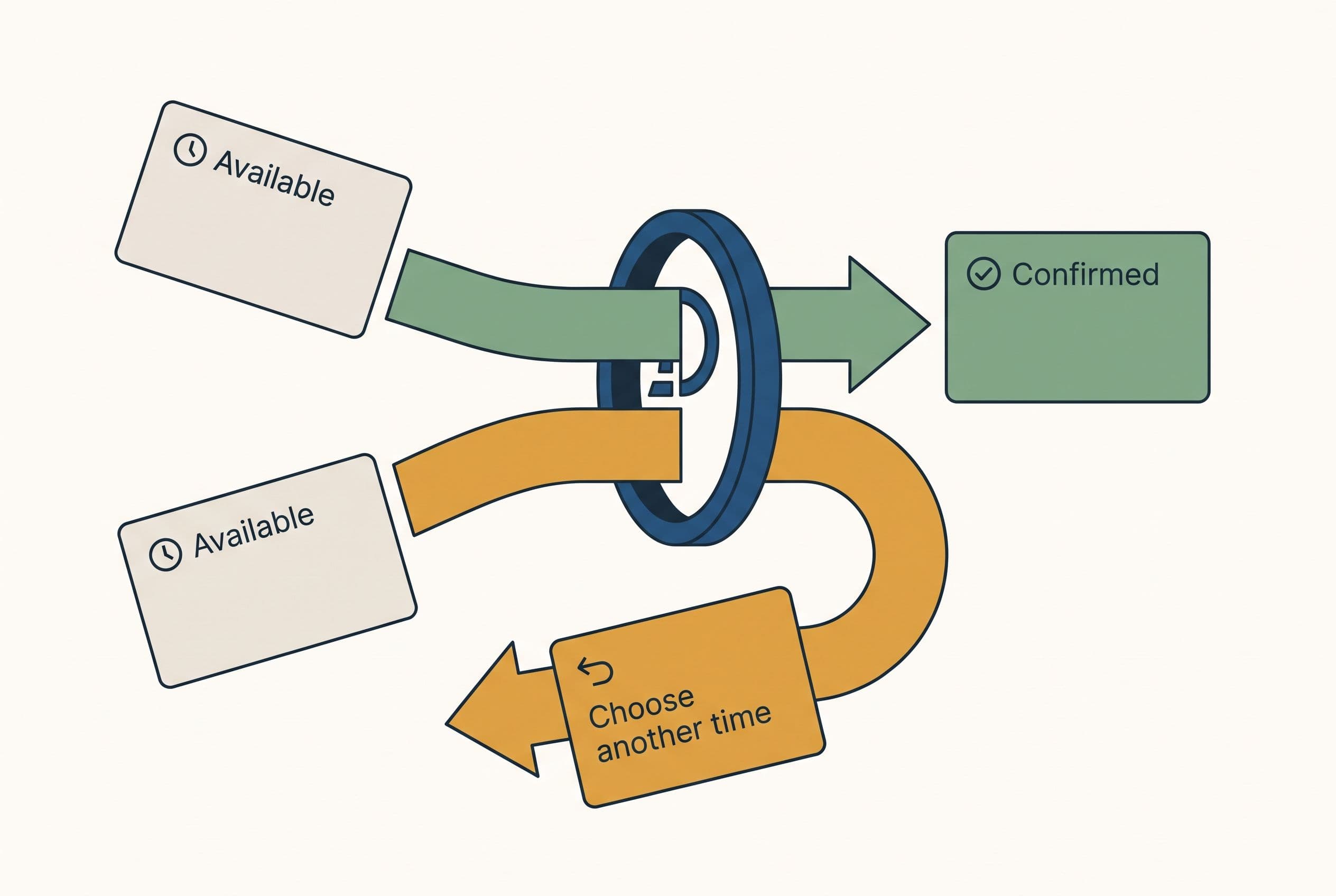
I'd distinguish a requested appointment from a confirmed appointment in the data model. Otherwise, the scheduler can tell a customer they're booked while your staff still thinks they're reviewing a request.
For deposits, I'd scope the Stripe payment flow together with cancellation and refund handling. Taking money is only one part of that integration.
Which system owns each record?
A calendar event, customer record, and payment record aren't interchangeable. I'd decide which system owns each one before wiring up webhooks.
A webhook is a notification that something happened. It isn't a guarantee that every connected system processed the change successfully. Retries, duplicate events, and API rate limits belong in the scope.
The same decisions show up when I scope integrations that stop staff entering the same information twice. If the scheduler creates another place to copy customer details, you've bought a new chore.
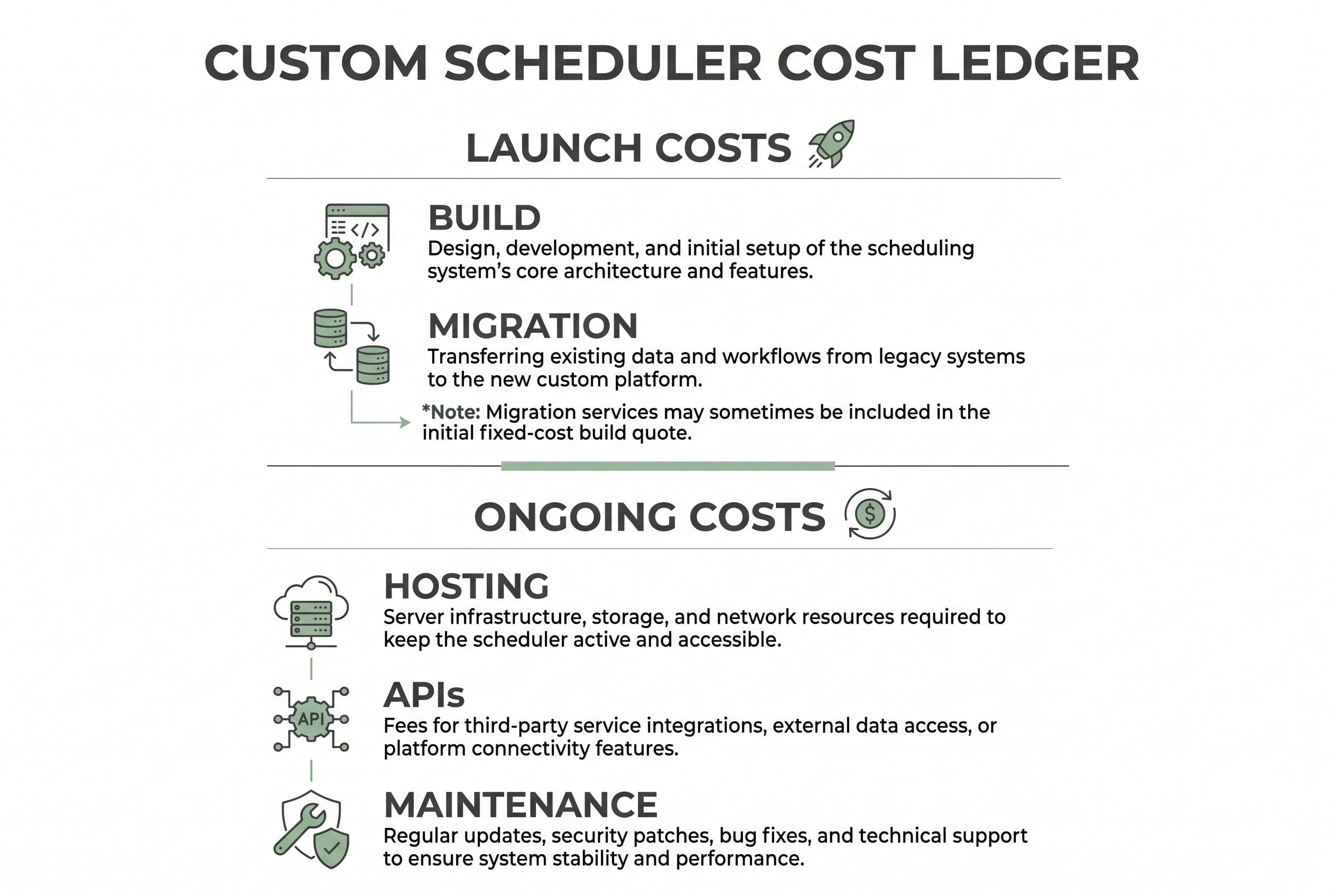
Build, migration, hosting, APIs, maintenance: five separate lines
A custom booking system cost estimate should separate the launch work from the bills that continue afterward. I wouldn't accept a proposal that rolls all of this into “development” and leaves the rest for later.
| Cost line | What I'd define before quoting | How I'd treat it in the budget |
|---|---|---|
| Build | Booking screens, availability rules, permissions, integrations, testing | Fixed project scope within the applicable published range |
| Migration | Records to move, export format, cleanup, future bookings, reconciliation | Explicitly included in the fixed scope or identified as excluded |
| Hosting | App runtime, database, backups, logs, environments | Recurring operating expense, separate from the build |
| APIs | Messages, payment processing, external calendar access | Provider charges based on the actual services and usage |
| Maintenance | Updates, monitoring, incident response, ownership of fixes | Defined coverage and budget—not an implied lifetime promise |
Migration isn't just uploading a spreadsheet
I'd inspect an actual data export before treating migration as a small task. Customer details, future bookings, cancellation states, and external calendar identifiers need different handling.
There's also a cutover decision: keep existing appointments where they are and start new bookings in the replacement, or move future appointments and reconcile both systems. The second path can require more work and carries more risk.
Migration labor included in my fixed quote isn't added again in the arithmetic. Separate line items should clarify the total, not inflate it.
Hosting and APIs don't disappear with code ownership
A stack such as Next.js and Postgres can support a custom scheduler. It still needs somewhere to run, backups that can be restored, and a way to investigate failures.
I'd estimate hosting against expected traffic and storage rather than invent a flat number before seeing the scope. For SMS reminders through Twilio, I'd separate messaging usage and applicable fees from my development work. Payment processing stays separate as well.
Maintenance needs an owner
Owning the code doesn't mean dependency updates, expired credentials, and calendar-provider changes take care of themselves.
Before handoff, I'd define what counts as a defect against the agreed scope, what counts as new work, and who handles operating issues. A vague “support included” line is how both sides end up expecting different things.
For the broader budgeting framework behind these categories, I explain what custom software actually costs separately from any one scheduler's feature list.
Two customers clicking the same slot is the test I'd budget for
The scheduler can look finished before it's safe to use.
Here's the failure I'd test: two customers load the same available slot, then both try to confirm it. Hiding the slot in the browser after one click isn't enough. The booking write needs a database-level rule or transaction that prevents the second conflicting reservation.
For a scheduling tool alternative with deposits, I'd also define what happens if payment succeeds but confirmation fails. That needs a recoverable state, not an apology email improvised later.
My acceptance tests would include:
- Two people attempting to reserve the same constrained resource.
- A customer and staff member viewing the appointment in different time zones.
- A daylight-saving transition affecting local availability.
- A disconnected external calendar or delayed sync.
- A duplicated payment or reminder notification.
- A cancellation that should release availability but hasn't yet.
These aren't premium extras. They're the difference between a calendar-shaped interface and a working booking system.
I'd run those checks in a staging environment before go-live. I use AI-assisted development to ship faster, but faster code generation doesn't remove the need to test booking conflicts or payment failures.
The cheapest scope keeps a small amount of SaaS
I'd reduce the quote by cutting responsibilities, not by skipping tests.
Start with one service type, a defined set of staff roles, and one confirmation path. Keep historical records archived if they don't need to be active. Use email confirmations first if SMS doesn't solve a demonstrated problem.
I'd also question whether the public booking page needs to be replaced at all. Sometimes the real problem is what happens after booking: staff assignment, customer intake, or updating another system.
A smaller internal tool around the existing scheduler may be the better booking software alternative. You retain a subscription, but avoid paying to rebuild a part that already works.
If customers also need documents, status updates, and account history, I'd separate the first client-portal screens from the scheduling engine. Otherwise, “replace Calendly” quietly becomes “build our entire customer platform.”
What makes the quote grow? Multiple calendar providers, two-way sync, complex recurring appointments, location-specific rules, pooled equipment, and messy migration data. Each adds behavior to specify and test.
Don't hire me to replace a cheap booking link that already works. If you're buying custom software only to avoid a modest subscription, keeping the existing product—or switching to another scheduler—is usually the better trade.
The subscription comparison needs three years, not three screenshots
I wouldn't choose a Calendly replacement without checking less expensive rental options first. These supplied pricing references offer a starting point, not a promise that every plan includes your required features.
| Rental option | Referenced pricing | Scope and date caveat |
|---|---|---|
| Acuity Scheduling Starter | $16/month, billed annually | One calendar and basic scheduling; July 2026 reference |
| SimplyBook.me Basic | $8.25/month, billed annually | 100 bookings/month and 2 users; verified June 2026 |
| Setmore Pro | $5/user/month, billed annually | Unlimited appointments; August 2026 reference |
The Acuity figures come from Meetergo's 2026 pricing coverage. The supplied SimplyBook.me pricing was verified in June 2026 using sources including Koalendar's pricing breakdown. Setmore's August 2026 reference can be checked against its published pricing page.
I'd verify checkout pricing, billing terms, and required features before making the decision. Cheap entry pricing doesn't help if your needed workflow sits elsewhere.
I haven't treated the supplied Calendly price as current: it was last verified in December 2025. Your actual renewal quote is a better input for a 2026 comparison. I also cover the options for replacing or extending Calendly for readers who haven't settled on a custom build.
Illustrative arithmetic—not a client result
Using the referenced Acuity Starter price, and assuming it stays unchanged, three years costs $16 × 36 = $576 before taxes or extras. My minimum simple-build price is $2,500, before operating expenses. Custom loses that subscription-only comparison.
Now use your own business figures:
Three-year rental cost = subscription payments + paid add-ons + labor spent on workarounds.
Three-year custom cost = fixed build + migration (counted separately only when it isn't already included in the build price) + hosting + APIs + maintenance + retained subscriptions.
I'd count labor savings only when you can identify the task, its frequency, and the time it consumes. Saved staff time isn't automatically cash back in the bank. It may instead mean more capacity or fewer interruptions.
The three-year build-versus-buy calculation is useful here because it includes the exit decision, not just the initial purchase.
Per-seat licensing can punish growth when the bill rises with headcount rather than usage. But custom software isn't automatically cheaper. The break-even point exists only if the costs you actually remove exceed the costs you add.
I'd compare other builders on the same basis. Hourly billing rewards slow work; an inexpensive offshore hourly rate doesn't establish a final cost. An agency with more people can be useful for a larger program, but five people on a two-person job isn't extra value. I want named deliverables, acceptance tests, and a handoff—not months of paid discovery ending in a slide deck.
Turn your booking rules into a fixed quote
To build a scheduling app without scope drift, I'd need your current booking flow, the exceptions staff handle manually, a sample export, the systems that must stay connected, and your current subscription spend.
Your planned involvement is a scoping call, a short weekly review, and a final test pass. I'd ask you to bring the operational decisions—who can book what, who approves it, and what should happen when something fails. I handle translating those decisions into the software.
My delivery ranges are weeks, not quarters, but the agreed scope and access to the required systems matter. I'd surface any dependency that threatens that schedule before treating a date as a commitment.
Fixed price means overruns on the agreed scope are my problem, not yours. New features are a separate scope decision. The code lives in your own repo from day one, but repo access isn't the same as legal ownership. I'd put your ownership of the custom deliverables and the timing of that transfer in the contract. Third-party libraries, services, and assets stay subject to their own licensing and ownership terms. I'd also put hosting accounts, credentials, and your data under your control, with source code and deployment and handoff documentation so another developer can take over.
The free project estimator at free project estimator gives you a range before you're asked for contact details. Calculators that hide the number to harvest emails aren't budgeting tools.
Run the estimator: five questions, about ninety seconds, and the range appears on screen BEFORE any form asks who you are. If the number works for you, send it over to get a fixed quote inside one business day.
Want a real number for your own project?
Answer a few questions and get an instant price range and timeline. No call required, no obligation.
Get your instant estimateTalk through your software project with MattFrequently asked questions
- How much does a custom Calendly alternative cost?
- I quote simple builds at $2,500–$10,000, medium builds at $5,000–$15,000, and advanced builds at $10,000–$20,000. Delivery ranges from 1–6 weeks depending on scope. Hosting, API usage, and maintenance need separate budgeting, and the quote should specify whether migration is included.
- Is building a scheduler cheaper than paying for Calendly?
- I wouldn't build just to replace an inexpensive booking link. Custom becomes worth evaluating when it removes substantial workaround labor, multiple subscriptions, or booking rules the existing product can't handle. I compare three years of total costs, including ongoing operation of the replacement.
- What makes a custom booking system expensive?
- The biggest drivers I'd examine are availability rules, connected systems, and what happens before a booking is confirmed. Shared equipment, bidirectional calendar sync, payments, and complicated migration add work. A booking page alone is much smaller than the system behind it.
- Can I keep Calendly and build custom features around it?
- Yes, if its available integrations support the required workflow. I'd consider keeping the booking interface and building only the missing intake, assignment, or internal workflow. That can reduce scope, though you retain the subscription and its platform constraints.
- Will I own the custom scheduler's source code?
- With BuiltInWeeks, the code lives in your own repo from day one. The contract defines your ownership of the custom deliverables and when that transfer happens—on final payment—while third-party libraries and services keep their own license terms. Another developer can take over with the source and handoff documentation. Hosting and third-party services still have their own operating costs.
What would software built for your business look like?
Replacing a subscription, fixing software that fell short, or adding AI to your workflow? Talk through the scope with Matt.
Part of these guides
Matt Brody
Founder, BuiltInWeeks
I build custom software for small and mid-sized businesses — the kind you own outright instead of renting by the seat. Fixed price, delivered in weeks, source code handed over at the end.
More about how I workKeep reading

Aircall Alternative for Small Sales Team: Porting Checks
I'd pick the replacement only after checking whether your numbers, routing, and sales workflow can move safely. Here's the checklist I'd use before authorizing a port—and the three-year math that decides whether custom software belongs on your shortlist.
Read more
ServiceTitan Pricing in 2026: $245–$500/Tech + Setup
For an illustrative 10-technician business, reported ServiceTitan rates work out to $29,400–$60,000 a year before implementation and extras. I separate that subscription math from the build, migration, hosting, API, and maintenance costs of owning a narrower replacement.
Read more
Custom Client Portal: Build These 3 Core Screens First
I'd build around three client screens before buying another subscription: project status, files and approvals, and billing links. Here's the checklist I use to decide whether a service business should build, extend what it has, or keep renting.
Read more