FSM Software Cost in 2026: Custom Builds $2,500–$25,000

Replace your FSM subscription—or just fix the broken part?
I'd budget $2,500–$25,000 for a scoped custom FSM software build—not a feature-for-feature replacement of an entire enterprise platform. The decision comes first: do you need to replace your field service management software, or does dispatch just need one tool the current system doesn't provide?
That distinction can save you a rebuild.
At BuiltInWeeks, I quote fixed prices against a defined scope. Here's the published breakdown, before AI features:
| Build level | Fixed-price range | Delivery | Field-service scope I'd consider |
|---|---|---|---|
| Simple | $2,500–$10,000 | 1–2 weeks | Focused job dashboard or basic work-order CRUD app |
| Medium | $5,000–$15,000 | 2–4 weeks | Multiple workflows, user roles, integrations |
| Advanced | $10,000–$20,000 | 4–6 weeks | Real-time updates, complex assignment rules, multi-tenancy |
AI features multiply the applicable range by 1.25, putting the overall envelope at $2,500–$25,000. These bands overlap because screens don't determine complexity. The rules behind them do.
For an owner replacing disappointing software, I'd start with this checklist:
- Keep it: scheduling, invoicing, and field updates already work; the bill is tolerable.
- Extend it: one workflow causes duplicate entry, but accounting and customer records are sound.
- Replace it: recurring charges and workarounds justify migration, and the replacement can be tightly scoped.
- Pause: you can't export essential records or name who'll approve the new workflow.
A lower subscription bill isn't enough. I want a replacement that saves the office time without making technicians' jobs harder. My wider guide to what custom software actually costs covers the same budgeting distinction beyond field service.
What drives custom FSM software cost? I price rules, not screens
The biggest drivers of custom FSM software cost are workflow rules, integrations, and data migration.
A calendar is straightforward compared with deciding who can move an emergency job, which technician is qualified, and what happens to the customer's arrival message afterward. That's where a basic scheduling screen becomes an operating system for the business.
My relevant project experience here isn't an FSM deployment. I built an automated SEO blog platform that runs from keyword research through publishing, with Claude drafting, Grok, Gemini, and ChatGPT reviewing, and a Zapier integration pushing posts to Facebook and the Google Business profile.
This is a real client project, described anonymously. It publishes with no content team behind it, and it includes its own analytics. I don't have a supplied build price or previous staffing bill, so I can't honestly attach a dollar payback period to it.
The useful connection is the workflow: when any two reviewers agree on a change, Claude implements it. The product isn't just a writing screen. It's the rules connecting each stage.
I'd scope field service the same way: define what moves a job forward, who can approve it, and what happens when an outside system doesn't respond. I'm not presenting a content platform as proof of an FSM result.
For your quote, I'd need answers to three questions:
- Who changes the job? Dispatcher, technician, manager, customer—or several of them?
- Which system owns each record? The FSM app might own job status while QuickBooks owns the accounting entry.
- What must move from the old platform? Active jobs only, or historical attachments, equipment records, and customer notes too?
If the real problem is copying completed jobs into accounting, I'd examine removing duplicate entry with an integration before replacing dispatch.
What I'd put on the FSM quote—and what I'd leave out
I wouldn't sell you “scheduling, CRM, payments” as three vague line items. Those words hide too much.
Here's the acceptance checklist I'd use to make field service software pricing comparable:
| Scope item | What the quote needs to define | What changes the work |
|---|---|---|
| Dispatch board | Assign, reschedule, cancel, and filter jobs | Recurring visits, multiple crews, conflict rules |
| Technician view | See assigned work and submit completion details | Offline operation, photos, signatures |
| Customer records | Contacts, locations, service history | Equipment hierarchies, duplicate cleanup |
| Accounting connection | Approved data sent to QuickBooks | Two-way edits, tax handling, failed sync recovery |
| Notifications | Which job events trigger Twilio messages | Consent, delivery failures, changing arrival windows |
| Migration and handoff | Included records, checks, training materials | Missing exports, attachments, inconsistent IDs |
Those aren't separately priced modules. They're the boundaries of the fixed quote. I'd rather define the whole job than pretend a reusable menu can price your migration accurately.
For a first release, I'd usually keep dispatch, technician updates, and the required accounting handoff. I'd skip a customer portal unless customers genuinely need to view or change something themselves.
Where a portal does belong, starting with three core customer screens helps prevent the FSM project from turning into a second website rebuild.
Payments need their own boundary. I can wire up Stripe without rebuilding a payment processor. Transaction charges remain operating expenses, just as Twilio messaging remains usage-based spending rather than disappearing into the build price.
Cheaper: one clear record owner, a usable export, standard job states, and a browser-based technician interface.
More work: conflicting records, custom billing rules, changing requirements, and several systems allowed to overwrite the same field.
I'd get those decisions onto paper before starting. Hourly billing that rewards slow work is a bad incentive; an undefined fixed-price scope isn't a cure either.
What keeping your current FSM costs over three years
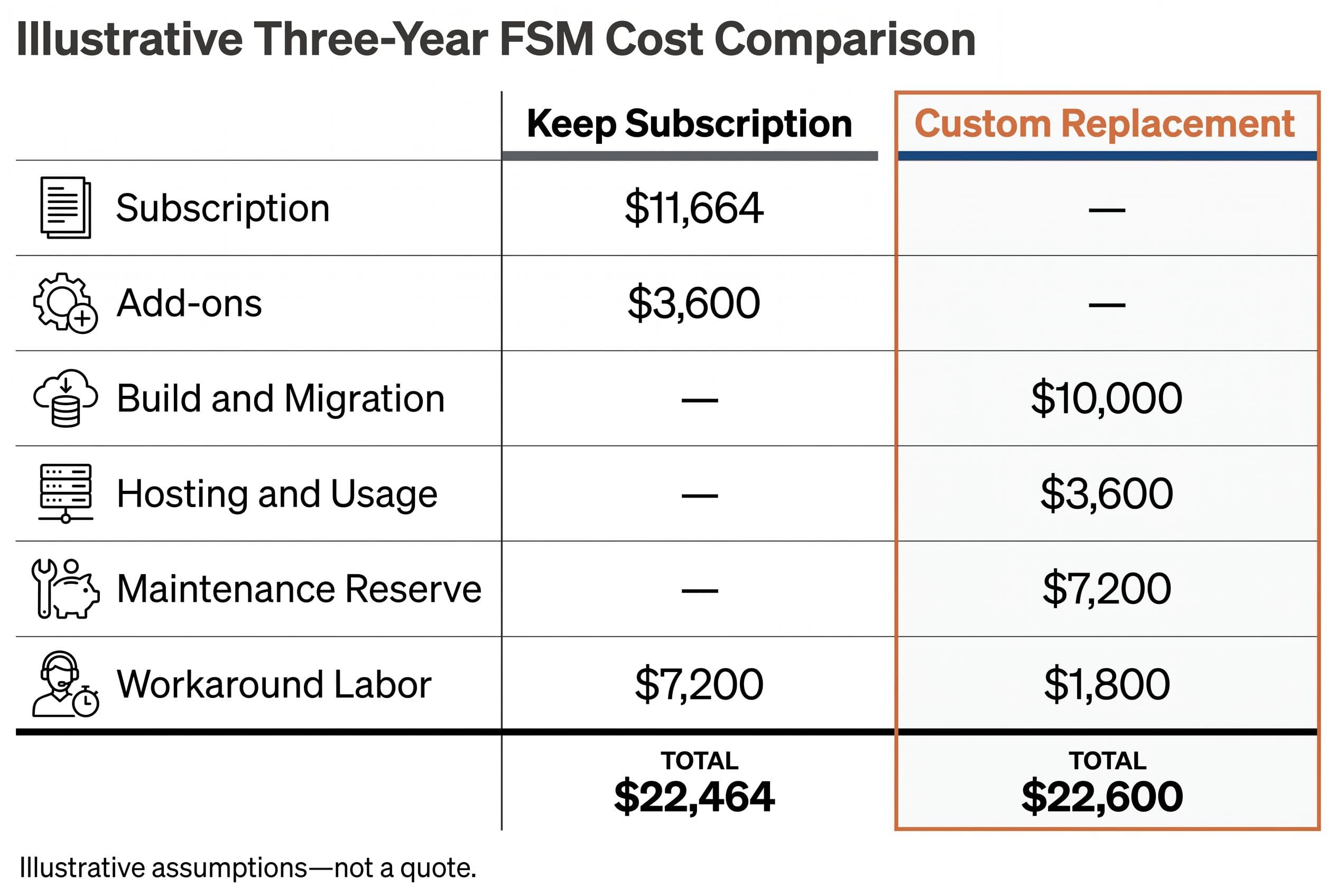
Before I recommend a build, I'd price doing nothing. Not just the subscription—the add-ons and office work it leaves behind.
For a third-party-reported example, Toricent Labs' 2026 Housecall Pro pricing breakdown lists Essentials at $149 per month, billed annually, for up to five users, with additional users typically around $35 per month each. I haven't verified those prices against Housecall Pro's own pricing or a customer contract, so I'd use them as assumptions—not a confirmed current offer. I'd confirm your actual contract before treating that as your bill.
Under those assumptions, the subscription for ten users would be approximately $324 per month: $149 plus five additional users at $35.
The following is illustrative arithmetic, not a client result, vendor quote, or maintenance offer. I'm assuming an unchanged ten-user team, $100 monthly in separate add-ons, and $200 monthly of owner-valued workaround labor.
On the custom side, I'm assuming a $10,000 medium build with the defined migration included, $100 monthly for hosting and service usage, $200 monthly reserved for maintenance, and $50 monthly of remaining manual work. Those operating allowances need replacing with estimates for your workload and support arrangement.
| Three-year cost | Keep the subscription | Scoped custom replacement |
|---|---|---|
| Subscription | $11,664 | — |
| Separate add-ons | $3,600 | — |
| Build and defined migration | — | $10,000 |
| Hosting and service usage | — | $3,600 |
| Maintenance reserve | — | $7,200 |
| Workaround labor | $7,200 | $1,800 |
| Total | $22,464 | $22,600 |
The subscription wins this example by $136. With migration risk still on the custom side, I wouldn't replace it merely to chase savings.
Keep renting when the bill is too small for the payback math, the existing product handles your workflow, or essential ecosystem connections can't reasonably be replaced. Don't hire me to recreate a working subscription just because owning code sounds appealing.
Headcount can change the answer. Under the same subscription assumptions, twenty users would cost approximately $24,264 over three years before add-ons or workaround labor. That's seat creep: spending rises because you hired, even if the underlying workflow didn't change.
I still wouldn't carry the custom allowances forward blindly. More technicians may mean more messages, photos, support, and storage.
For a broader three-year comparison and exit checklist, I'd use the same method: include retained subscriptions, migration overlap, your team's testing time, and any support you still need. Workaround labor is capacity you might recover—not automatically cash removed from payroll.
If you're specifically weighing replacing Housecall Pro, the export and accounting checks matter as much as the monthly charge.
No signal at the job site changes the quote
“Works on a phone” and “works without reception” aren't the same requirement. I'd settle that before choosing the first-release scope.
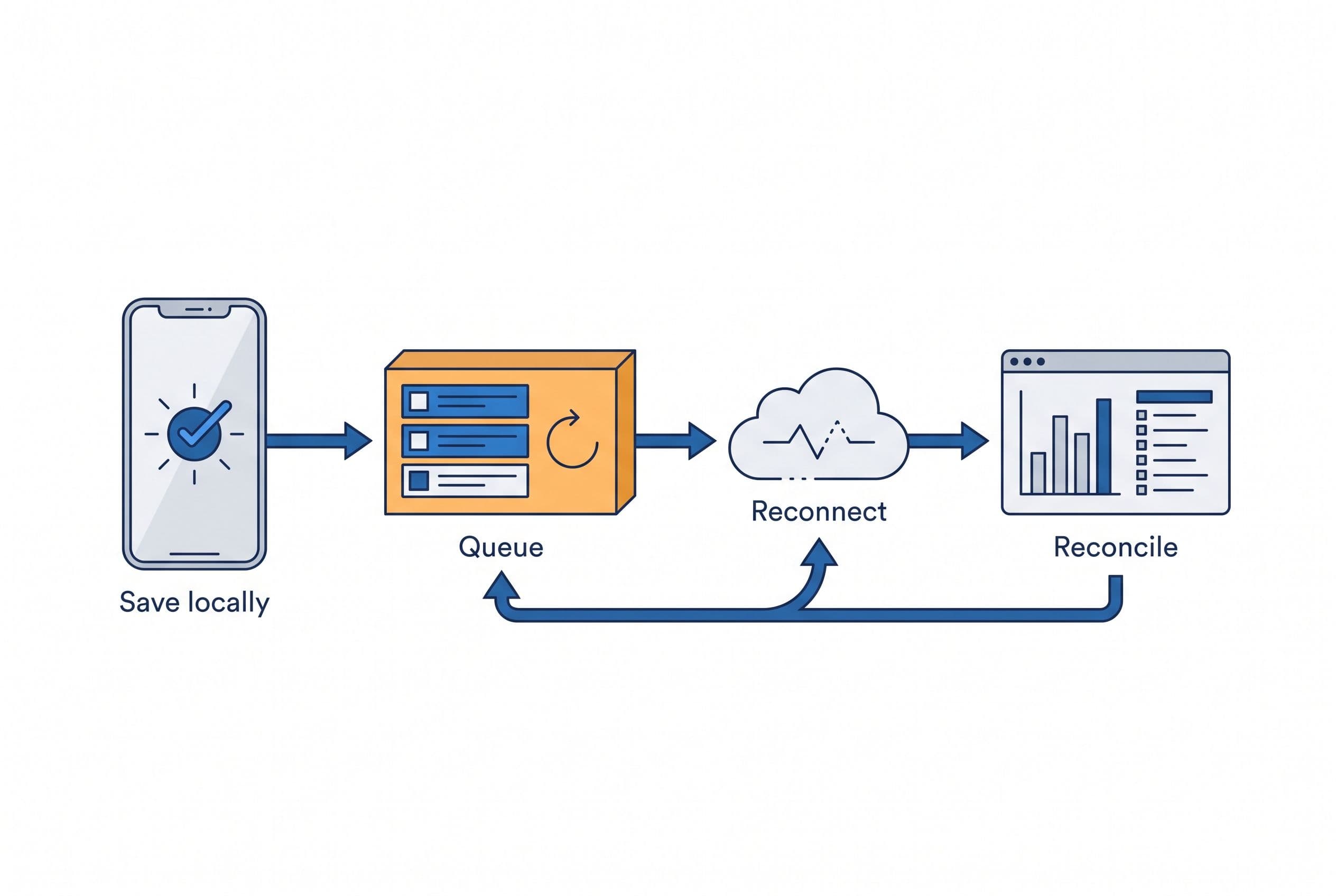
A mobile browser can show jobs, collect notes, and upload photos while connected. Offline operation adds local storage, queued changes, retries, and rules for conflicting edits.
Suppose a technician marks a job complete without reception while dispatch reassigns it. Which change wins when the phone reconnects?
That's not polish. It's business logic.
My field service app cost checklist would include:
- Can technicians lose reception during the work that matters?
- Must they open job details without a connection?
- Must photos and signatures survive closing the app?
- Can two people change the same job before either reconnects?
- Does the office need a clear distinction between saved locally and received by dispatch?
I'd keep offline operation out of the first release only if the actual working conditions allow it. Otherwise, I'd narrow other features and price the offline behavior explicitly. I wouldn't bury it under “mobile-friendly” and surprise you later.
The same applies to live location and route planning. A map pin, continuous location updates, and route calculations are different scopes with different service dependencies. Buying custom FSM software doesn't make those dependencies free.
A cheap FSM license and an agency build buy different things
For a small operation with ordinary scheduling and invoicing, I'd compare subscriptions before commissioning software.
ScanManifold's 2026 Jobber pricing breakdown lists Core for one user at $49 per month billed monthly, or $29 per month billed annually. That includes scheduling, quoting, invoicing, client management, and online payments. I haven't verified those prices against Jobber's own pricing or a customer contract, so I'd treat them as a third-party-reported example, not a confirmed current offer. At that level, a custom replacement needs a reason beyond avoiding rent.
The case for a Jobber replacement gets stronger when the workflow no longer fits—not simply because a subscription exists.
Traditional custom development is a different purchase. SDH global's 2026 pricing guide places most custom software projects at $50,000–$500,000+. That's a broad market benchmark, not an FSM-specific estimate or my pricing.
My ranges aren't a claim that I deliver every project in that benchmark for less. I use AI-assisted development, constrain the scope, and ship a defined application in weeks instead of quoting an entire enterprise suite.
Here's how I'd separate the choices:
- Subscription: strongest when the standard workflow fits and you want product support rather than software ownership.
- Focused custom build: strongest when a specific operational mismatch is expensive enough to fix.
- Larger agency engagement: can fit a wider program with substantial coordination and specialist needs. I'd challenge five-person staffing for a two-person job and months of paid discovery that produce only slides.
- Offshore hourly team: can work with clear specifications and technical oversight. A cheap rate doesn't price the eventual rewrite or handoff.
- In-house developer: fits continuing product work. If you want a long-term embedded developer rather than a bounded delivery, I'm not that hire.
The build vs buy field service decision isn't about declaring either model superior. I'd pick the one that gets dispatch and technicians through the day with the least total cost and avoidable friction.
Turn your dispatch checklist into a fixed FSM quote
To turn the FSM platform cost range into a quote, I'd need the current invoice, an example data export, the essential workflows, and the failures you can't tolerate at go-live.
I'd also want one person authorized to settle scope questions. Otherwise, every review becomes a committee redesign.
My delivery plan would put your involvement into a scoping call, a short weekly review, and a final test pass. Export cleanup and internal training can require more of your time; I'd identify that work rather than hide it behind “we handle everything.”
Before go-live, I'd test the agreed workflow in a staging environment: create a job, assign it, change it, complete it, and verify the accounting handoff. I'd also test the defined failure cases and reconcile migrated records before switching off the old system.
For the agreed scope, fixed price means overruns are my problem, not yours. New requirements get a scope decision before extra work starts.
The code lives in your own repo from day one. The contract transfers ownership of the custom code and source to you on final payment; I keep only generic reusable components, and third-party libraries and services retain their own license terms.
I'd make handoff realistic for a developer familiar with the stack: source and repo access, deployment notes and configuration, environment variables, service credentials, and documented workflow rules. I'd also spell out ownership or transfer of hosting, database access, service accounts, backups, and the licenses needed for retained reusable components. Code quality and documentation still matter; owning the source doesn't make takeover instant. That's the practical difference between owning your custom FSM software and depending on a platform you can't leave.
Run the free project estimator at free project estimator: five questions, about ninety seconds, and the range appears on screen BEFORE any form asks who you are. If the number works for you, send it over to get a fixed quote inside one business day.
Want a real number for your own project?
Answer a few questions and get an instant price range and timeline. No call required, no obligation.
Get your instant estimateTalk through your software project with MattFrequently asked questions
- How much does custom FSM software cost in 2026?
- I quote simple builds at $2,500–$10,000, medium builds at $5,000–$15,000, and advanced builds at $10,000–$20,000. AI features multiply the applicable range by 1.25, making the overall envelope $2,500–$25,000. These prices cover defined scopes, not unlimited replacement of an enterprise platform.
- Is building field service management software cheaper than buying it?
- Not automatically. I compare three years of subscriptions, add-ons, and workaround labor against the build, migration, hosting, maintenance, and remaining manual work. If the existing product fits and the bill is small, I'd keep the subscription.
- How long does it take to build custom FSM software?
- My published delivery windows are 1–2 weeks for simple builds, 2–4 weeks for medium builds, and 4–6 weeks for advanced builds. I'd define integrations, migration, and any offline requirements before committing to the delivery plan.
- Can custom FSM software work offline and connect to QuickBooks?
- I'd scope both capabilities explicitly rather than assume they're included in a mobile app. Offline work needs local storage, retries, and conflict rules; a QuickBooks connection needs clear record ownership and failed-sync handling. Those requirements influence the quote.
- Who owns the custom field service software?
- The code lives in your own repo from day one, and the contract transfers ownership of the custom code and source on final payment. I retain generic reusable components, while third-party libraries and services keep their own license terms. Source access and handoff documentation allow another developer to take over.
What would software built for your business look like?
Replacing a subscription, fixing software that fell short, or adding AI to your workflow? Talk through the scope with Matt.
Part of these guides
Matt Brody
Founder, BuiltInWeeks
I build custom software for small and mid-sized businesses — the kind you own outright instead of renting by the seat. Fixed price, delivered in weeks, source code handed over at the end.
More about how I workKeep reading

ServiceTitan Pricing in 2026: $245–$500/Tech + Setup
For an illustrative 10-technician business, reported ServiceTitan rates work out to $29,400–$60,000 a year before implementation and extras. I separate that subscription math from the build, migration, hosting, API, and maintenance costs of owning a narrower replacement.
Read more
Cloud Based Field Service Management Software: DIY Cost
I'd budget $5,000–$15,000 for a focused dispatch app with integrations, not a clone of an entire field service suite. Here's how I'd price the workflow, account for cloud costs, and decide whether replacing the subscription makes sense.
Read more
Field Service Management: Build vs Buy Costs by Team Size
I'd usually buy for a small crew, compare the three-year bill as seats grow, and build only the workflows that justify ownership. Here's the arithmetic—including migration, hosting, APIs, and maintenance that cheap build quotes leave out.
Read more