Housecall Pro vs ServiceTitan: $13K vs $93K+ Over 3 Years

Housecall Pro vs ServiceTitan comes down to two monthly bills. For most shops under ten people, Housecall Pro is cheaper and simpler, and I'd tell you to buy it. ServiceTitan only makes sense if you'll actually use the depth you're paying for. At an estimated $245–$300 per technician per month plus a five-figure implementation, a lot of shops won't.
Neither sales rep will mention the third option: owning the system yourself. It doesn't win by default. Against Housecall Pro's pricing, a custom build rarely pays for itself. Against ServiceTitan's, it often does in the first year.
Here's the side-by-side. The checklist comes after.
| Housecall Pro | ServiceTitan | |
|---|---|---|
| Who it fits | Owner-operators and small crews, roughly 1–10 users | Residential HVAC, plumbing and electrical shops running several trucks, with dispatchers, CSRs and a sales process |
| Pricing model | Flat tiers: Basic $59/mo (annual) for 1 user; Max $299/mo (annual) for up to 8 users, then $35/user/mo | Per technician per month: Starter estimated at $245–$300/tech, with a typical floor around $1,500/mo |
| Setup cost | You set it up yourself | Implementation estimated at $5,000 to $50,000+ |
| Payments | Housecall Pay, from 2.59% on cards and 1.00% on ACH | Built-in processing. Get the rate in writing on your quote |
| What it handles best | Scheduling, invoicing, online booking, getting paid on site | Call booking, dispatch board, pricebook, memberships, reporting across many techs |
| Where it falls short | Not much room for custom workflows or deep reporting once you add trucks | Price, setup time, and features a small shop won't touch |
| What leaving costs | Low. You mostly retrain habits | The implementation fee is gone for good. Check the contract term and data export before you sign |
Housecall Pro figures come from housecallpro.com/pricing (September 2026). ServiceTitan figures are third-party estimates (July 2026). Your quote will be different.
My one-line verdicts:
- Solo or a 2–3 person crew: Housecall Pro. Done.
- 4–10 users with a simple workflow: Housecall Pro Max.
- 10+ techs, a call center, memberships, and someone who'll actually read the reports: ServiceTitan.
- 6+ techs, a ServiceTitan bill you resent, or a workflow neither product fits: get a price on building it.
A disclosure: I build custom software at fixed prices, so weigh what I say about option three accordingly. The best example I have of "built in weeks" is my own family's project, not a client's. We homeschool four kids. Teaching reading meant working through more than a thousand pages of books and workbooks. It worked, but it was scattered, slow and hard to keep up with. I built a web app that turns all of that into 50 structured phonics lessons, about 15 minutes a day, parent and kid together. It replaced a shelf of workbooks with one clear path. It was built in weeks, and we use it every day. It didn't replace a subscription, so I can't claim any payback math. What it shows is the method: find the process your people actually run, and build that and nothing more.
Housecall Pro is the honest pick for crews under ten
The pricing is published and easy to follow. Basic costs $59/month on annual billing ($79 month-to-month) for one user. Max costs $299/month on annual billing ($329 month-to-month) for up to 8 users. Each user after that is $35/month.
Here's the seat math for a growing shop (illustrative arithmetic, Max plan, annual billing):
- 8 users: $299/mo → $3,588/yr
- 10 users: $299 + 2 × $35 = $369/mo → $4,428/yr
- 14 users: $299 + 6 × $35 = $509/mo → $6,108/yr
Those are modest numbers. For a crew that schedules, invoices and collects, Housecall Pro covers the workflow well, and I wouldn't try to talk you out of it.
Run your own user count through the calculator below. There's no form and no call, and you'll see what your current stack costs per year.
Price your stack in two minutes
List the subscriptions you pay for and see what they cost over 3, 5 or 10 years next to owning the software. No email needed to see the number.
Processing fees deserve a look, but don't let them decide this for you. Housecall Pay starts at 2.59% on cards and 1.00% on ACH. Any system charges something to process payments, including a custom build running on Stripe (here's Stripe's published pricing). Compare the rates. Don't compare "has a fee" against "no fee."
Where Housecall Pro starts to strain is the work it was never designed for: equipment histories, commercial service agreements, multi-step approvals. That work ends up in a spreadsheet sitting beside the software. If that's you, I covered the trade-offs in the build-or-stay call for a small plumbing shop, and there's a broader list of Housecall Pro alternatives if you're shopping around.
ServiceTitan earns its price only if you use the depth
ServiceTitan is built for a different business. It assumes you have a dispatcher, CSRs booking calls, a pricebook your techs sell from, and memberships that drive repeat revenue. If you run all of that, the product does a lot of work for you.
Here's what it costs (illustrative arithmetic on the third-party Starter estimates):
- 10 techs at $245–$300: $2,450–$3,000/mo → $29,400–$36,000/yr
- 4 techs: 4 × $300 is only $1,200, but the typical floor is around $1,500/mo, so you pay about $18,000/yr, which works out to roughly $375 per tech per month
- Implementation on top: an estimated $5,000 to $50,000+, paid once, and you don't get it back
Per-tech pricing goes up with headcount, not with how much you use it. Apprentices, seasonal hires and the tech who's out on leave all cost the same as your best closer. And most shops have a few logins that barely get touched. Under per-seat pricing, every one of those is money spent on nothing.
If you're searching "servicetitan too expensive," it's usually for one of three reasons. You're a small shop paying the floor. You use three screens out of thirty. Or you paid for an implementation that never really finished. I broke the full price sheet down in what ServiceTitan actually costs per tech in 2026, and the ServiceTitan alternatives page covers the options.
Housecall Pro vs ServiceTitan: three years of each, in dollars
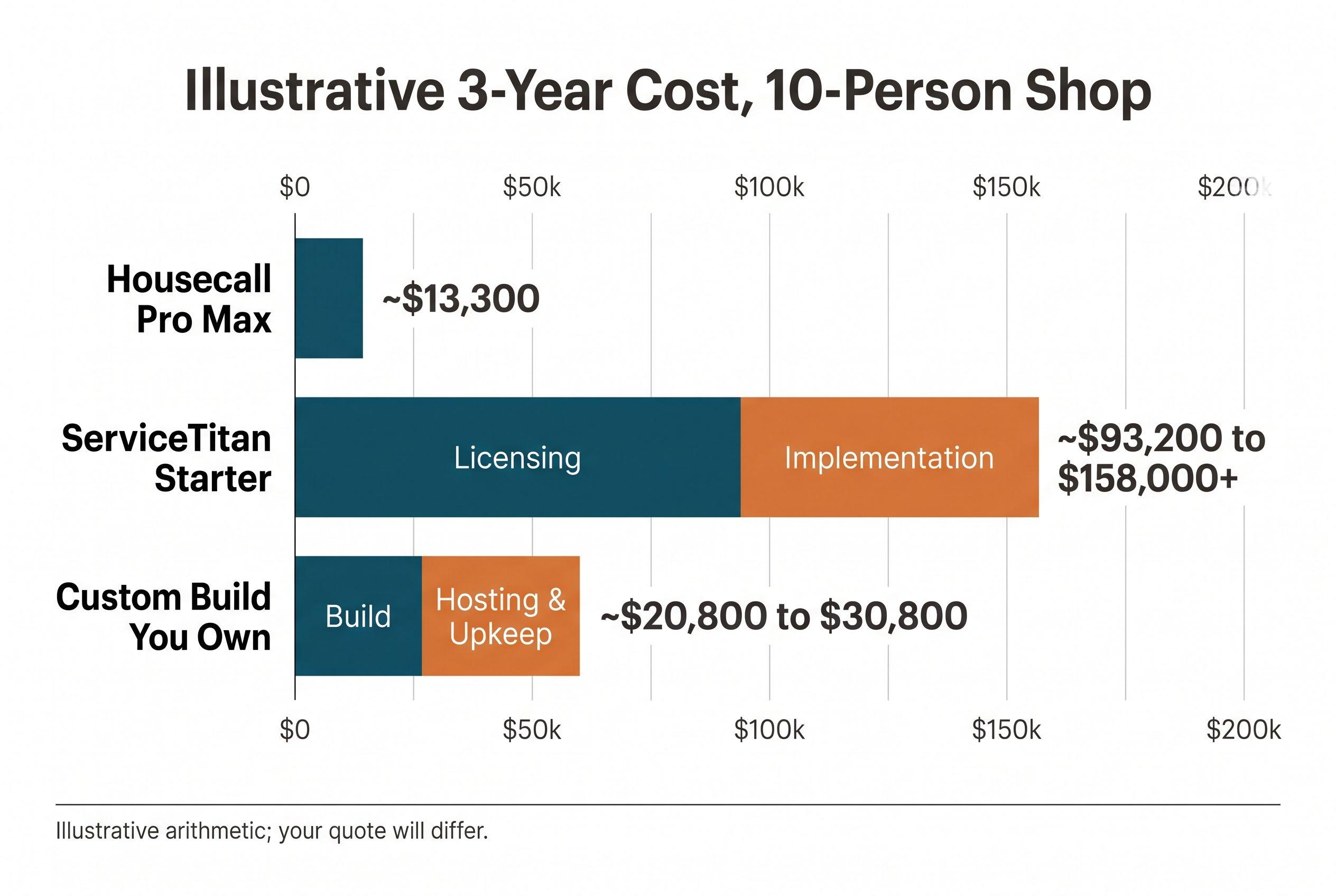
The decision really gets made here. Below is an illustrative 10-person shop with every person counted the same way on both platforms (your contract decides who counts). The custom column uses $10,000–$20,000 for the build. That's the top of my medium range running into my advanced range, because a 10-person shop moving years of jobs, customers and equipment history over usually lands there once migration's included. On top of that is an assumed $300/month for hosting, SMS usage through Twilio (Twilio's pricing page has the per-message rates), and occasional changes. That $300 is my assumption, not a quote. Swap in your own number.
| 3-year cost, 10 users/techs | Housecall Pro Max (annual) | ServiceTitan Starter | Custom build you own |
|---|---|---|---|
| Software or build | $4,428/yr × 3 = $13,284 | $29,400–$36,000/yr × 3 = $88,200–$108,000 | $10,000–$20,000 one-time, including data migration |
| Setup | $0 | $5,000–$50,000+ | Included in the build |
| Hosting, SMS, upkeep | Included | Included | ~$3,600/yr × 3 = $10,800 (assumed) |
| 3-year total | ~$13,300 | ~$93,200–$158,000+ | ~$20,800–$30,800 |
Read the table honestly. Against Housecall Pro, a custom build loses on cost. Over three years it runs roughly $7,500–$17,500 more. Once it's built, the running cost is only about $800 a year lower than the Housecall Pro bill, so the build only makes sense if a workflow is costing you real hours. Against ServiceTitan, it's a different story. The build fee alone is less than one year of licensing, and even three full years of owning it, upkeep included, comes in under ServiceTitan's first year once you add the setup fee. By year three the gap is somewhere between roughly $62K and $137K+.
Staying on your current subscription is the right answer in three situations. Your bill is Housecall Pro-sized. You rely on ServiceTitan's call booking, marketing and financing tools in ways you'd have to rebuild piece by piece. Or the product already handles your workflow and nobody's keeping a side spreadsheet. If any of those is true, keep paying. I mean that.
A longer timeline helps the build case, because the subscription keeps compounding and the build doesn't. Your own bill is the number that counts.
Not sure which column your business looks like? Send me the actual invoice and I'll tell you whether a replacement pays back or whether you should keep paying.
See your software before you pay for it
Tell me what you run today on a short call. I build a demo of your replacement, free, and walk you through it. The price is fixed in writing before you pay anything.
When owning it beats both
A custom field service build makes sense in a few specific situations:
- You're paying ServiceTitan for 6+ techs and your team really works in dispatch, the job screen and invoicing.
- You run a workflow neither product handles: commercial maintenance contracts with their own approval steps, equipment asset logs, multi-location reporting, or anything you're doing in a spreadsheet today. (Here's what the HVAC asset-log spreadsheet costs to replace.)
- You're paying for add-ons on top of the base plan to cover gaps, so the real bill is well above the advertised one.
Here's what I'd build. A Next.js web app the techs use on their phones. Postgres on Supabase for jobs, customers and equipment history. Stripe for payments, Twilio for "on my way" texts, and a sync to QuickBooks or Xero. That's typically a medium build at $5,000–$15,000 over 2–4 weeks. If you need live dispatch updates or multiple locations, it's an advanced build at $10,000–$20,000 over 4–6 weeks. (That's why the three-year table uses $10,000–$20,000: a 10-person shop with real history to migrate rarely lands at the bottom of medium.)
Here's what you'd be doing during that time: one scoping call, a short weekly review, and a final test pass before go-live. That's all.
The price is fixed, so if the build runs over, that's my cost, not yours. The code goes into your repository from day one, so you can see every bit of it as it's built. Legal ownership is a separate step: when you make the final payment, the contract transfers ownership of the custom code and source to you. I keep only my generic reusable components, and third-party services like Stripe and Twilio keep their own license terms. You also get handoff documentation, so any developer can pick it up after me.
Compare that with how the agency world usually sells this. SpdLoad's 2026 breakdown puts average custom software projects at $120,000–$500,000 and up. US agencies typically bill $100–$200 an hour (Nova Suite AI, April 2026), and hourly billing pays them more the slower they go. Field service software is about as well-understood as software gets, so you shouldn't pay for a months-long "discovery phase" to rediscover it.
Who shouldn't hire me for this: anyone on a Housecall Pro bill under a few hundred dollars a month, anyone whose revenue depends on ServiceTitan's marketing and financing ecosystem, and anyone who wants a developer embedded in the business for years. Hire a full-time engineer for that. Otherwise, the bigger question of owning your software instead of renting it is covered in more depth in that guide.
Seven checks before you sign either contract
Go through this list before you commit to anything, whether that's a demo-driven ServiceTitan contract, a Housecall Pro upgrade, or a build quote.
- Count your paid seats today and 24 months from now. Per-tech pricing makes growth expensive, so price the shop you're planning to be.
- Write down the three screens your team uses all day. If a $3,000/month product comes down to three screens, that tells you something.
- Find the spreadsheet. Whatever runs next to your current software is the workflow it doesn't handle.
- Ask whether you need call booking, memberships and marketing attribution. If not, ServiceTitan is more than you need. Take it off the list.
- Get data export in writing. Customers, jobs, invoices and equipment history, in CSV, on request. If they won't put that in writing, you're locked in.
- Test the accounting sync with your bookkeeper, using your real chart of accounts in QuickBooks or Xero, not the demo file.
- Read the contract term and the implementation scope. Know what you're paying for before you pay $5,000–$50,000+.
What rules each option out:
- ServiceTitan: fewer than about five techs, no dispatcher, or no time for a long implementation.
- Housecall Pro: you need multi-step custom workflows or multi-location reporting, or a lot of your users barely log in.
- Custom build: the bill is too small for the payback math, nobody can give it an hour a week during the build, or you need features that only exist in a vendor's ecosystem.
What I'd pick, by shop size
Plenty of people search "housecall pro vs jobber vs servicetitan," so here's how all three fit.
- 1–5 people: Housecall Pro or Jobber. Both are tiered subscriptions built for small crews. Pick the one whose scheduling screen your techs like better after a free trial. (If Jobber's dispatch is what bugs you, I wrote about fixing dispatch for HVAC crews on Jobber, and there are Jobber alternatives too.)
- 6–10 people: Housecall Pro Max, unless a spreadsheet workaround is costing someone hours every week. In that case, get a build price for that one workflow.
- 10+ techs using the full feature set: ServiceTitan. Negotiate the implementation fee hard.
- 10+ techs using a fraction of ServiceTitan: this is where owning it usually wins, and where I'd run the numbers first.
This week: pull one bill, list three screens
You don't need to rip anything out this month. Do one thing this week: pull your last software invoice and write down the three screens your team actually uses all day. That's enough to tell which column of the three-year table you're in.
Then take those two things to the free project estimator. It takes about ninety seconds. You'll see a price range on screen before it asks who you are, and if you send it, you'll get a fixed quote back within a business day. From there you're deciding with real numbers instead of comparing sales demos.
P.S. If you're a small shop paying ServiceTitan's monthly floor, start there. Price Housecall Pro and a build side by side, because at under five techs you're already past the point where ServiceTitan fits. That's usually the fastest payback I see in this whole comparison.
See a free demo of your replacement software
Book a short call and tell me what you run today. I build a demo of the replacement for free and show it to you on Zoom. The price is a flat fee, fixed in writing before you pay anything, and you own the code.
Book the callOr get a rough price range from the estimatorFrequently asked questions
- Is Housecall Pro or ServiceTitan better for a small HVAC or plumbing company?
- For most shops under ten people, Housecall Pro is the better fit. Its Max plan is $299/month on annual billing for up to 8 users, and setup is self-serve. ServiceTitan is built for larger multi-truck operations with dispatchers, call booking and memberships, and small shops often end up paying its typical floor of around $1,500/month for features they don't use.
- How much does ServiceTitan cost per technician in 2026?
- Third-party estimates from July 2026 put the Starter plan at about $245–$300 per technician per month, with a typical monthly floor around $1,500. There's also a one-time implementation fee estimated at $5,000 to $50,000 or more. ServiceTitan quotes each customer individually, so get the full number in writing before you sign.
- What does it cost to replace ServiceTitan with custom software?
- A custom field service app covering dispatch, jobs, invoicing, payments and accounting sync typically runs $5,000–$15,000 over 2–4 weeks at BuiltInWeeks. If you need real-time dispatch or multiple locations, it's $10,000–$20,000 over 4–6 weeks. In an illustrative 10-tech scenario, that costs less than one year of ServiceTitan licensing. You'll still pay ongoing hosting and upkeep.
- Is it worth replacing Housecall Pro with a custom build?
- Usually not on cost alone. Housecall Pro is inexpensive enough that a custom build's hosting and upkeep eat most of the savings. It's only worth replacing if your team runs a workflow Housecall Pro doesn't handle, like equipment histories or commercial service agreements, and that workaround is costing you real hours every week.
- Housecall Pro vs Jobber vs ServiceTitan: which should I choose?
- For crews of 1–5 people, Housecall Pro and Jobber are both reasonable tiered subscriptions, so pick the one your techs find easier to use. For 10+ techs who use call booking, pricebooks and memberships, ServiceTitan earns its price. If you have 10+ techs but only use a fraction of ServiceTitan, price a custom build before you renew.
What would software built for your business look like?
Tell me what you run today on a short call. I build a demo of your replacement, free, and show it to you before you pay anything.
Matt Brody
Founder, BuiltInWeeks
I build custom software for small and mid-sized businesses — the kind you own outright instead of renting by the seat. Fixed price, delivered in weeks, source code handed over at the end.
More about how I workKeep reading

Cost to Replace ServiceTitan: $10K–$25K Plus ~$150/Mo
Replacing ServiceTitan with software you own costs $10K–$25K to build and roughly $150 a month to run. Here's the line-by-line arithmetic, the three-year comparison against per-tech licensing, and the shops that should keep paying for it (or switch to Jobber).
Read more
Housecall Pro Alternative for Small Plumbing Company: Build?
Most small plumbing shops should keep renting. A plumbing company with 8 or more users and workflows that don't fit the software should run the numbers. Here's the checklist I use, the conditions that rule a build out, and three years of seat math laid out so you can check it.
Read more
Switching From Housecall Pro: Rebuild Payment Links First
The hardest part of switching from Housecall Pro isn't scheduling or the customer list. It's the money in flight: unpaid invoice links, saved cards, deposits and autopay. Here's the checklist I'd run before cancelling, the conditions that say wait, and what a payment-link rebuild actually costs.
Read more