Cost to Replace ServiceTitan: $10K–$25K Plus ~$150/Mo

For a small HVAC, plumbing or electrical shop, replacing ServiceTitan with custom software you own costs $10,000–$25,000 to build, fixed price, plus roughly $150 a month to keep it running. That covers dispatch, jobs, customers, estimates, invoicing, payments, texting and a QuickBooks sync.
The build is the number everybody asks about. It's not the only one, so below I've split out build, migration, hosting, APIs and maintenance as separate lines. Every figure I made up for illustration is labeled as illustrative. The third-party numbers (ServiceTitan, Jobber, Housecall Pro, agency rates) are what's commonly reported or what the vendors listed when I checked. Those change, so check them against your own quote before you lean on them.
One thing before the math: for a lot of shops the cheapest way off ServiceTitan isn't a custom build. It's Jobber or Housecall Pro. I'll show you where that line falls.
What you're paying ServiceTitan, and why you had to sit through a demo to find out
ServiceTitan doesn't publish its prices. You get a number after a sales demo, which tells you something about how negotiable the number is.
Since there's no official price list, everything below comes from third-party pricing roundups, not from ServiceTitan. Treat it as ballpark. The commonly reported figures are $245 to $500 per technician per month, a typical monthly floor of about $1,500, and implementation fees from $5,000 to $50,000+ depending on company size and setup. For a business under $1M in revenue, reported year-one cost runs $15,000–$40,000+. Your own quote is the only number that counts. (If you want the tier-by-tier version, I broke down what ServiceTitan actually charges per tech in 2026 separately.)
Here's what that looks like for a hypothetical six-tech shop. Illustrative arithmetic, not a quote from ServiceTitan:
- 6 techs × $300/tech/month = $1,800/month
- $1,800 × 12 = $21,600/year
- Plus a one-time implementation fee, say $10,000 (low end of the reported range)
- Year one: about $31,600. Every year after: $21,600, and it climbs every time you hire a tech.
That last part is the real problem with per-seat licensing. Your bill tracks your headcount, not how much you actually use the thing. Hire two techs for the summer rush and the software gets more expensive in the same month the payroll does.
Put your own tech count and per-seat rate in here and watch the three-year total add up:
Price your stack in two minutes
List the subscriptions you pay for and see what they cost over 3, 5 or 10 years next to owning the software. No email needed to see the number.
I've run this exact math before, on a $30K dialer
The project I can point to isn't a field service build. It's a sales dialer. The payback math is the same, though, and that's the part that matters here.
The business was paying Kixie about $30,000 a year. They kept running into limited customization, clunky workflows, and a price that kept going up. I built them a custom power dialer in React: one-to-one calling or up to 10 lines at once that only connects when someone picks up, unlimited users, lead lists assigned to any rep, Zapier webhooks for follow-ups, SMS templates, one-click voicemail drops, and real analytics on connect rates and rep performance.
The build cost $10,000. That's a third of one year of the Kixie bill, so it paid for itself in about four months. Zero monthly licensing after that. (A real client project. Details generalized, numbers rounded, results vary.) If you're still paying for that kind of tool, here's what replacing Kixie looks like.
What carries over to ServiceTitan: a per-seat tool built for a bigger company than yours, a bill that only goes up, and a workflow you're bending to fit the software. When all three are true, owning it usually wins. When only the first one is true, it usually doesn't.
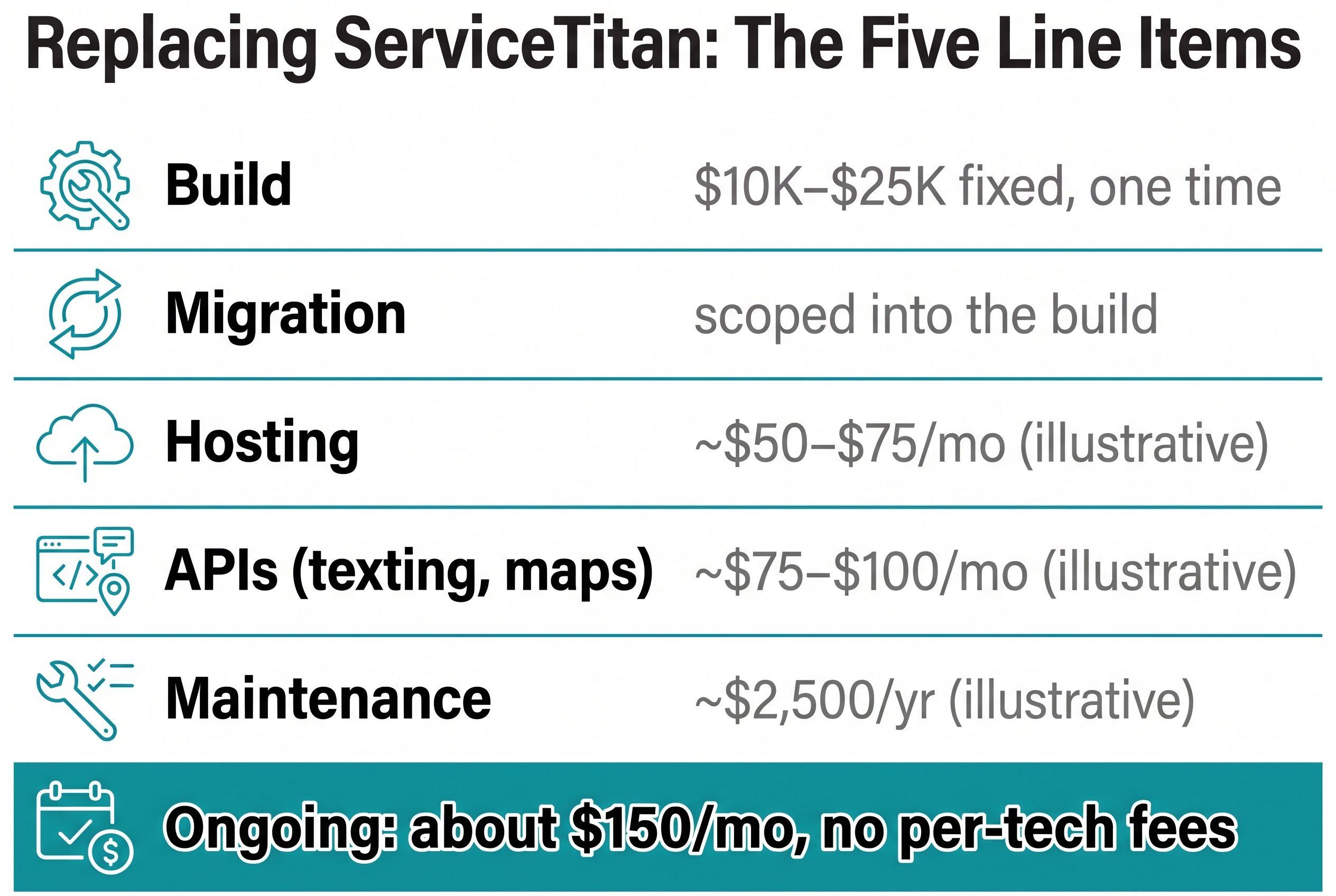
What it costs to replace ServiceTitan: the five line items
Most "custom software cost" articles give you one big number. That hides the parts that bite you later. Here are the lines broken out.
| Line item | One-time | Ongoing | What it covers |
|---|---|---|---|
| Build | $10,000–$25,000 fixed | — | Dispatch board, jobs, customers, estimates, invoices, tech mobile view, office roles |
| Migration | Scoped into the build quote | — | Customers, equipment history, open jobs, maintenance agreements, pricebook |
| Hosting | — | ~$50–$75/mo (illustrative) | App hosting, Postgres database, file storage for photos and signed estimates |
| APIs | — | ~$75–$100/mo (illustrative) | Twilio texting (including the A2P 10DLC registration and carrier fees US business texting requires), maps/routing, email. Depends on volume |
| Maintenance | — | ~$2,500/yr (illustrative) | One small paid change request a year, at our simple-build floor. That's the minimum. Security patches and library upgrades come up too, so don't treat it as a ceiling |
| Payment processing | — | Compare to today | Stripe charges per transaction; so does every FSM tool. Check your current rate against Stripe's before you call it a wash. I've left it out of the math |
The ~$150/month is my working assumption for a shop sending a few thousand texts a month. It's usage-based. A shop that texts every customer three times per job pays more for Twilio than one that only sends appointment reminders. Either way you pay for what you send, not for how many people you employ.
The stack I'd use is boring on purpose: Next.js and TypeScript for the app, Supabase on Postgres for the data, Stripe for card and ACH payments, Twilio for SMS, and a sync to QuickBooks or Xero. Most developers who know this stack can pick it up. That's the point.
A word on "QuickBooks sync," because it means different things at different prices. At the low end it's a one-way push: invoices and payments go into QuickBooks, customers matched by name. A full two-way sync is real work (OAuth app approval, sandbox vs. live, API rate limits, mapping items, customers, invoices and payments) and it pushes the build toward the top of the range.
Three things that push you toward $10K or toward $25K
Here's how the range actually breaks down. Our medium tier runs $5,000–$15,000 over 2–4 weeks, but nothing I'd call a real ServiceTitan replacement comes in at the bottom of it. A basic replacement for one location lands at the top of that tier, $10,000–$15,000, and toward the long end of its timeline. That's why the floor I quote is $10,000 and the timeline starts at about three weeks, not two. Three variables move it from there:
1. Offline mode for techs
If your techs work in basements and crawlspaces with no signal, the mobile view has to save work locally and sync when the phone reconnects. I build that as a PWA, and the hard part is conflict handling: what happens when the office and the tech both edited the same job. That's real engineering. It's the most common reason a build moves into the advanced tier ($10,000–$20,000, 4–6 weeks). If you need offline mode and a full two-way QuickBooks sync, plan on the timeline running past six weeks. I'll tell you that at quote time, not halfway through.
2. The pricebook and good-better-best estimates
A flat list of services with prices is simple. Tiered options, equipment bundles, financing and member pricing are rules work. Rules are what separate a medium build from an advanced one.
3. AI features
Transcribing call notes into a job, drafting an estimate from tech photos, summarizing a customer's equipment history. These are useful, and they add about 25% to the build (I multiply the range by 1.25). On a $20,000 advanced build, that's $25,000, the top of the envelope. I'd usually ship without them and add them later, once you know which one you'd actually use.
What doesn't move the number: user count. Ten techs or forty, the build price is the same, and nobody bills you per head next year.
The migration nobody puts in the quote: agreements, equipment, history
This is where most ServiceTitan exits go wrong. The software isn't the hard part. Your maintenance agreements are.
A typical HVAC shop's recurring revenue lives in membership agreements: who's on a plan, when their next tune-up is due, what equipment is at the address, what was done last visit. If that data comes over messy, you lose renewals quietly over the next twelve months and don't notice until spring.
Before I quote, I want to see your data export. Specifically:
- Customers and locations. Usually clean.
- Equipment records per location. Often half-filled-in. Model and serial numbers are frequently missing.
- Active agreements with renewal dates. The single most important table you have.
- Open jobs and unpaid invoices at cutover. These need a cutover date, not a migration.
- Pricebook. Usually worth rebuilding instead of copying, because most shops' pricebooks are years of accumulated junk.
A clean export keeps the build in the lower part of its tier. A messy one, with three people's naming conventions and duplicate customers, pushes it up. I'd rather tell you that at quote time than in week three.
The cutover itself: run both systems for one to two weeks, dispatch new jobs in the new system, and close out old ones in ServiceTitan. Then turn off the renewal. Check your contract term before you sign anything with anyone, me included. Plenty of shops are locked into an annual commitment, and that sets your real start date.
Three years of keeping ServiceTitan vs. owning the replacement
This is the section that actually makes the decision. Same hypothetical six-tech, eight-user shop from above. All figures illustrative. The Jobber and Housecall Pro numbers are their plan prices as I last saw them, and both vendors change plan names, user caps, add-on fees and monthly vs. annual rates often. Check their current pricing pages before you decide anything on these cells.
| 36-month cost | ServiceTitan | Housecall Pro Max | Jobber Grow | Custom build you own |
|---|---|---|---|---|
| Software / licensing | $64,800 (6 × $300 × 36) | $10,764 ($299 × 36, up to 8 users) | $8,244 ($229 × 36, up to 10 users) | $0 |
| Implementation / build | ~$10,000 | — | — | $10,000–$25,000 |
| Hosting + APIs | Included | Included | Included | ~$5,400 ($150 × 36) |
| Maintenance / changes | Included | Included | Included | ~$7,500 ($2,500 × 3) |
| 3-year total | ~$74,800 | ~$10,764 | ~$8,244 | ~$22,900–$37,900 |
| Cost of hiring 4 more techs | +$14,400/yr | Extra users $35/mo each | Extra users $29/mo each | $0 |
Read that table honestly, because it doesn't say "build."
Against ServiceTitan, the custom build wins clearly. Here's the payback math. ServiceTitan at $1,800 a month minus about $150 a month to run your own leaves roughly $1,650 a month in savings. $15,000 ÷ $1,650 is about 9 months. $25,000 ÷ $1,650 is about 15. If that same shop grows to 12 techs, the ServiceTitan line doubles to $3,600 a month, savings jump to about $3,450, and $25,000 ÷ $3,450 pays back the top-end build in around seven months.
Against Jobber or Housecall Pro, the build loses on pure dollars. If one of those does your workflow, just move to it. It's the cheaper way off ServiceTitan, and I'd tell you that on the phone. Watch the user caps, though. An eight-user shop is already at the edge of Housecall Pro Max, and every hire after that adds a monthly fee. (I wrote up where Jobber's dispatch falls short for HVAC and when Housecall Pro stops fitting a small plumbing shop, so you can see which side of that line you're on.)
So who should keep paying ServiceTitan? Shops that actually use the heavy parts: a real call center, multi-location reporting, marketing attribution across a dozen campaigns. If that's you, a $25K build isn't going to replace a platform you've wired your whole operation into, and I'm the wrong hire. Same if your bill is closer to the $1,500 floor and the tool mostly works. The payback stretches past a year and the disruption may not be worth it. And if what you want is a developer embedded with your team long term, hire one. I build it, hand it off, and step back.
The custom build makes sense in a narrower but real case. You've outgrown Jobber or Housecall Pro because of a workflow they don't handle (agreement-heavy HVAC, commercial service contracts, a dispatch rule that's specific to how you run), and ServiceTitan is the only off-the-shelf tool that handles it, at a price built for a 50-tech operation.
If you'd rather not run this math yourself, send me the bill:
See your software before you pay for it
Tell me what you run today on a short call. I build a demo of your replacement, free, and walk you through it. The price is fixed in writing before you pay anything.
What the same $25K buys you from everyone else
You've got options besides me and ServiceTitan. Here's the honest trade on each.
- A traditional agency. US agency rates are commonly reported at a median of $100–$170 an hour (2024). Clutch's 2026 pricing research puts the average custom software project at $132,480 with a 13-month timeline, and benchmarks for a custom field service MVP alone are reported at $30,000–$50,000 over two to three months. Those are third-party figures, so check them yourself before you budget around them. Either way, hourly billing pays them more the slower they go, and a "discovery phase" can eat a chunk of your budget before you see a screen. You'll get something solid. You'll pay for the overhead.
- Offshore shops. The quote looks great. Then you count the timezone lag, the spec rewrites, and the six months of fixes after launch. When that ends in a full rewrite (and it often does), the rewrite costs more than the original build.
- No-code (Airtable, Bubble, Make). Cheaper to start, and fine for a three-person shop. But you're renting again, on a different platform's terms. I covered the math in what it costs when an Airtable setup outgrows itself.
- An in-house developer. Makes sense if software is your product. For a 6-tech HVAC company it's a salary for a job that's mostly done after six weeks.
- Me. A fixed price inside $10,000–$25,000, delivered in 3–6 weeks for most shops (longer if you need offline mode plus a full two-way QuickBooks sync, and I'll say so up front). If it runs over budget, that's my problem, not yours. The code lives in a repo under your account from day one, so you can see every commit. Legal ownership of the custom code and source transfers to you on final payment. I keep only my generic reusable components, and third-party libraries and services keep their own license terms. You get handoff documentation, so a developer who knows the stack can take it over.
Your time on it is small: a scoping call, a short weekly review where you click through what shipped, and a final test pass with a dispatcher and one tech before go-live. That's it. No months of workshops.
Turning your tech count into a fixed number
You don't need to understand any of the code to settle this. You need three numbers: your monthly ServiceTitan bill, your tech and office headcount, and whether Jobber or Housecall Pro could do the job. The wider breakdown of what custom software actually costs covers the other categories. If you want the bigger picture on owning your software instead of renting it, start there. And if you want ServiceTitan specifically compared side by side, here's every realistic ServiceTitan alternative.
Here's the gut check. Look at your bill and ask yourself: am I paying ServiceTitan like I'm a 40-truck company? If the honest answer is yes, that's the signal. You don't need a feeling. You need to know exactly what it costs to stop.
So find out. free project estimator asks five questions and takes about ninety seconds. Your price range is on screen before it asks who you are. If you want it locked, I'll send a fixed quote within one business day. Then you'll know whether you're building, switching to Jobber, or staying put, and you'll have the number to back it up.
See a free demo of your replacement software
Book a short call and tell me what you run today. I build a demo of the replacement for free and show it to you on Zoom. The price is a flat fee, fixed in writing before you pay anything, and you own the code.
Book the callOr get a rough price range from the estimatorP.S. Your fastest first move costs nothing: pull your ServiceTitan contract and find the renewal date. That date, not the build, decides when your savings actually start.
Frequently asked questions
- How much does it cost to replace ServiceTitan with custom software?
- For a small single-location HVAC, plumbing or electrical shop, a custom replacement typically costs $10,000–$25,000 fixed price to build, plus roughly $150 a month for hosting and APIs like texting and maps (an illustrative estimate that depends on volume). Offline tech apps, complex pricebook rules and AI features push it toward the top of that range. User count doesn't change the price.
- Is ServiceTitan too expensive for a small HVAC company?
- Often, yes. Published estimates put ServiceTitan at $245–$500 per technician per month with a typical floor around $1,500 a month, plus $5,000–$50,000+ in implementation. Estimated year-one cost for businesses under $1M in revenue is $15,000–$40,000+. A small shop that doesn't use the call center, multi-location or marketing features is usually paying for capacity it doesn't need.
- What is the cheapest ServiceTitan alternative for a small business?
- On pure dollars, it's usually Jobber or Housecall Pro. Jobber's Grow plan is $229/month for up to 10 users and Housecall Pro's Max plan is $299/month for up to 8 users, both billed annually. A custom build only beats them when your workflow needs something they don't handle, or when your headcount makes their per-user add-ons expensive.
- How long does it take to replace ServiceTitan?
- A focused custom build typically takes 3–6 weeks depending on scope, and then you run both systems for one to two weeks during cutover. In practice your ServiceTitan contract term often sets the real timeline, so check your renewal date before you commit to anything.
What would software built for your business look like?
Tell me what you run today on a short call. I build a demo of your replacement, free, and show it to you before you pay anything.
Part of these guides
Matt Brody
Founder, BuiltInWeeks
I build custom software for small and mid-sized businesses — the kind you own outright instead of renting by the seat. Fixed price, delivered in weeks, source code handed over at the end.
More about how I workKeep reading

Housecall Pro Alternative for Small Plumbing Company: Build?
Most small plumbing shops should keep renting. A plumbing company with 8 or more users and workflows that don't fit the software should run the numbers. Here's the checklist I use, the conditions that rule a build out, and three years of seat math laid out so you can check it.
Read more
Monday.com Too Expensive? $3K–$17K Over 3 Years, by Seats
At 8 users, monday.com probably isn't too expensive. At 25 users on Pro, the 3-year bill is in the same range as building your own app. Here's the seat math, the checklist I'd run before canceling anything, and the conditions where you should just keep paying.
Read more
Cost to Replace Airtable: $5K–$15K + $40/Mo Hosting
Replacing Airtable with an app you own usually costs $5,000–$15,000, takes 2–4 weeks, and runs about $40 a month to host. For plenty of teams it still doesn't pay back. Here's the seat math, a pre-flight checklist, and the conditions that should keep you renting.
Read more