Jobber Alternative for HVAC Contractors: Fix Dispatch

I'd replace Jobber only if the dispatch rules justify it
If you're looking for a Jobber alternative for HVAC contractors, I'd start with one decision: is Jobber missing your scheduling rules, or haven't those rules been set up clearly? Those are different problems. Only one necessarily calls for new software.
A prettier calendar won't stop a dispatcher from assigning the wrong technician. Neither will moving the same incomplete equipment records into another subscription.
Here's my first-pass checklist:
- Keep it: Your team can schedule the work correctly using the product's existing settings, and the subscription is cheaper than replacing it.
- Extend it: Invoicing and customer records work, but dispatch depends on a separate spreadsheet of qualifications, equipment, or agreement obligations.
- Replace it: The missing rules affect daily operations, an extension can't reliably access the necessary data, and the replacement math holds up.
For a multi-feature custom app with integrations and user roles, my published range is $5,000–$15,000 over 2–4 weeks. Real-time features and complex scheduling rules fall into the advanced range: $10,000–$20,000 over 4–6 weeks. Those aren't quotes for replacing every feature in a field-service suite.
Scope first. Especially here.
I have a real example of replacing an expensive tool, though it wasn't an HVAC project. I built a React power dialer that replaced about $30,000 a year in Kixie licensing for $10,000—a third of one year's subscription, with payback in about four months.
This is a real, anonymized client project; the subscription figure is approximate, and results vary.
The dialer supported unlimited users, custom lead lists, calling up to 10 lines at once, and Zapier webhooks for follow-ups and updates. It was built in weeks, owned outright, with zero monthly licensing fees. That doesn't mean zero operating costs; the four-month comparison is against the replaced licensing.
The relevant lesson from that Kixie replacement isn't that every subscription deserves demolition. It's that a defined workflow can be worth owning when the existing tool's limits and annual bill justify the build.
Find the rule hiding in your HVAC dispatch spreadsheet
When I evaluate a Jobber alternative for HVAC contractors, I don't start with a feature checklist. I start with the assignments your dispatcher has to reject manually.
A calendar answers, “Who's free?” HVAC dispatch also needs to answer, “Who's eligible, equipped, nearby enough, and available for the whole job?”
Those answers depend on structured records. If qualifications live in someone's memory and maintenance obligations live in a separate workbook, another calendar still won't have the information it needs.
I'd review actual scheduling exceptions with your dispatcher:
- Qualification: Does the job require a specific credential, training record, or company-approved skill?
- Equipment: Is the technician qualified for this system, not just this broad job category?
- Duration: Does the appointment include travel, setup, and any required second technician?
- Agreement: Is this a visit the customer is owed, or simply a recurring calendar entry?
- Readiness: Are the necessary parts available before the appointment is confirmed?
- Authority: Who can override a scheduling warning, and where is the reason recorded?
Then I'd separate missing data from missing behavior. If the technician's qualification record doesn't exist, that's a data problem. If the record exists but scheduling ignores it, that's a rule problem. If the rule works but nobody uses the workflow, that's an adoption problem.
Don't buy a rebuild to fix undefined operating rules. I'd want the dispatcher and owner to agree on those rules before I quote them.
I also wouldn't claim Jobber lacks a capability without checking your current plan, configuration, and a live example. My broader Jobber replacement options are useful once you've identified what actually fails—not just what feels frustrating.
How I'd price a Jobber alternative for HVAC contractors over three years
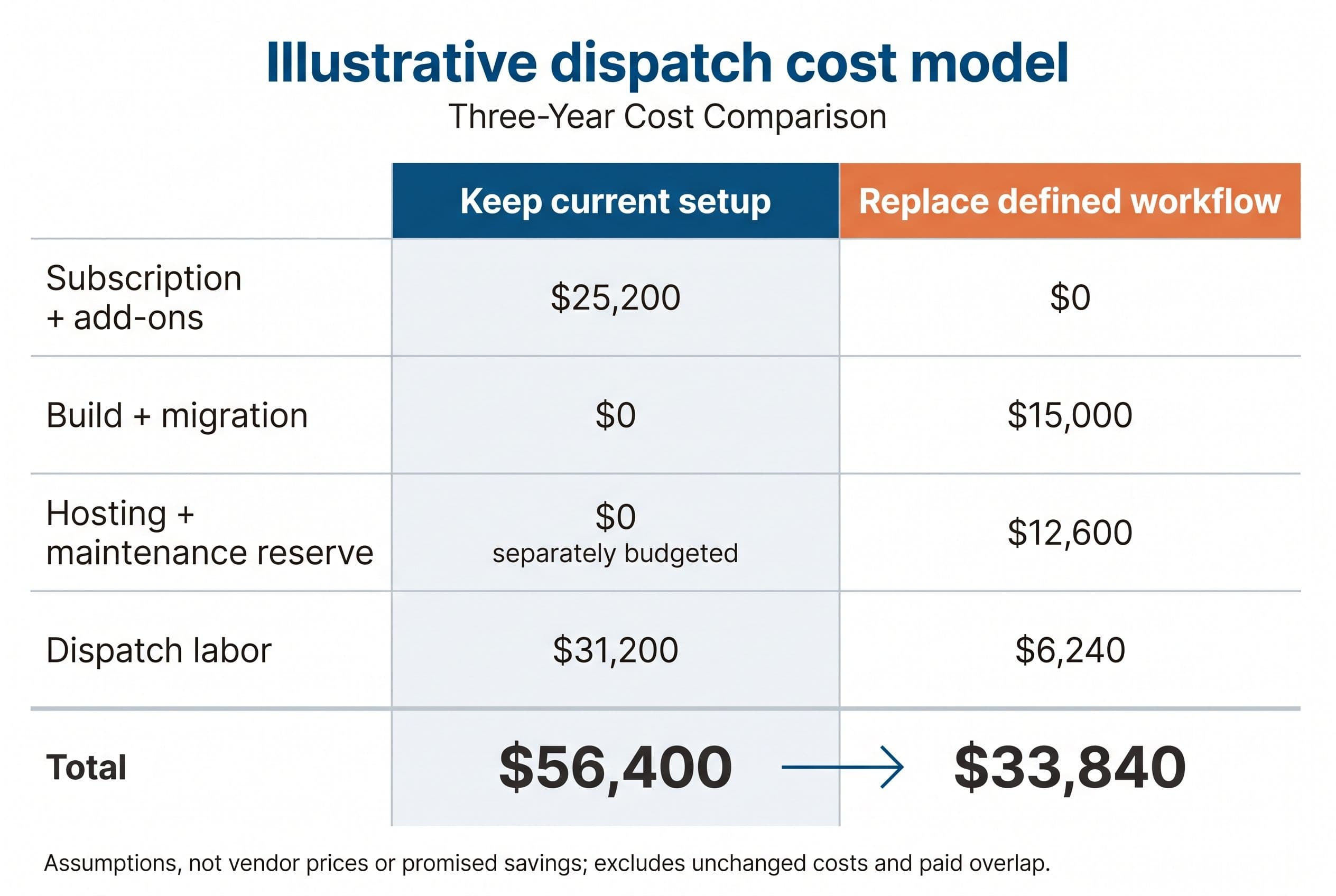
Before choosing custom HVAC dispatch software, I'd put keeping the current setup on the same spreadsheet as replacing it.
The following is illustrative arithmetic, not Jobber pricing, a client result, or a quote. Substitute your actual invoices, loaded labor cost, and measured dispatch time. I'm assuming unchanged headcount and no subscription increases.
For the rental side, assume your combined base plan and user charges total $600 a month, with $100 a month in add-ons. Assume the workaround takes five hours a week at a loaded internal labor cost of $40 an hour.
For the replacement, assume a $15,000 fixed build including a defined migration. Separately, allow $100 a month for third-party hosting and infrastructure and an owner-held maintenance reserve of $3,000 a year. Neither operating allowance is a published BuiltInWeeks service price.
| Three-year cost item | Keep current setup | Replace the defined workflow |
|---|---|---|
| Base subscription and user charges | $21,600 | $0 for the replaced subscription |
| Subscription add-ons | $3,600 | $0 for replaced add-ons |
| Build and agreed migration | $0 | $15,000 |
| Third-party hosting allowance | Included in subscription assumption | $3,600 |
| Maintenance reserve | No separate reserve assumed | $9,000 |
| Dispatch administration | $31,200 | $6,240 |
| Three-year total | $56,400 | $33,840 |
The replacement column assumes dispatch administration falls from five hours to one hour a week, across 156 weeks. That's an assumption to test, not a result I'm promising. It produces a modeled difference of $22,560.
Here's the damaging part of the math: without valuing staff time, the current subscriptions total $25,200, while the replacement's build and operating allowances total $27,600. On cash expenses alone, renting wins in this example.
I wouldn't hire me for this if your bill is too small to recover the build cost, your workflow already works, or your business depends on an ecosystem you can't leave. Staying with SaaS is the right decision in those cases.
Recovered employee hours aren't automatically cash savings, either. I'd count them separately unless they reduce overtime, avoid a hire, or create usable capacity.
An extension also keeps the existing subscription bill. Migration overlap, retained services, payment processing, and messaging charges belong in your actual worksheet; this simplified replacement example excludes costs assumed unchanged and assumes no paid overlap.
For a wider comparison, my breakdown of field-service build-versus-buy costs by team size helps separate subscription savings from operational savings.
Test agreement visits and credentials before comparing calendars
I'd make these two workflows the acceptance test for any Jobber alternative for HVAC contractors. They're specific enough to expose a weak replacement before you commit.
Maintenance agreements need obligations, not just repeating appointments
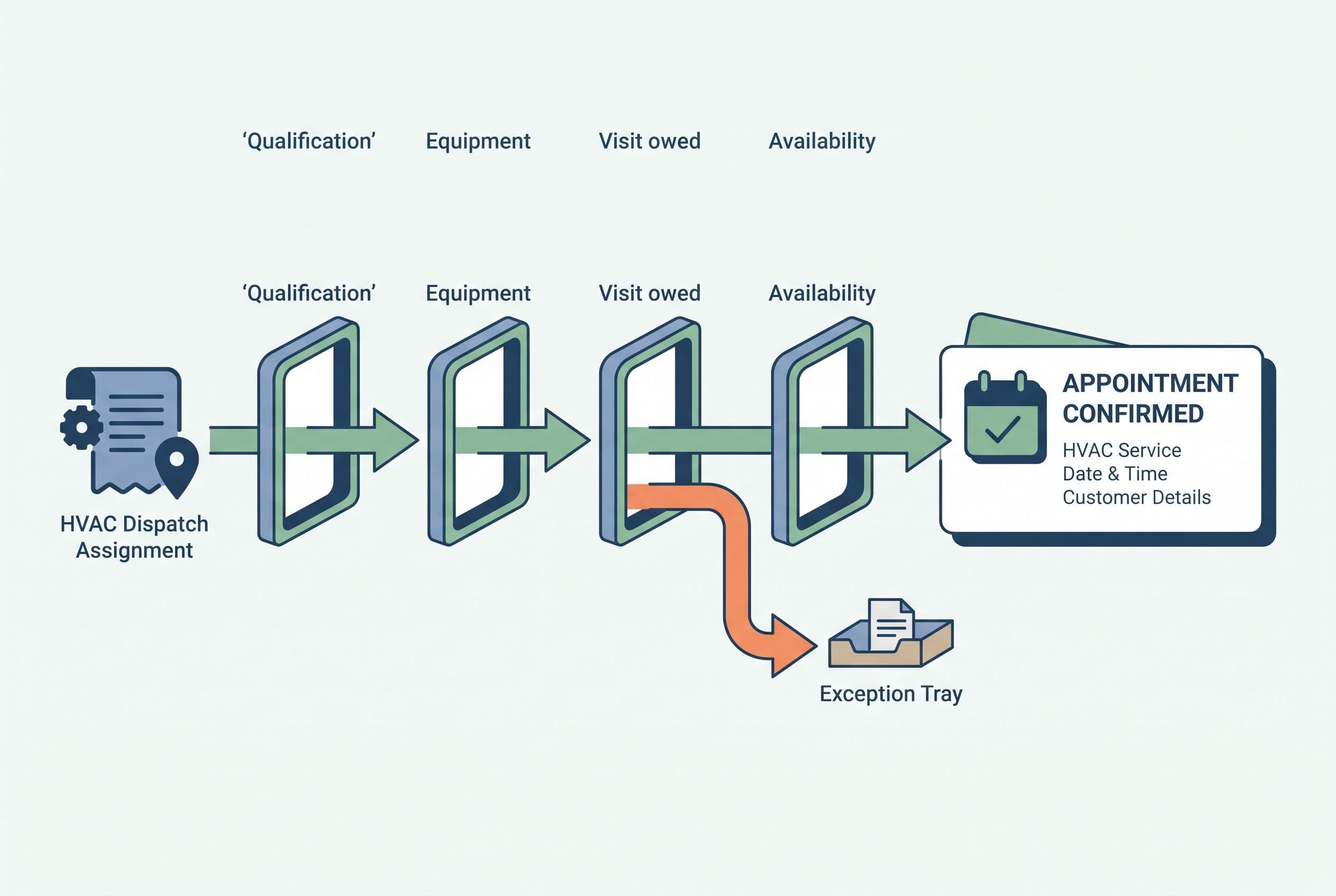
For HVAC maintenance agreement scheduling, I'd want the software to distinguish an agreement, a covered asset, a visit owed, and a booked appointment.
Otherwise, rescheduling an appointment can muddy whether the contractual visit was completed. Canceling a booking shouldn't silently erase an obligation.
My checklist would include:
- Each agreement identifies the covered locations and equipment.
- Visit obligations have due windows and completion status.
- Rescheduling preserves the original obligation and its history.
- A dispatcher can see overdue, unbooked, and completed visits separately.
- Renewal or cancellation follows an explicit rule for future obligations.
I'd test messy cases: a customer with multiple systems, a replaced unit, a canceled appointment, and an agreement that ends before the next planned visit. These are proposed tests, not claims about what Jobber currently supports.
Qualification checks need dates and override rules
For technician certification scheduling, I'd store the credential type, verification status, expiration date where applicable, and the work categories it permits under your business rules.
Then I'd check eligibility on the scheduled service date, not only when someone creates the appointment. A credential valid today may expire before the job happens.
I'd separate legal requirements from company preferences. An EPA Section 608 credential isn't interchangeable with manufacturer training or your own approved-skills list; the responsible person in your business needs to confirm which requirements apply to each job.
Software can enforce the rules you've approved. It shouldn't invent them.
I'd also define which conflicts block assignment and which merely warn. If dispatch can bypass everything without a recorded reason, the qualification check is decoration.
Choose between repairing, extending, and replacing dispatch
Once the failures and costs are clear, I'd compare three paths. Not twenty apps with different-colored calendars.
| Path | I'd choose it when | What can disqualify it |
|---|---|---|
| Reconfigure the current system | Existing capabilities can handle the agreed rules | A required rule still can't be enforced after a live test |
| Add a focused dispatch layer | Customer records and billing work; scheduling is the gap | Required data isn't available reliably through supported access |
| Replace the defined workflow | Dispatch failures and subscription costs justify ownership | Essential surrounding workflows make the scope too large |
For an extension, I'd verify supported API access, API rate limits, available webhooks, and write permissions before promising integration. None should be assumed for your Jobber account.
I'd assign one source of truth for each record. If both systems can independently change appointment status, I'd define conflict handling before wiring them together.
QuickBooks may remain the accounting system while the custom app handles eligibility and agreement visits. I'd rather preserve working accounting than rebuild it just to claim you have an all-in-one platform.
A larger packaged system is another legitimate option. If you're considering that route, my breakdown of ServiceTitan's subscription and implementation costs helps frame the buying questions. I'd still require a demonstration using your failed dispatch cases, not a salesperson's clean sample account.
I use the same workflow-first approach in what custom software looks like in your industry. The industry label matters less than the operating rules the software must actually carry.
Ship the assignment rules before rebuilding the back office
For the common case—a working customer and billing system with dispatch gaps—I'd scope a narrow first release.
My starting point would be eligibility, agreement obligations, and an exception queue. Route planning, inventory purchasing, payroll, and a customer portal wouldn't automatically join the project.
Here's how I'd move it toward production:
- Write the acceptance cases. Define an allowed assignment, a blocked assignment, an expired qualification, a rescheduled agreement visit, and an authorized override.
- Inspect exports and integration access. Confirm that customers, locations, equipment, and agreement records can be extracted or accessed in usable form.
- Build the rule model. I'd consider React for the interface and Postgres for structured records, with explicit relationships between technicians, qualifications, assets, and visits.
- Test in a staging environment. Run representative cases without changing the live dispatch board. Include failed updates and duplicate submissions, not just the happy path.
- Reconcile the migration. Check record counts, relationships, active obligations, and exceptions against the agreed source data.
- Cut over with a rollback plan. Name who makes the go-live decision and how dispatch continues if a critical problem appears.
I use AI-assisted development to ship production software in weeks, but that doesn't remove the need to test permissions, scheduling logic, and failed integrations.
For this kind of bounded multi-feature build, I'd assess the medium range of $5,000–$15,000 in 2–4 weeks. If it requires real-time coordination and complex rules, I'd assess the advanced range of $10,000–$20,000 in 4–6 weeks. A full suite replacement may need a smaller first scope rather than a fictional promise that everything fits.
Your planned involvement is a scoping call, a short weekly review, and a final test pass with whoever actually dispatches. You'll also need to supply data access and resolve business-rule questions; I won't pretend those decisions make themselves.
Hand over dispatch rules, not a wish list of screens
To quote a Jobber alternative for HVAC contractors, I'd want a compact decision packet:
- Your subscription invoice, including seats and add-ons.
- The dispatch spreadsheet with sensitive information removed.
- Examples of assignments that needed manual correction.
- Agreement terms and the rules for visits owed.
- Qualification categories and who approves them.
- A list of systems that must stay connected.
- Sample exports and known data-access restrictions.
- The person authorized to approve scheduling behavior.
That's more useful than a long list of screens. It tells me what the software has to decide and what it must never do.
I quote a fixed price for the agreed scope. Overruns on that scope are my problem, not yours. New scope gets a separate decision, rather than disappearing into hourly billing that rewards slow work.
The code lives in your own repo from day one. The contract transfers ownership of the custom code and source on final payment; I retain only generic reusable components, and third-party libraries and services retain their own license terms.
With the source and handoff documentation, any developer can take over. That's what I mean by owned field service software—not a different platform holding your operation hostage.
There's no reason to pay for months of discovery just to learn whether the budget is plausible. My free project estimator has no email wall, no discovery call before a number, and no sales sequence.
Answer five questions in free project estimator to see the range on screen; send it over if you want a fixed quote within one business day.
Want a real number for your own project?
Answer a few questions and get an instant price range and timeline. No call required, no obligation.
Get your instant estimateTalk through your software project with MattFrequently asked questions
- What's the best Jobber alternative for HVAC contractors with dispatch gaps?
- I'd choose based on the failed scheduling rule, not the size of the feature list. If your current configuration can handle it, keep Jobber; if billing works but dispatch doesn't, consider a focused extension. Replace the workflow only when data access, scope, and three-year costs support it.
- How much does custom HVAC dispatch software cost?
- My published medium-build range is $5,000–$15,000 over 2–4 weeks for multi-feature apps, integrations, and user roles. Advanced builds with real-time features and complex rules are $10,000–$20,000 over 4–6 weeks. I'd quote the agreed dispatch scope, not assume an entire field-service suite fits those ranges.
- Can custom software handle HVAC maintenance agreement scheduling?
- I'd model agreements, covered equipment, visits owed, and appointments as separate records. That lets rescheduling preserve the underlying service obligation. Due windows, renewals, cancellations, and completion rules need to be agreed before the build.
- Can dispatch software check technician certifications before assignment?
- I'd build checks against the required qualification and its validity on the scheduled service date. Your business must confirm the applicable legal requirements and internal skill rules. The software can then block assignments or require a documented override where appropriate.
- Will I own the source code for my HVAC dispatch software?
- The code lives in your repo from day one, and the contract transfers ownership of the custom code and source on final payment. I retain generic reusable components, while third-party libraries and services keep their own license terms. Source access and handoff documentation let another developer take over.
What would software built for your business look like?
Replacing a subscription, fixing software that fell short, or adding AI to your workflow? Talk through the scope with Matt.
Part of these guides
Matt Brody
Founder, BuiltInWeeks
I build custom software for small and mid-sized businesses — the kind you own outright instead of renting by the seat. Fixed price, delivered in weeks, source code handed over at the end.
More about how I workKeep reading

HVAC Business Spreadsheet Workarounds: $5K Asset Log?
A $5,000 HVAC asset log is a reasonable starting scope—not a replacement for your entire field-service platform. I separate the build price from cleanup, hosting, and upkeep, then compare three years of ownership with keeping the subscription.
Read more
Alternative Calendly: Custom Scheduler Costs $2.5K–$20K
I price custom schedulers from $2,500–$20,000 before AI features, but replacing a cheap booking link rarely pays. Here's the arithmetic, the scope that moves the quote, and the recurring costs that don't disappear when you own the code.
Read more
ServiceTitan Pricing in 2026: $245–$500/Tech + Setup
For an illustrative 10-technician business, reported ServiceTitan rates work out to $29,400–$60,000 a year before implementation and extras. I separate that subscription math from the build, migration, hosting, API, and maintenance costs of owning a narrower replacement.
Read more