HVAC Business Spreadsheet Workarounds: $5K Asset Log?

A $5,000 asset log is plausible. Three years costs more.
I'd consider a $5,000 fixed-price build for a narrow HVAC equipment register—not a whole dispatch, invoicing, and service-management system. For HVAC business spreadsheet workarounds, the difference is whether I'm replacing one awkward workflow or rebuilding your business software.
Here's transparent arithmetic for a hypothetical small-team asset log:
- Build and agreed import: $5,000.
- Your migration preparation: $320, assuming eight hours at an internal labor value of $40 an hour.
- Hosting and backups: a planning allowance of $50 a month, or $1,800 over three years.
- Paid external APIs: $0 assumed because this scope doesn't need messaging, payment processing, or another paid integration.
- Maintenance: a planning allowance of $100 a month, or $3,600 over three years—not a BuiltInWeeks maintenance quote.
Three-year ownership budget: $10,720 before everyday staff use. These are illustrative assumptions, not a completed project, provider price list, or promise that every asset log fits this budget.
My published simple-build range is $2,500–$10,000, delivered in 1–2 weeks. A clean, focused register can belong there. Multiple integrations, complicated user roles, and additional workflows can move it into my medium range: $5,000–$15,000 over 2–4 weeks.
The $5,000 question is useful. But I'd settle the scope before treating it as the answer.
What my family's reading app taught me about replacing scattered records
I built a phonics reading app for my own family. My wife and I homeschool our four kids, and we'd already taught two to read when our five-year-old was ready.
The process worked. It was just scattered across more than a thousand pages of books and workbooks, which made consistency harder.
I distilled it into 50 structured lessons, designed for a parent and child together for about 15 minutes a day. I built it in weeks, and my family uses it every day.
This is a real personal project, not an HVAC client case study. I don't have a supplied project price or financial savings figure for it, so I won't manufacture payback math.
The relevant lesson is narrower: I replaced scattered material with one clear path, rather than copying every workbook into a different container.
That's how I'd approach HVAC business spreadsheet workarounds. An app that reproduces every tab, duplicate column, and color-coding convention hasn't fixed the process. It's given the same confusion a login screen.
For an equipment log, the clear path is usually: find the site, identify the unit, read its history, add the visit. Everything outside that path needs to justify its place in the first quote.
The expensive part is deciding which physical unit a row describes
I'd inspect a sample of your HVAC equipment register spreadsheet before choosing the stack. Three variables move the HVAC asset log development budget more than the appearance of the dashboard.
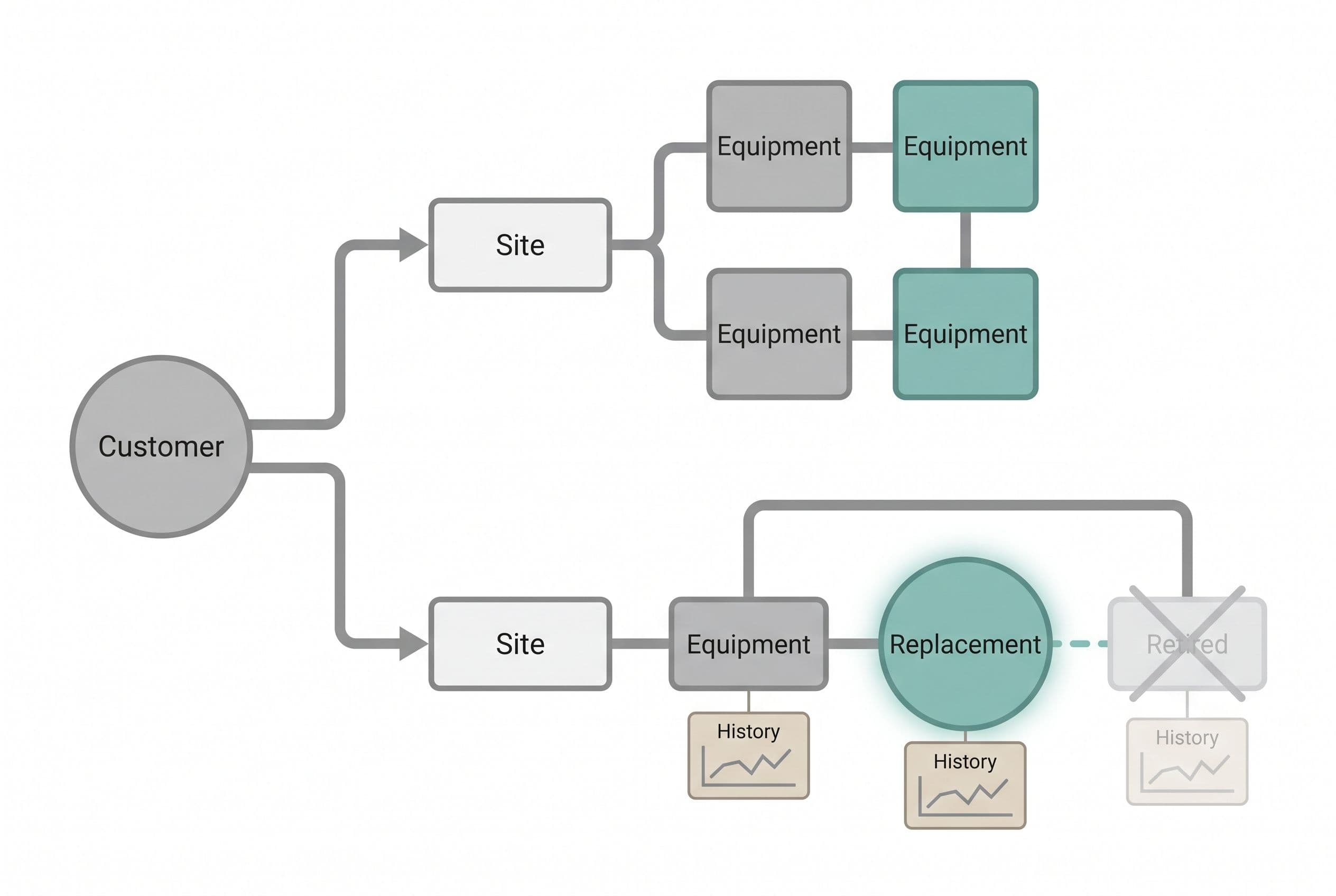
First: equipment identity. A customer can have multiple sites, and a site can have multiple units. Indoor and outdoor equipment may need separate records and a relationship between them.
I'd use an internal asset ID rather than make a serial number the database's only identifier. Missing serial numbers shouldn't stop a technician from recording a visit, and a corrected transcription shouldn't create a new asset.
Second: the quality of the history. Equipment serial number records, visit notes, and invoice descriptions don't necessarily agree. Service history data cleanup means deciding what belongs to which unit—not merely getting a spreadsheet to upload.
I'd preserve the original imported value alongside any corrected value where reconciliation matters. Uncertain records should enter a review queue, not get silently attached to whichever unit looks closest.
Third: field conditions. A mobile-friendly web app with an internet connection is one scope. Offline entry, queued photo uploads, and conflict handling are another.
I'd start with a responsive web app unless offline use is a real requirement. My breakdown of web versus native mobile development costs explains why “technicians use phones” doesn't automatically mean you need an app-store release.
There’s another HVAC-specific trap: replacing a unit mustn't erase the old unit's history. I'd retire the old asset and link the replacement, keeping both attached to the site. Otherwise, the next technician may read service notes for equipment that's no longer there.
Keeping the spreadsheet has a three-year price, too
Before recommending a build, I'd price the status quo. The relevant number isn't your entire software bill if the asset log won't replace that entire product.
For a concrete rental baseline, Maintainly's published pricing lists its Small Business plan at $12 per user per month when billed annually, including unlimited work orders and custom asset fields. Five users would therefore cost $720 annually, or $2,160 over three years at an unchanged rate.
That isn't your bill. It's a supplied, published price used to make the comparison inspectable.
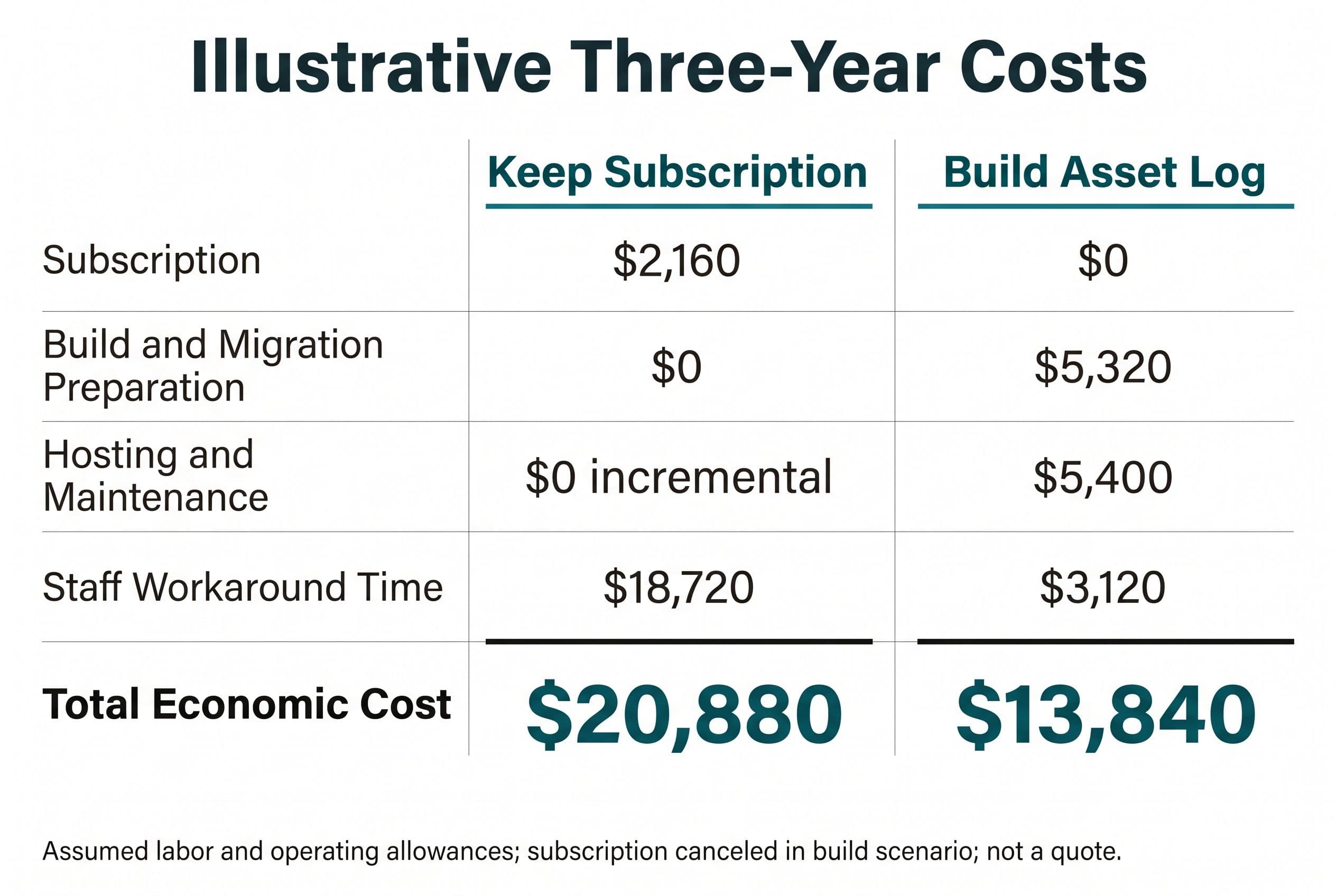
Here's an illustrative scenario, not an HVAC industry average: the team keeps that subscription but spends three hours weekly reconciling spreadsheets and finding equipment history. I value that time at an assumed $40 an hour and use 156 weeks across three years.
For the custom option, I assume the work falls to half an hour weekly. That's a target to test, not an outcome I've proved.
| Three-year cost | Keep subscription and workarounds | Build the narrow asset log |
|---|---|---|
| Subscription: five users at the published annual-billing rate | $2,160 | $0, only if canceled |
| Subscription add-ons | $0 assumed | $0 assumed |
| Build, including agreed import work | $0 | $5,000 illustrative scope |
| Owner-side migration preparation | $0 assumed | $320 assumed |
| Hosting and backups | Included in rental for this comparison | $1,800 allowance |
| Paid external APIs | $0 assumed | $0 assumed |
| Maintenance | Included in rental for this comparison | $3,600 allowance |
| Staff workaround time | $18,720 assumed | $3,120 assumed |
| Total economic cost | $20,880 | $13,840 |
Under those assumptions, the custom option is $7,040 lower over three years. Most of that difference is recovered staff capacity, not cash removed from payroll.
Cash alone tells the opposite story: $2,160 in subscription fees versus $10,400 in build and operating allowances, before valuing your time. That's why I won't sell this on subscription savings alone.
Don't hire me to replace a low-cost product that already handles your workflow. Staying with SaaS wins when the bill is small, the workarounds are minor, or essential integrations mean you can't actually cancel it.
If the real subscription is ServiceTitan, I'd separate the equipment-history problem from dispatch, billing, and everything else you still need. The ServiceTitan cost breakdown helps distinguish a removable expense from one you'll keep; my ServiceTitan alternatives comparison covers the broader replacement decision.
If that subscription stays, its cost belongs in both columns. I won't count imaginary cancellations as savings.
What I'd put inside—and outside—the $5K quote
I'd scope a customer equipment history app around a searchable register, an asset-detail view, and a service-entry form. Shared data relationships underneath those screens matter more than a fancy home page.
Here's how I'd separate the costs rather than bury them in “development.”
| Cost bucket | Proposed first-build boundary | What changes the quote |
|---|---|---|
| Build | Customer, site, equipment, and service records; search; basic access control; CSV export | Separate customer portals, complex permissions, inventory, scheduling |
| Migration | One agreed cleaned import format, validation report, test import, final import | Conflicting sources, undocumented fields, uncertain asset matches |
| Hosting | Web app, database, backups | Attachment volume, recovery requirements, heavier usage |
| APIs | None required for the standalone register | Syncing other systems, SMS, accounting connections |
| Maintenance | Budgeted separately after launch | New features, integration changes, support expectations |
For this kind of app, I'd consider Next.js, TypeScript, and Postgres. The important part isn't the brand list: a relational database can keep customers, sites, equipment, and visits connected without repeating the same address across dozens of rows.
I'd include a usable data export. It should preserve asset IDs and the relationships needed to reconstruct service history, not dump unrelated tables and call that an exit plan.
The illustrative $5,000 build includes only the migration work described in the agreed scope. Your preparation time remains separate. If the source data needs substantial investigation, I'd reduce the initial import or revise the fixed quote before starting—not reveal the cleanup bill at handoff.
API access also needs checking before I quote an integration. Available endpoints, permissions, and API rate limits determine whether “just sync it” is a modest task or a separate piece of work.
A browser-based register beats a miniature field-service suite
The cheapest useful version doesn't do less of everything. It does one job completely.
I'd keep these boundaries firm:
- Keep accounting where it is. An equipment log doesn't need to replace QuickBooks to record a service visit.
- Import structured history first. Old attachments can remain in an agreed archive unless bringing them across is necessary for daily use.
- Make uncertain data visible. I'd rather show “serial number unconfirmed” than present a guessed value as fact.
- Defer customer access. Internal access and customer-facing access involve different permissions and testing.
- Treat offline use as a scope decision. It isn't a switch I'd promise to turn on later for free.
This is where a lot of spreadsheet replacements become expensive: every annoyance elsewhere in the business gets added to the same project.
Market comparisons need that scope distinction. Ortem Technologies' 2026 cost guide puts internal tools and workflow automation at $20,000–$60,000 over 8–16 weeks. Berkeley Blvd.'s 2026 breakdown puts a focused internal tool at $8,000–$25,000.
Those are their published benchmarks, not my prices, and they aren't like-for-like quotes for your register. I'd compare import responsibilities, acceptance tests, integrations, and ownership before comparing totals.
Hourly billing that rewards slow work is a bad fit for a well-bounded asset log. So is a paid discovery phase that produces a slide deck before anyone will discuss a range. I want enough investigation to define the job—not an open-ended invoice for describing it.
For the wider decision, my guide to owning your software instead of renting it explains the obligations that come with replacing a subscription. Owning the code removes one dependency; it doesn't remove upkeep.
From equipment spreadsheet to a tested, transferable asset log
For a simple scope, I'd plan around the published 1–2-week delivery window, with the actual schedule agreed after reviewing the data and requirements. That clock shouldn't quietly assume you've already cleaned records nobody has inspected.
Your involvement is a scoping call, a short weekly review while the build is underway, and a final test pass. Data preparation is additional work when the export needs cleanup; the eight-hour allowance above is an assumption, not a cap.
I'd use your sample records to agree on acceptance tests before building:
- A technician can distinguish similar units at the same site.
- A service entry attaches to the intended asset.
- A retired unit's history remains available after replacement.
- An uncertain imported record stays flagged until someone resolves it.
- An export preserves the connections between equipment and visits.
I'd test those in a staging environment before the final import. Passing them matters more than a polished demo with perfect sample data.
Fixed price means overruns on the agreed scope are my problem, not yours. Extra scope gets a separate decision before I do it.
The code lives in your own repository from day one. The contract transfers ownership of the custom code and source to you on final payment; I keep only generic reusable components, and third-party libraries and services retain their own license terms. With the source and handoff documentation, another developer can take over.
This week, list the three screens your team actually needs for equipment history, then put that list into the free free project estimator for a ninety-second price check: range on screen first, form second, and a fixed quote back inside a business day after you submit the project details.
Want a real number for your own project?
Answer a few questions and get an instant price range and timeline. No call required, no obligation.
Get your instant estimateTalk through your software project with MattFrequently asked questions
- Can I replace HVAC business spreadsheet workarounds with a $5,000 app?
- I'd consider $5,000 for a narrow equipment register with customer and site records, service history, search, and an agreed clean import. Offline operation, complex integrations, and extensive data cleanup can change that scope. My published simple-build range is $2,500–$10,000 over 1–2 weeks.
- What should an HVAC equipment register spreadsheet include before migration?
- I'd identify the customer, site, individual asset, manufacturer, model, serial number where known, and equipment status. Each service record needs a dependable connection to its asset. Missing or uncertain values should remain flagged rather than being guessed during import.
- What ongoing costs does a custom HVAC asset log have?
- I'd budget separately for hosting, backups, maintenance, and any paid APIs. The article uses illustrative allowances of $50 monthly for hosting and $100 monthly for maintenance, not provider prices or a maintenance quote. Actual costs depend on storage, integrations, and support requirements.
- When should an HVAC company keep its existing software?
- I'd keep it when the subscription is inexpensive, equipment history already works well, or essential workflows prevent cancellation. A custom asset log shouldn't get credit for removing a bill you'll still pay. Recovered staff time can support the decision, but it isn't automatically a cash saving.
What would software built for your business look like?
Replacing a subscription, fixing software that fell short, or adding AI to your workflow? Talk through the scope with Matt.
Part of these guides
Matt Brody
Founder, BuiltInWeeks
I build custom software for small and mid-sized businesses — the kind you own outright instead of renting by the seat. Fixed price, delivered in weeks, source code handed over at the end.
More about how I workKeep reading

ServiceTitan Pricing in 2026: $245–$500/Tech + Setup
For an illustrative 10-technician business, reported ServiceTitan rates work out to $29,400–$60,000 a year before implementation and extras. I separate that subscription math from the build, migration, hosting, API, and maintenance costs of owning a narrower replacement.
Read more
Client Management Software for Small Business: DIY Cost
A focused client tracker costs $2,500–$10,000 to have me build; doing it yourself trades cash for your time. I’ll trace one lead-to-follow-up workflow and show where renting, configuring, or owning the software makes financial sense.
Read more
Field Service Management Platforms: What $500/Mo Buys
At $500 a month, I'd compare the entire job-to-payment workflow—not a feature checklist. Here's where renting wins, where custom software earns its keep, and how I'd handle the switch without losing jobs.
Read more