Document Assembly Software: Builder Costs $2.5K–$20K

What I'd charge to turn a change request into a finished document
Custom document assembly software starts at $2,500–$10,000 for a focused build. For a builder who needs user roles, approval routing, and connections to other systems, my published range is $5,000–$15,000, delivered in 2–4 weeks.
That's not a quote for replacing your entire construction management platform. It's a range for replacing a specific piece of work: entering a change once, calculating its price, generating the right document, and getting it through approval without rebuilding it in Word.
Here's how I'd separate the scopes:
| Scope | Fixed-price range | Delivery | What fits |
|---|---|---|---|
| Simple | $2,500–$10,000 | 1–2 weeks | Focused entry form, agreed calculations, document generation, basic change register |
| Medium | $5,000–$15,000 | 2–4 weeks | Multiple features, user roles, approval routing, integrations |
| Advanced | $10,000–$20,000 | 4–6 weeks | Complex rules, real-time features, multi-tenancy |
The ranges overlap because a short feature list can hide difficult rules. One accounting connection with messy data can take more work than several clean document layouts.
I'd apply a 1.25 multiplier to these ranges for builds with AI features. My overall envelope is $2,500–$25,000: the low end is a build without AI, and the high end is an advanced build with it. I wouldn't add AI to calculate contract changes or fill known template fields. Ordinary code is the better tool for repeatable arithmetic.
For a wider budget comparison, I explain what custom software actually costs beyond this particular workflow. Here, I'd keep the discussion on custom change order software cost—not a speculative rebuild of everything your office uses.
The subscription replacement I've actually built
I haven't been given a builder case study to claim here. My relevant experience is replacing expensive subscription software with a focused system the business owns.
I built a custom power dialer in React for a business paying about $30,000 a year for Kixie. The build cost $10,000, a third of the annual licensing it replaced, so it paid for itself in about four months on that licensing comparison.
This is a real, anonymized client project; the annual subscription figure is approximate, and results vary.
The dialer supported unlimited users, custom lead lists, calling up to 10 lines at once, SMS templates, voicemail drops, analytics, and Zapier webhooks for follow-ups and updates. It shipped in weeks, with no monthly licensing fees for the custom software, and the business owned it outright.
The Kixie replacement decision was about paying for the workflow the team needed instead of continuing to rent something that kept getting in its way.
That doesn't prove document assembly software will pay back in four months. It proves why I start with the existing bill and the work being replaced. Hosting, APIs, and maintenance still belong in your calculation; owning code doesn't make operating it free.
Your unchanged change-order process has a three-year price
Before I'd recommend a build, I'd price doing nothing. Not just the subscription. The subscription plus the clerical work it leaves behind.
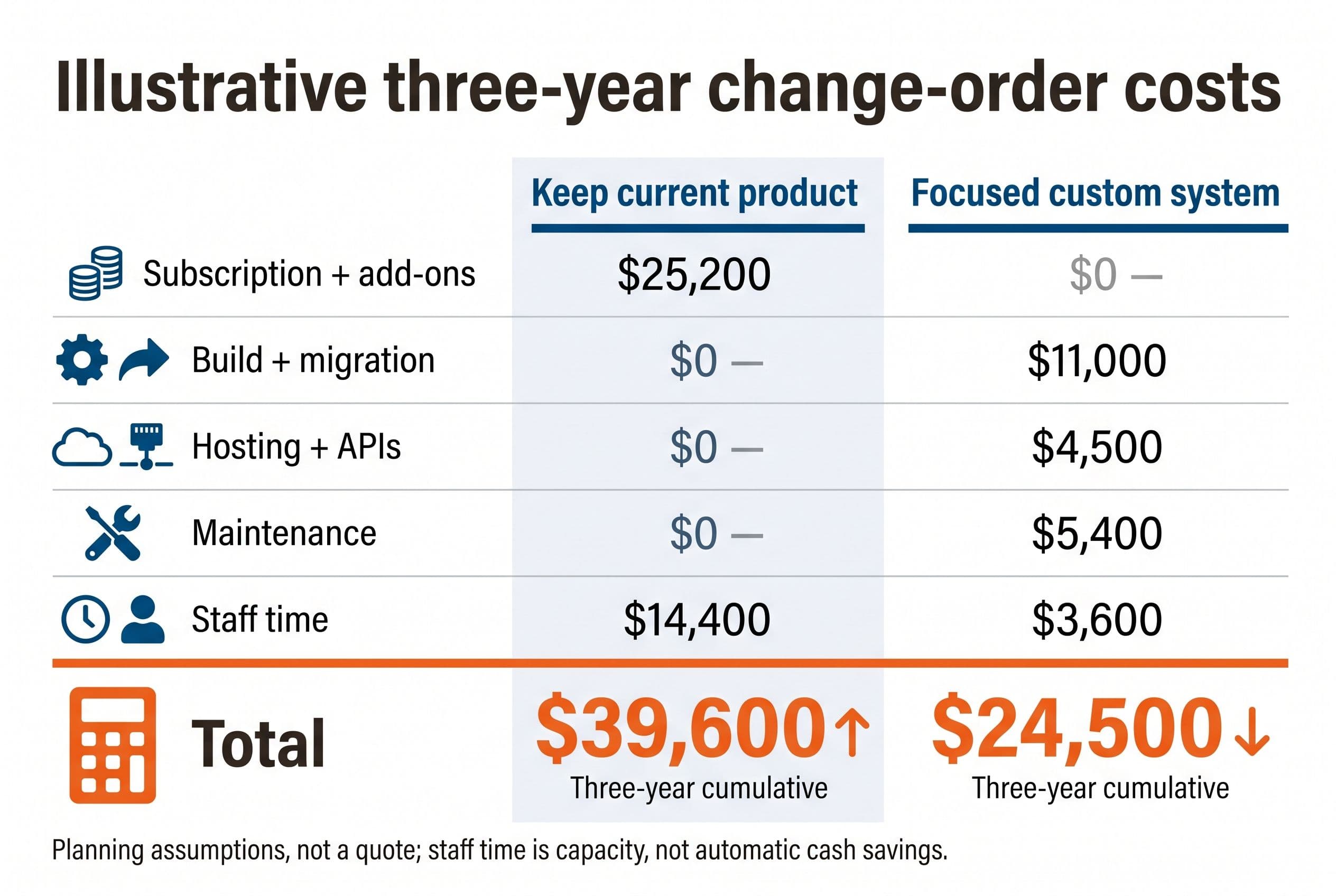
Here's illustrative arithmetic for a U.S. builder—not a client result, a vendor price, or a BuiltInWeeks quote. I'm assuming an unnamed product charges for 12 seats, with add-ons, and that the office spends eight hours a month copying information, rebuilding documents, and chasing status.
For the custom option, I'm assuming a $10,000 medium build, a clean enough export that import tooling fits within that scope, and client-side migration work shown separately.
| Three-year cost | Keep current product | Focused custom system |
|---|---|---|
| Subscription: 12 seats × $50/month × 36 | $21,600 | — |
| Existing product add-ons: $100/month × 36 | $3,600 | — |
| Fixed build, illustrative | — | $10,000 |
| Migration: 20 client staff hours × $50 | — | $1,000 |
| Hosting reserve: $75/month × 36 | — | $2,700 |
| Signature and other API reserve: $50/month × 36 | — | $1,800 |
| Maintenance reserve: $150/month × 36 | — | $5,400 |
| Remaining admin: 8 vs. 2 hours/month × $50 × 36 | $14,400 | $3,600 |
| Total economic cost | $39,600 | $24,500 |
Under those assumptions, the custom route costs $15,100 less over three years. The hosting, API, and maintenance amounts are planning allowances, not published third-party prices or my service rates. They need replacing with actual estimates before a decision.
There's a useful distinction here. Excluding staff time, the existing product costs $25,200 and the custom option costs $19,900. The rest of the difference is recovered staff capacity—not automatically cash back in your bank account.
I'm also assuming flat subscription pricing, no overlap period, and an actual reduction in admin work. If you need both systems during rollout, that overlap gets added. If the old subscription can't be canceled, it doesn't count as savings.
Keep the SaaS if its bill is small, its workflow already fits, or you're tied to an ecosystem this build can't replace. Don't hire me to replace a useful low-cost subscription just because ownership sounds appealing.
For perspective, the supplied SiteStamp pricing is $69.99 a month flat for unlimited users and projects: $2,519.64 over three years before other costs. I wouldn't justify custom document assembly software against that subscription alone.
The same distinction between canceled bills and hoped-for savings drives the three-year replacement math for seat-based software. Per-seat licensing that punishes hiring is worth challenging. A reasonably priced product that does the job isn't the enemy.
Three scope choices move the quote more than PDF formatting
The PDF is usually the visible output. The expensive decisions happen before it exists.
How many rules sit behind each change?
I'd separate construction contract templates from pricing logic. The template controls presentation and approved language; the application calculates quantities, labor, materials, markup, and the resulting totals.
Then come the exceptions. Does markup apply to every cost category? Can a credit follow the same approval path? Does a schedule extension require approval even when the price doesn't change?
Those answers determine whether document assembly software is a focused form or a rules-heavy application. I want them settled before a fixed quote, not discovered after the first live document goes out.
Who can approve which version?
A superintendent submitting a request isn't necessarily authorized to approve its price. An office manager preparing a document isn't necessarily authorized to change contract language.
I'd write those permissions into the scope. Automated change order generation should remove copying, not remove the person responsible for the decision. That's the same boundary I describe in workflows that keep human approval before a quote goes out.
Where does the approved information go?
If QuickBooks needs the result, I'd establish what record we're creating, which account owns it, and how the system handles a failed transfer. API access, rate limits, and supported fields need checking before I promise an integration.
A Postgres database can hold the change register and document versions. It doesn't solve mismatched job identifiers by itself.
I cover that underlying problem in stopping repeated entry across business systems. Builder document automation that creates another disconnected record just moves the typing elsewhere.
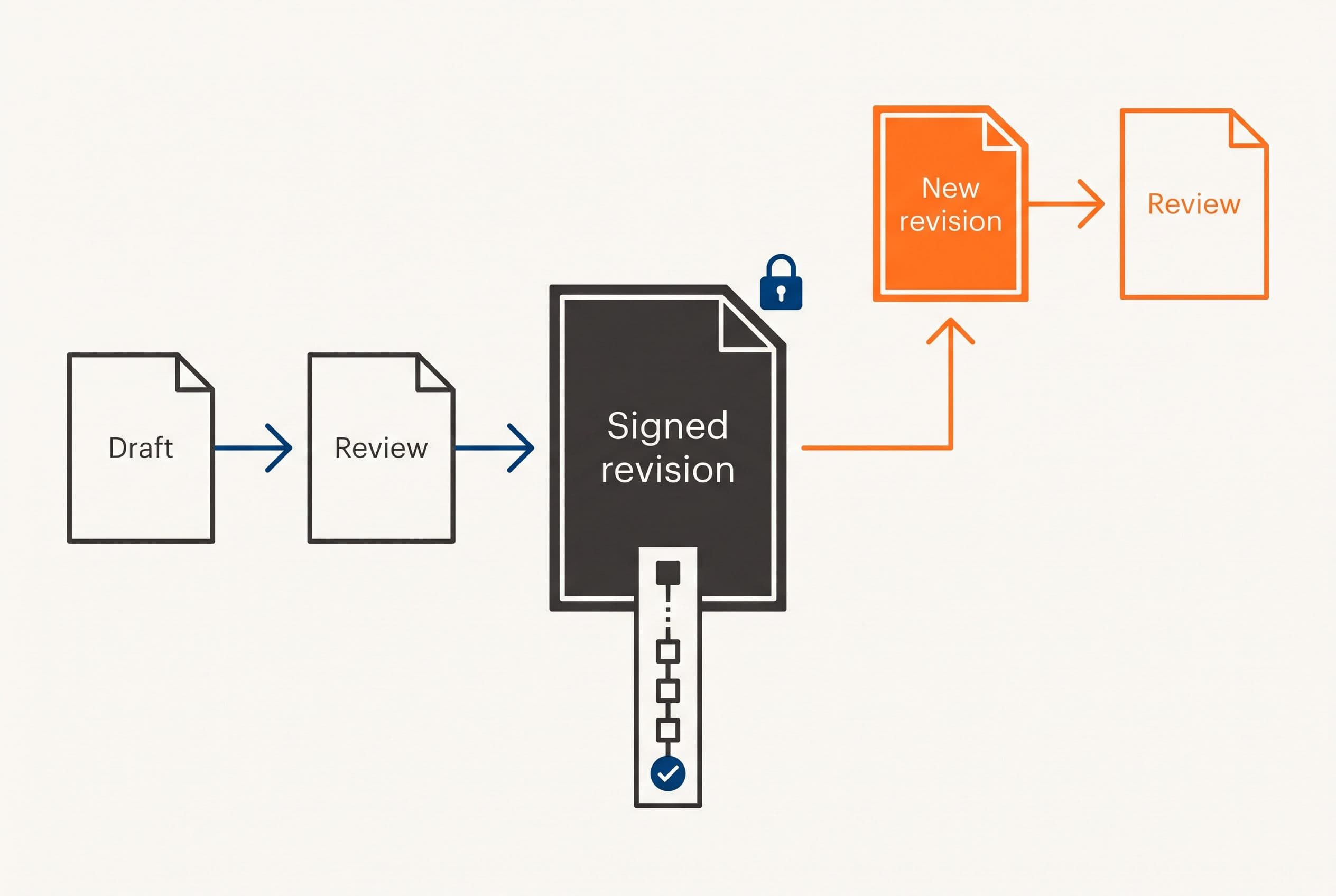
A signature on the wrong revision is still the wrong revision
This is the part of construction change order document software I'd test before polishing the dashboard.
Suppose a change is sent for approval, then somebody edits the quantity. That's a hypothetical, but it's exactly the kind of condition the software needs to handle deliberately.
The signed artifact must stay tied to the version that was approved. I wouldn't let a later edit silently replace it.
My scope would define:
- A stable change identifier and separate revision identifier.
- A frozen copy of the document sent for signature.
- Recorded submission, approval, rejection, and signature events.
- A clear route for superseding an earlier revision.
- A rule for when approved amounts reach the job budget or accounting system.
Electronic signature integration adds more than a button. I'd cover declined requests, expired requests, duplicate callbacks, and the return of the completed document. A webhook reporting completion should update the matching revision, not whichever draft happens to be newest.
I'd also keep an internal approval distinct from a customer's signature. Whether either authorizes work depends on your contract and process—not the color of a status badge.
You provide construction contract templates reviewed by your counsel. I wire up their approved fields and workflow; I don't sell legal drafting disguised as document assembly software.
What belongs in build, migration, hosting, APIs, and maintenance
I'd want these separated in the proposal even if some are included in the fixed build price. A cheap headline with four missing cost categories isn't transparency.
| Line item | What I'd define before signing | What changes the cost |
|---|---|---|
| Build | Screens, calculations, templates, permissions, approval states, acceptance tests | Exceptions, roles, template variation |
| Migration | Import tooling, included records, cleanup owner, reconciliation | Poor exports, attachments, missing identifiers |
| Hosting | Application, database, file storage, backups, monitoring | Usage, storage volume, recovery requirements |
| APIs | Signature service, email delivery, accounting access | Transaction volume, access plans, integration limits |
| Maintenance | Dependency updates, defect handling, monitoring responsibilities | Support coverage and ongoing changes |
For migration, I'd distinguish my import work from your team's cleanup. In the earlier example, import tooling is assumed inside the $10,000 build; the $1,000 migration allowance values staff time. Dirty historical data could change that scope.
I'd make a first release cheaper by importing active jobs and open changes, while keeping older documents in an accessible archive. I'd make it more expensive by demanding that every old attachment become perfectly structured data before anyone can use the new system.
Hosting and API accounts should be visible to you. No mystery platform fee standing between you and your records.
Maintenance also needs a boundary. Fixing something that fails agreed acceptance criteria isn't the same as adding a new approval workflow later. My fixed price means overruns on the agreed scope are my problem, not an invitation to send you more hours.
I use AI-assisted development to ship production software in weeks. I still need a staging environment, source control, and a final test pass; faster implementation isn't a reason to skip them.
What I'd keep, extend, or replace before writing code
I'd check the current product before recommending custom document assembly software. A feature that's already included may be cheaper to configure than recreate.
| Route | Where I'd use it | The trade I'd check |
|---|---|---|
| Keep and configure | Existing change workflow meets the need | Training and setup may solve more than replacement |
| Add a focused document layer | Core job management works, document preparation doesn't | Current subscription remains; API access matters |
| Replace the narrow workflow | Repeated work and cancelable fees justify ownership | You take on operating and maintenance responsibilities |
| Replace the whole platform | Several connected workflows justify the scope | This is no longer just a document project |
Buildertrend's change order offering and Procore's change order tools deserve a capability check if you're already paying for them. The supplied pricing research lists both as requiring a demo for specific pricing, so I won't invent a monthly figure.
If you're considering replacing part of Buildertrend, I'd first separate the troublesome workflow from the features you still depend on. Ripping out useful scheduling and financial processes to fix document generation is a bad trade.
The time between steps matters, too. Rhumbix's 2026 change order tracking article reports 24 days between a signed T&M ticket and request submission with manual processes, versus 3.5 days with digital solutions. That's a reason to measure your handoff delay—not a promise that my build will reproduce those figures.
For outside development quotes, I'd compare deliverables and acceptance criteria rather than the hourly number. Hourly billing that rewards slow work, or months of paid discovery ending in a slide deck, doesn't become a bargain because the rate looks reasonable.
Turn your actual change-order packet into a fixed quote
For the common case, I'd scope one complete path first: request, pricing review, generated document, customer signature, approved register, accounting handoff.
My scoping inputs would be an approved template, a redacted finished change order, the exceptions that alter calculations, the approval roles, and a sample export from the current system. I'd also need the actual subscription invoice and contract terms so we don't count fees you can't stop paying.
Your involvement is a scoping call, a short weekly review, and a final test pass, plus supplying templates and checking your data. I won't pretend migration cleanup takes none of your time.
The code lives in your own repository from day one. The contract transfers ownership of the custom code and source on final payment; I retain only generic reusable components, and third-party libraries and services keep their own license terms. With the source and handoff documentation, any developer can take over.
“I want to know what it'll cost to stop rebuilding every change order—and whether keeping what we have is cheaper.”
Settle that with the free project estimator at free project estimator: five questions, about ninety seconds, and a price range visible before any form. Submit the project details afterward for a fixed quote back within one business day.
Want a real number for your own project?
Answer a few questions and get an instant price range and timeline. No call required, no obligation.
Get your instant estimateTalk through your software project with MattFrequently asked questions
- How much does custom document assembly software cost for builders?
- My focused builds cost $2,500–$10,000 and take 1–2 weeks. Multi-feature systems with user roles and integrations run $5,000–$15,000 over 2–4 weeks; complex rules can put the build in the $10,000–$20,000 advanced range. Migration, hosting, APIs, and maintenance need explicit treatment in the budget.
- Can change order software generate documents and collect electronic signatures?
- I'd scope document generation and electronic signature integration together, including sending requests, tracking status, and storing the completed document. Each signature needs to remain attached to the exact revision sent for approval. Your approved contract language and authorization rules determine the workflow.
- Should I replace Buildertrend or Procore for change order automation?
- I'd first check whether your existing plan and configuration already handle the workflow. If the rest of the platform works, a focused document layer may be a better choice than full replacement. Savings calculations must retain any subscription you still need.
- What ongoing costs remain after buying custom change order software?
- I'd budget for hosting, database and document storage, signature or other API usage, and maintenance. Migration and temporary subscription overlap can also add upfront costs. Owning the custom code removes its per-seat licensing, not the cost of running it.
What would software built for your business look like?
Replacing a subscription, fixing software that fell short, or adding AI to your workflow? Talk through the scope with Matt.
Part of these guides
Matt Brody
Founder, BuiltInWeeks
I build custom software for small and mid-sized businesses — the kind you own outright instead of renting by the seat. Fixed price, delivered in weeks, source code handed over at the end.
More about how I workKeep reading

AI Workflow Automation: Quotes With Human Approval
I'd automate the work around a quote before I'd let AI touch the price. Here's how I'd build inquiry intake, draft preparation, and human approval into a workflow you own—with clear exception handling and payback math.
Read more
Integrated Business Management Software: Dental Costs
I'd budget $5,000–$15,000 for a scoped dental operations app with integrations—not a replacement for your entire clinical system. Here's how I separate the build from migration, hosting, API access and maintenance, then compare it with three more years of renting.
Read more
Business Software Integration: Stop Triple Order Entry
I'd connect the order flow before replacing three working tools. Here's how I decide what owns each field, what happens when a sync fails, and whether the hours saved justify a small custom build.
Read more