Airtable Alternative for Small Business: AI Intake Checks

Replace the intake bottleneck, not every Airtable base
I'd build a focused intake app if your team spends more effort correcting document data and chasing approvals than using it. If Airtable already handles the workflow with little cleanup, I'd keep it.
That's the decision behind an airtable alternative for small business: do you need a different database, or do you need purchase orders to arrive, get checked, and reach the right person without someone babysitting every step?
My first-pass checklist is short:
- Keep Airtable if the records are useful and intake is the only weak spot.
- Add an extraction service if reading attachments is the bottleneck, but routing and approval already work.
- Build a focused replacement if exceptions, permissions, and approval history are scattered across inboxes and automations.
- Don't switch yet if nobody can define what makes a purchase order ready for approval.
For a multi-feature app with integrations and user roles, my published medium-build range is $5,000–$15,000 over 2–4 weeks. AI features multiply the price range by 1.25, making that $6,250–$18,750. Those are scope bands, not a quote for an unseen workflow.
I'd usually scope one document type, one intake channel, a review queue, and one downstream destination first. A replacement for every spreadsheet, accounting process, and supplier portal isn't the same project.
My Airtable replacement options cover the broader choice. Here, I'm concentrating on the part that starts with an attachment and ends with an approved record.
The attachment isn't the workflow
A purchase order can look simple while hiding several different jobs: receiving a file, identifying the supplier, reading line items, checking totals, assigning an approver, and recording what happened.
AI extraction handles only part of that.
A model can return plausible fields even when a scan is unclear. An automation can successfully create a record that shouldn't have been created. A green checkmark on a Zapier run isn't proof that the quantity or delivery address is right.
I'd separate the system into three responsibilities:
- Extraction proposes values. Missing information stays missing instead of becoming a confident guess.
- Application rules check values. Required fields, duplicate checks, and arithmetic don't depend on the model's judgment.
- A person approves the business action. Extracting a purchase order doesn't authorize spending or sending it downstream.
My relevant experience here isn't a claimed purchase-order deployment. It's a web app I built for my own family.
My wife and I homeschool our four kids. We'd already taught two to read, but teaching our five-year-old meant working through more than a thousand pages of books and workbooks. I built a web app that turns that scattered material into 50 structured, 100% phonics lessons, designed for a parent and child together for about 15 minutes a day.
It was built in weeks, and my family uses it every day. This is a real personal project, not a client case study; it doesn't establish document-extraction accuracy or business payback.
The useful connection is scope: I replaced a scattered process with one clear path while keeping the person doing the teaching involved. That's how I'd approach intake, too. Remove the copying and chasing—not the judgment.
For the broader distinction between generated software and production-ready software, I cover building with AI coding tools.
Check where your purchase orders actually get stuck
Before I recommend an Airtable document intake replacement, I'd trace an attachment from arrival to final approval. Not the tidy process diagram. The actual route, including forwarded emails and corrections.
Here's the diagnostic I'd use:
- Arrival: Can staff tell whether an attachment was received, rejected, or never processed?
- Identity: Can the system distinguish a new order from a forwarded copy or revision?
- Extraction: Can the reviewer compare every important field with its source document?
- Validation: Are missing fields, unknown suppliers, and inconsistent totals visibly blocked?
- Approval: Is there a named owner for each pending decision?
- Delivery: Can failed downstream writes be retried without creating another order?
- History: Can someone reconstruct who changed and approved the record?
If arrival is the problem, I'd fix email attachment processing before touching your tables. If extraction is the problem, I'd test representative documents before promising automation. If approvals are the problem, another AI model won't settle who has authority to approve.
There are disqualifying conditions, too. I wouldn't ship automated downstream writes without a duplicate strategy, or promise extraction quality without sample documents. Sensitive files also need an agreed retention policy and a decision about which services may receive them.
A custom document approval workflow needs explicit states: received, needs review, approved, rejected, and delivered. "Someone probably checked it" isn't a state.
If your team also uses the same inbox for customer requests, the ownership and queue questions in deciding whether to build a helpdesk or keep renting one apply here. Intake needs a responsible person, not just another notification.
Put three years of copying next to three years of ownership
I'd price doing nothing before choosing the replacement. Subscription fees are visible. Re-keying line items and chasing missing approvals often aren't.
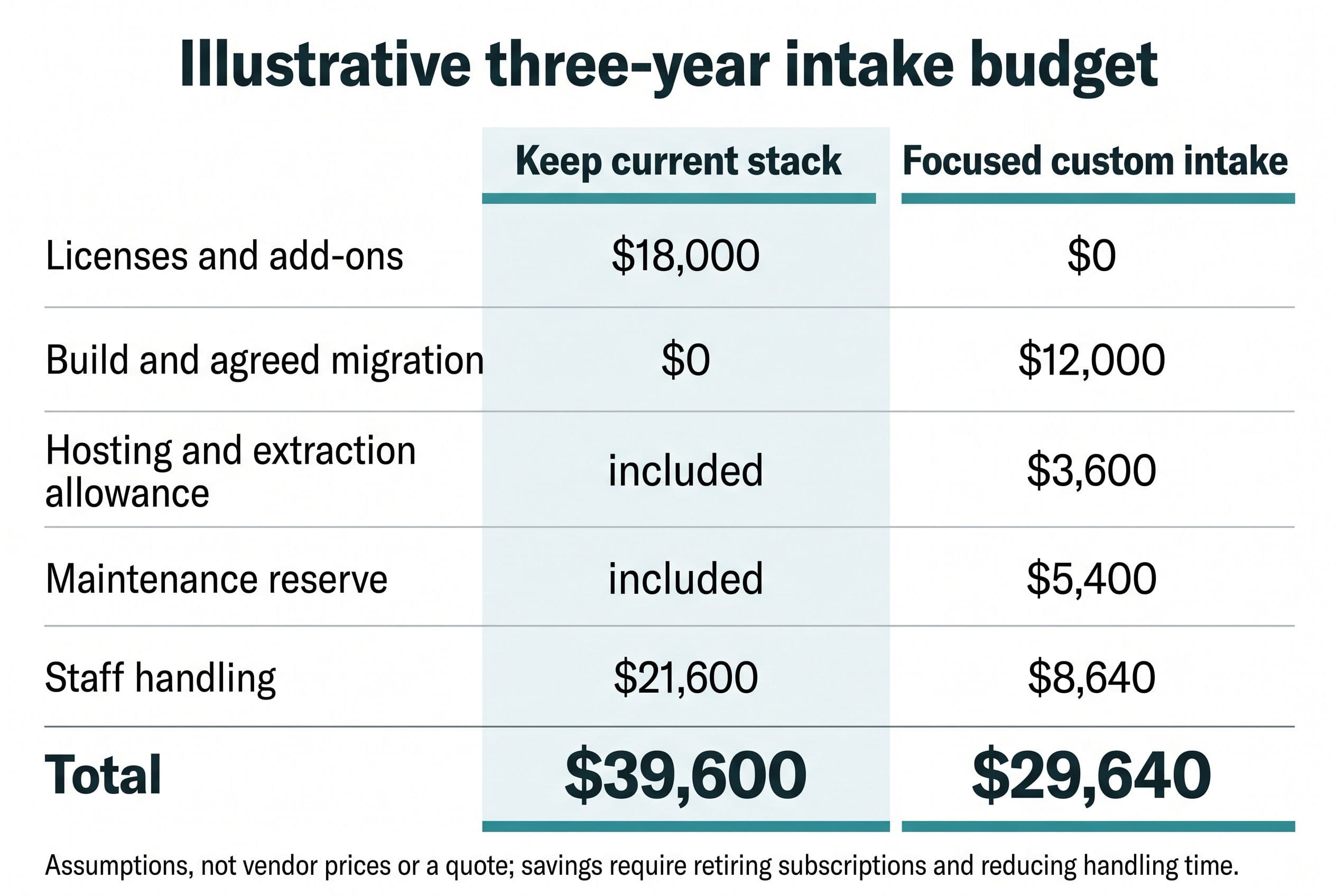
The following is illustrative arithmetic, not a client result, vendor price list, or BuiltInWeeks quote. Substitute your invoices and measured staff time before using it to make a decision.
For the current stack, assume a combined seat-license budget of $400 a month, another $100 a month for add-ons and automation, and 20 staff hours a month at an assumed loaded labor cost of $30 an hour. These are category-level planning assumptions, not published Airtable prices.
For the replacement, assume a $12,000 fixed build with the agreed migration included, a $100 monthly allowance for hosting, storage, and extraction usage, and a $150 monthly reserve for independently purchased maintenance. Those operating allowances aren't quotes from me or any named provider.
I also assume review work drops to eight hours a month. That's a scenario to test, not an AI savings promise.
| Three-year cost | Keep the current stack | Focused custom intake |
|---|---|---|
| Seat-license budget | $14,400 | $0 for the replaced licenses |
| Existing add-ons and automation | $3,600 | $0 for the replaced services |
| Build and agreed migration | $0 | $12,000 |
| Hosting, storage, extraction allowance | Included in assumed stack budget | $3,600 |
| Independent maintenance reserve | Included in assumed stack budget | $5,400 |
| Staff handling and review | $21,600 | $8,640 |
| Total | $39,600 | $29,640 |
The modeled difference is $9,960 over three years. It depends on retiring those subscriptions and actually reducing handling time.
Without labor savings, the replacement costs more in this example: $21,000 against $18,000. Staff time recovered also isn't automatically cash saved; it might mean more capacity rather than a smaller payroll.
Keep the SaaS if its bill is too small for the payback math, its workflow already fits, or you depend on an ecosystem you can't reasonably leave. Don't hire me to rebuild a working base just because custom sounds better.
If you keep Airtable for other departments, count only the licenses and add-ons you can cancel. The same discipline matters in comparing CRM seat costs with owning the code: an invoice you still pay isn't a saving.
I'd also include migration outside the example's agreed scope, parallel running, and unusual support requirements before signing. An attractive spreadsheet isn't a substitute for a complete budget.
Choose between a better front door and a full replacement
An airtable alternative for small business doesn't have to mean ripping Airtable out on launch day. I see three reasonable paths for this problem.
| Path | I'd choose it when | The trade I'd make explicit |
|---|---|---|
| Keep Airtable; repair intake | The base works, but attachments arrive inconsistently | You retain the existing platform and automation dependencies |
| Add a document extraction service | Reading documents is the main burden | Extraction still needs validation, approvals, and exception handling |
| Build a focused intake app | Review, permissions, and routing are the real problem | You take responsibility for operating and maintaining software |
The supplied Nanonets pricing research, dated July 2026, lists a Pro option at $499/month for 5,000 documents. It also lists $999/month for 10,000 pages; documents and pages aren't interchangeable units, so I'd confirm the applicable plan and limits before budgeting.
That can be a sensible purchase if it solves the extraction problem without forcing a broader rebuild. I wouldn't build an extraction engine from scratch just to avoid buying a useful service.
But extraction pricing alone doesn't price an approved order. You still need to account for review time, routing, failed deliveries, storage, and whatever receives the final data.
For custom work, I'd consider Next.js and TypeScript for the application, with Postgres for workflow records. Supabase could provide parts of that infrastructure. Those are implementation choices—not reasons for an owner to buy software.
I'd rather quote a bounded workflow than sell months of discovery that end in a slide deck. Hourly billing that rewards slow work is a bad fit for a clearly scoped intake tool.
Make AI purchase order intake propose, not approve
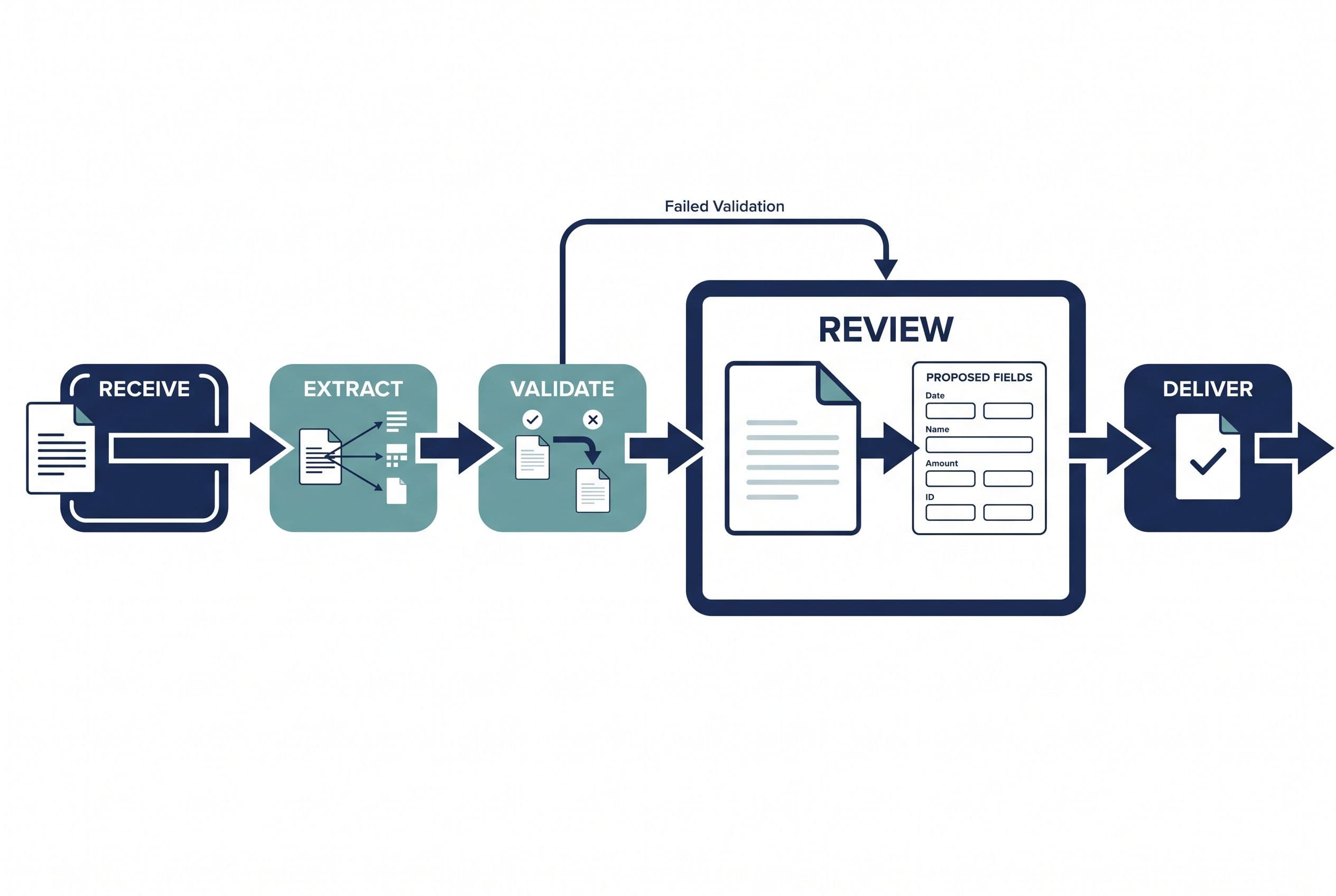
For the common case—attachments arriving by email and somebody copying them into records—I'd build the path in this order.
Receive the document without losing its identity
I would preserve the original attachment and its connection to the incoming message, then create a processing record. Unsupported or damaged files should enter a visible exception queue.
Duplicate protection belongs here. A forwarded copy shouldn't silently create a second order, while a revised purchase order shouldn't disappear as an assumed duplicate.
Extract fields into a draft, not a final order
The extraction output would follow a defined schema: supplier, purchase-order reference, dates, line items, and totals, limited to what your process needs.
I'd treat document content as untrusted input. Instructions embedded in an attachment must not change approval rules, trigger tools, or redirect data. The model reads the document; it doesn't run the business.
Put the source beside the proposed values
Human reviewed data extraction needs an actual review screen. I'd show the original beside editable fields, call attention to missing or inconsistent values, and preserve corrections in the record history.
A confidence score isn't enough. A confidently extracted quantity can still be wrong, and a number that passes arithmetic checks can still belong to the wrong order.
Approve, deliver, and reconcile
Approval would require the appropriate user role. The downstream write—whether to QuickBooks, an internal system, or Airtable during a transition—would happen only after that step.
I'd record delivery status separately from approval status. API rate limits, expired credentials, and failed webhooks need retry behavior and a visible owner, not an email that everyone assumes somebody else handled.
Test ugly attachments before retiring the old base
I wouldn't accept "the demo worked" as a launch test for an Airtable document intake replacement.
The test set needs the files your staff dislike: poor scans, multi-page orders, changed layouts, missing references, forwarded duplicates, and corrected versions. If those aren't available during scoping, extraction remains an open risk.
My launch checklist would include:
- The reviewer can locate the source for important extracted values.
- Missing or contradictory information reaches an exception queue.
- An unauthorized user can't approve or release an order.
- A failed delivery can be retried without duplicating the transaction.
- Original files, corrected values, and approval history can be exported.
- Someone knows how to recover from a failed processing job.
I'd use a staging environment before sending anything to live accounting records. During a controlled transition, the old process stays available until the new path passes the agreed checks.
Your involvement isn't a second job, but it isn't zero. I'd plan for a scoping call, a short weekly review, and a final test pass, with one person available to settle workflow questions and supply representative documents.
That decision-making is part of shipping in weeks. A developer can't responsibly invent your approval policy to keep the calendar moving.
Hand off the intake rules, then get a number without a sales funnel
To turn this into a fixed scope, I'd need sample attachments, required fields, approval rules, destinations, approximate document volume, and a list of exceptions. I'd also need to know what must migrate and what can remain in a read-only archive.
The handoff should include source control, deployment instructions, data export steps, service-account ownership, and instructions for failed jobs. Any developer should be able to take over with the source and handoff documentation.
The code lives in your own repo from day one. The contract transfers ownership of the custom code and source on final payment; I retain only generic reusable components, and third-party libraries and services retain their own license terms.
Fixed price means overruns on the agreed scope are my problem, not yours. A new integration or approval process is a scope change, and I'd price it before building it.
You don't need a sales meeting to find out whether this is remotely affordable. The free project estimator has no email wall, no discovery call before a number, and no sales sequence.
Answer five questions in free project estimator to see your range on screen; send it over for a fixed quote within one business day.
Want a real number for your own project?
Answer a few questions and get an instant price range and timeline. No call required, no obligation.
Get your instant estimateTalk through your software project with MattFrequently asked questions
- What is the best Airtable alternative for a small business processing documents?
- I'd choose based on the bottleneck. Keep Airtable and improve intake if the base works; consider an extraction service if reading attachments is the problem. A focused custom app makes more sense when approval rules, exceptions, and permissions don't fit the current workflow.
- How much does custom AI purchase order intake cost?
- My medium-build range is $5,000–$15,000 over 2–4 weeks, with AI features multiplying the price range by 1.25 to $6,250–$18,750. The fixed quote depends on document formats, integrations, approval rules, and migration. Hosting, extraction usage, and maintenance need separate operating budgets.
- Can AI extract purchase order data from email attachments?
- Yes, but I'd have it create a draft rather than an approved transaction. The application should check required fields and duplicates, then let a reviewer compare proposed values with the original attachment before release.
- Do I need to replace Airtable to automate document intake?
- No. I'd keep Airtable as the destination if its records and reporting still work for your team. A separate intake and review layer can address attachment processing without forcing a full migration.
- Who owns the code in a BuiltInWeeks intake app?
- The code lives in your own repo from day one, and the contract transfers ownership of the custom code and source on final payment. I retain generic reusable components, while third-party libraries and services keep their own license terms. Source access and handoff documentation let another developer take over.
What would software built for your business look like?
Replacing a subscription, fixing software that fell short, or adding AI to your workflow? Talk through the scope with Matt.
Part of these guides
Matt Brody
Founder, BuiltInWeeks
I build custom software for small and mid-sized businesses — the kind you own outright instead of renting by the seat. Fixed price, delivered in weeks, source code handed over at the end.
More about how I workKeep reading

Buildertrend Alternative for Small Remodeler: V1 Scope
I'd replace the change-order bottleneck, not rebuild an entire construction platform. Here's how I'd scope approvals, payment milestones, and a client portal—and check whether replacing Buildertrend pays.
Read more
Zendesk Alternative for Small Business: AI Triage V1
I'd start with AI that sorts support tickets—not AI that sends customers unchecked answers. Here's how I'd scope the workflow, handle failures, and compare three years of subscription costs against a system you own.
Read more
Aircall Alternative for Small Sales Team: Porting Checks
I'd pick the replacement only after checking whether your numbers, routing, and sales workflow can move safely. Here's the checklist I'd use before authorizing a port—and the three-year math that decides whether custom software belongs on your shortlist.
Read more