Cost to Replace GoHighLevel: $10K–$25K, Then the Cutover

You opened the GoHighLevel invoice again and counted the features your team actually uses. Four, maybe five.
When I quote it, a custom GoHighLevel alternative you own costs $10,000–$25,000 and takes 2–6 weeks to build. The build is the easy part. The cutover is the hard part: getting your contacts, conversation history, automations and phone numbers out of a platform that makes leaving harder than staying.
So the real question isn't whether this can be built. It's this one: are you paying for a platform with a hundred features so you can use four of them?
If you are, rebuilding those four and owning them usually beats renting. If your business actually runs on the funnels, memberships, white-label resale and sub-accounts, it usually doesn't. This post helps you work out which one you are before you spend anything.
What a custom GoHighLevel alternative costs: the $10K–$25K buys the slice your team actually opens
Nobody needs to rebuild all of GoHighLevel, and nobody should pay for that. What you're replacing is the part your team lives in, which for most service businesses and sales teams looks like this:
- A contact database and pipeline board
- A two-way SMS and email inbox
- Booking and reminders
- A dozen automations that fire follow-ups
- A dialer, if you do outbound
Here's where a build lands in our fixed-price ranges:
| What you're replacing | Typical scope | Price | Build time |
|---|---|---|---|
| CRM + pipeline + SMS/email inbox + booking for one business | Medium build | $10K–$15K for most | 2–4 weeks |
| The above, plus sub-accounts for multiple clients or locations, complex automation rules, real-time inbox | Advanced build | $15K–$20K | 4–6 weeks |
| Either one, plus AI features (reply drafting, call summaries, lead scoring) | About a quarter on top of either range | Up to $25K | Add about a week |
Why your number lands where it does: a medium build sits near $10K if you've got one pipeline and clean contacts, and closer to $15K if you need round-robin booking or a messy data cleanup. Advanced starts higher because every client or location needs its own walled-off data.
Traditional agencies bill by the hour and typically quote far higher and far longer than this. I don't have a number I can cite for that, so I won't make one up. Hourly billing rewards slow work. A fixed price makes the delay the builder's problem.
Two terms, up front. The price is fixed for the scope we agree on: if it runs over, that's my cost, not yours. And the code sits in your own repository from day one, with ownership transferring to you on final payment. (More on exactly what you get at handoff further down.)
If you already know roughly what you pay each month, the calculator below puts it next to a one-time build cost, with no form and no call.
Price your stack in two minutes
List the subscriptions you pay for and see what they cost over 3, 5 or 10 years next to owning the software. No email needed to see the number.
The closest thing I've built to what GoHighLevel users live in
I'll be straight: this one's a dialer, not a full GoHighLevel replacement. It's the piece of that stack that does the most work for outbound teams, and it's the closest match I can show you.
One client was paying for Kixie, a sales dialer, at about $30,000 a year. They kept running into its limits: not much room to customize, clunky workflows, and a price that kept going up. In outbound sales, where speed to lead decides everything, the tool was slowing them down. (A real client project. Details generalized, numbers rounded, and results vary.)
I built them a custom power dialer in React. Reps can call one lead at a time or run up to 10 lines at once and only connect when someone actually picks up. It has unlimited users, lead lists you can assign to any rep, built-in automations plus Zapier webhooks, SMS with pre-built templates, one-click voicemail drops, missed calls and messages in one place, and real analytics on connect rates and rep performance.
The build cost $10,000. That's a third of one year of the Kixie bill, so on the headline numbers it paid for itself in about four months. That's before upkeep and hosting (and calling usage, which you pay either way). Add those in and break-even moves out a bit, but it still lands well inside the first year, and there's no monthly licensing after that. That's the kind of payback I'm looking for when someone asks about leaving GoHighLevel. (If outbound calling is your main use, the Kixie alternatives breakdown covers the dialer side in more depth.)
Your GoHighLevel bill is bigger than the plan price
To be fair to GoHighLevel: its core plans aren't priced per seat the way most CRMs are, so the usual argument about seat creep doesn't apply here the same way. Check your own plan on GoHighLevel's pricing page, because plans change. If seat-priced CRMs are what you're comparing against, I've written up how seat costs add up against owning your code separately.
Check your invoice, but the GoHighLevel price per month you actually pay usually has three layers:
- The platform fee. It's tiered, and the higher tiers are built for agencies.
- Usage on top. Look for phone, SMS, email and AI line items. That's where the bill creeps past the plan price.
- The bolt-ons. Zapier, a separate dialer, a scheduling tool, or a contractor who untangles workflows every few months.
Add all three for the last three months and divide by three. That monthly figure is what you're comparing a build against, and it's usually higher than the plan price owners remember. Plug it into the calculator up top and you'll see where you land.
Seven checks before you spend a dollar on a GoHighLevel replacement
Go through these in order. Any one of the first three can end the conversation, and that's the point of doing them first.
- Do you resell GoHighLevel to your own clients? If you run its white-label SaaS mode for dozens of sub-accounts, replacing it means you become the platform vendor: billing, onboarding, support, uptime, for every client. That's a product company, not a $25K build.
- Do client websites, funnels or memberships run on it? Each of those is a separate migration with its own hosting and SEO risk. Keep them out of scope, or keep paying for them.
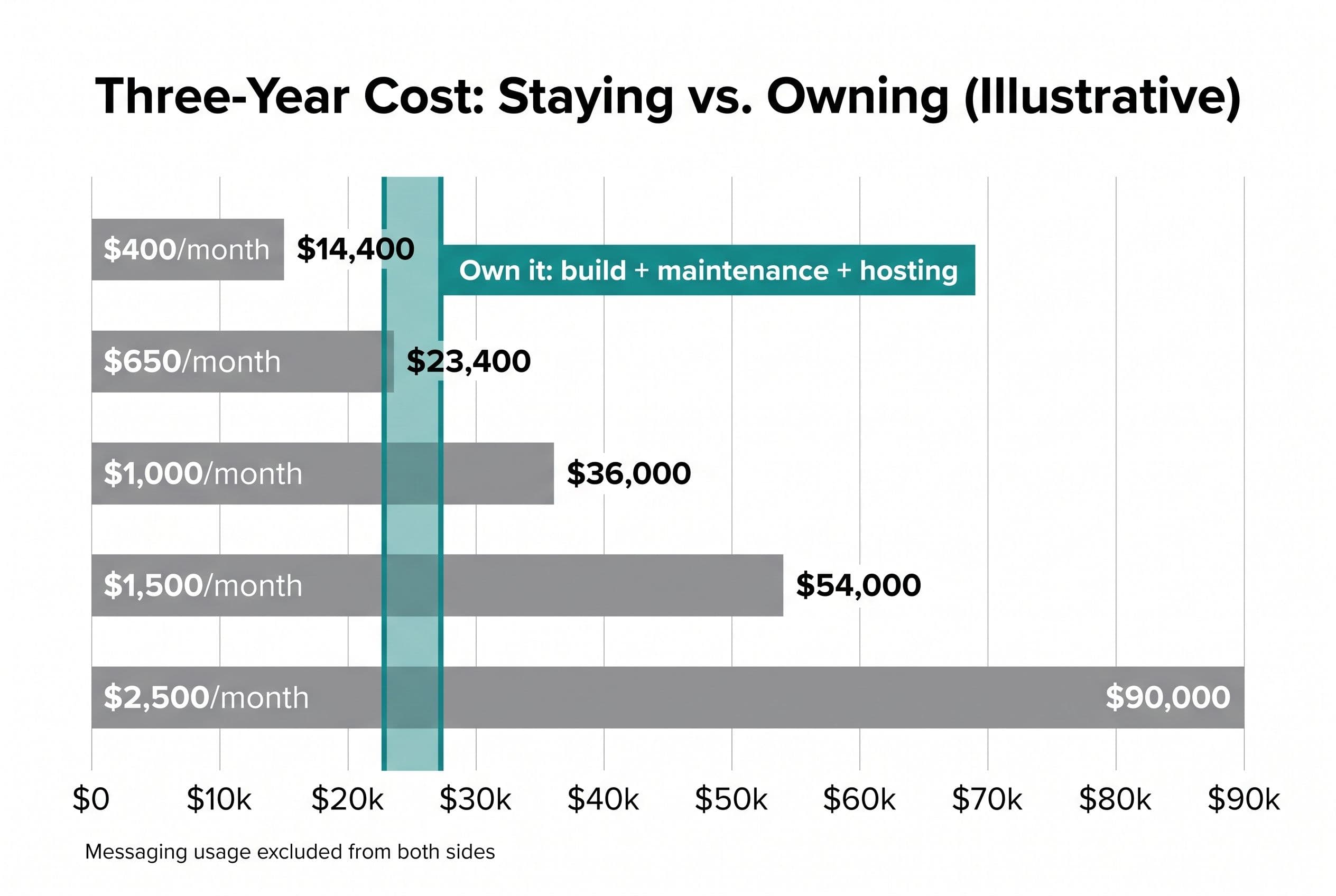
- Is your all-in bill large enough for the payback math? See the three-year table below. Under roughly $650 a month all-in, the numbers usually don't work.
- Can you name the three screens your team lives in? If you can't, nobody can scope the build. Whoever quotes you either guesses or bills you for a "discovery phase" that ends in a slide deck.
- Do you know what you can export? Most people don't until they try, and it's less than they expect. More on that below.
- Who controls your phone numbers? If your business lines live inside the platform, porting them out needs its own timeline.
- Can someone give this one scoping call and 30 minutes a week? That's all I need from you. If nobody has even that, wait.
I'll say it directly, because it saves us both a call. If you're an agency whose revenue depends on reselling GoHighLevel's white-label, or you want a developer embedded with your team for years shipping features every sprint, I'm the wrong hire. What I do is fixed-scope builds you take ownership of, and neither of those fits that.
Where the money goes in a GoHighLevel migration build
My default stack is Next.js and TypeScript on the front end, Postgres through Supabase for the data, Twilio for SMS and voice, SendGrid for email, and Stripe if you take payments. It's all standard, documented tooling that any competent developer can pick up later.
| Piece | What it replaces | What pushes the price up |
|---|---|---|
| Contacts + pipeline | GHL contacts and opportunities | Custom fields per pipeline, duplicate merging during import |
| Unified inbox | Conversations tab | Real-time updates, multiple numbers per user |
| Booking | Calendars | Round-robin across staff, multi-location rules |
| Automations | Workflows | Branching logic, wait steps, many triggers |
| Dialer | Built-in calling | Multi-line power dialing, voicemail drops |
| Data import | The export you'll fight for | Messy history, several sub-accounts merged into one |
| Handoff | Nothing; you never had code | It's included either way |
What keeps it near $10K: one business, one pipeline, automations you can write on a single page, and contacts that come over clean.
What pushes it toward $20K–$25K: multi-tenancy (sub-accounts), complicated workflow branching, real-time features, or AI on top. Not knowing the scope pushes it up too, which is why the checklist comes first.
Three years of staying vs. three years of owning
This is where you decide, so here's the math. The subscription figures below are illustrative, not GoHighLevel's list prices. Put your own all-in monthly number from the section above into the table.
I've left SMS, calling and email-sending usage out of both columns. You pay carrier and messaging usage either way, whether it runs through GoHighLevel or straight through Twilio. The rates won't match exactly, so look at your own usage lines, but I'm not counting it for either side.
Owning it (illustrative $15K build):
- Build: $15,000, one time
- Maintenance: I plan on roughly 15–25% of the build cost a year for upkeep. That's my planning assumption, not a published benchmark, so swap in your own figure if you've got one. At 15–25%, it's $2,250–$3,750 a year, or $6,750–$11,250 over three years
- Hosting and email, priced for the stack above: a basic app server for the Next.js side runs about $13/month on Azure's B1 plan, Supabase's Pro plan for the database is about $25/month, and SendGrid's Essentials plan starts at $19.95/month for 50,000 emails. That's roughly $58 a month, or about $2,100 over 36 months. Add Twilio number fees and a little headroom and call it about $2,100–$2,500. Check those pricing pages yourself; they move.
- Three-year total: roughly $24,000–$29,000
Staying (your all-in bill, illustrative):
| All-in monthly (platform + add-ons + bolt-ons) | 3-year cost of staying | 3-year cost of owning | Verdict |
|---|---|---|---|
| $400 | $14,400 | ~$24K–$29K | Keep renting |
| $650 | $23,400 | ~$24K–$29K | Roughly even, so keep renting |
| $1,000 | $36,000 | ~$24K–$29K | Owning wins by ~$7K–$12K |
| $1,500 | $54,000 | ~$24K–$29K | Owning wins by ~$25K–$30K |
| $2,500 | $90,000 | ~$24K–$29K | Owning wins by ~$61K–$66K |
That table assumes the subscription price never goes up and your needs never grow past your plan. You can decide how likely that is.
Here's when staying wins: your all-in bill is under about $650 a month, or you depend on the funnel builder, website hosting and white-label resale, which no $25K build should try to recreate. In either case, keep paying GoHighLevel and put the money somewhere else. The same reasoning applies to every platform, and I go through it more broadly in the guide to owning your software instead of renting it.
If you're above that line, the bill itself tells you whether the move pays off. The estimator at the end is the fastest way to check. If you'd rather I read the invoice myself, send it over.
Send us your software bill
Bring what you pay today. We'll tell you plainly whether a replacement would pay for itself, or whether you should keep renting.
What GoHighLevel lets you take with you, and what it keeps
This is where most GoHighLevel migrations go wrong, and it isn't the build. It's assuming the export button gives you everything.
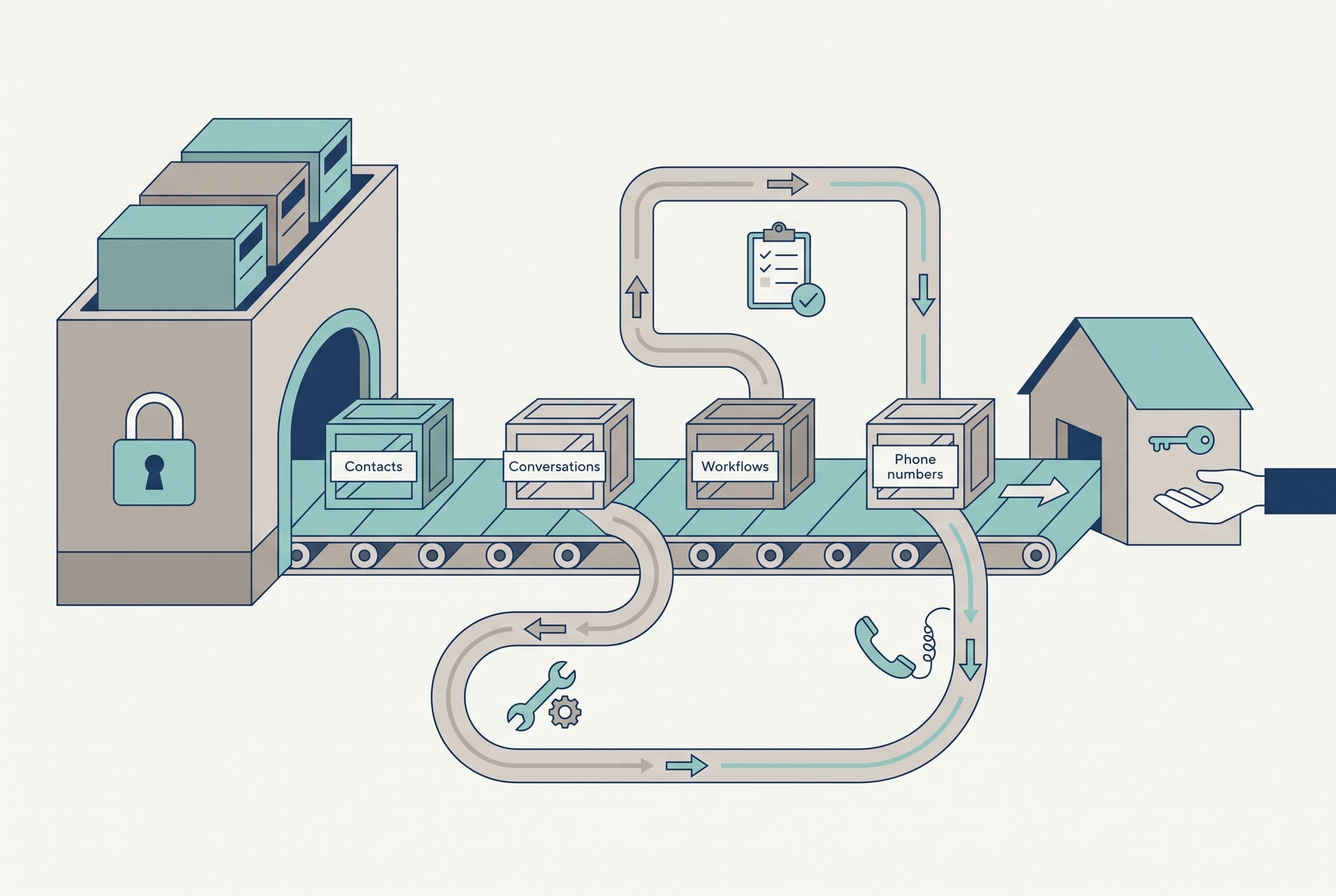
According to ExportGHL's documentation of the platform's export limits, the native contact CSV includes only the latest note, cut off at 255 characters. It leaves out conversation history, tasks and automation history. Workflows can't be exported to another CRM at all.
Here's what that means for you in practice:
- Export the contact CSV first anyway. It's your baseline and it proves your contact count.
- Pull everything else through the API. Full notes, conversation threads and opportunity history have to be extracted programmatically and mapped into the new Postgres database. I scope that as its own line item, because it is one.
- Document every workflow by hand. Record the trigger, conditions, waits and actions, or screenshot each step. You'll rebuild them as logic, not import them as files. Expect to find some workflows nobody uses anymore once you write them down. Those don't get rebuilt.
- Decide how much history you need. Do you need five years of SMS threads searchable in the new system, or a read-only archive you check twice a year? Archives cost far less. It's the same problem as leaving a helpdesk, and I walk through how to price the archive separately from the live system there.
- Start phone porting in week one. Carriers set that timeline, not developers. Go through these porting checks before you switch phone systems before you set a go-live date.
- File your A2P 10DLC registration in week one too. Business texting in the U.S. through your own Twilio account needs a registered brand and campaign, and carrier approval, not development, decides when SMS can go live. It runs separately from the port, so file both at once.
If you're still weighing other platforms instead of a build, here's a side-by-side of GoHighLevel alternatives. The export problem above applies whichever way you go.
The cutover, week by week
This is a typical 4-week schedule for a single-business replacement. Multi-tenant builds stretch the middle.
| Week | What I'm doing | What you're doing |
|---|---|---|
| 0 | Scoping call, fixed quote | One call, about an hour |
| 1 | Core app, database, API data pull into a staging environment; porting request and A2P 10DLC registration filed | Hand over the export and workflow notes |
| 2 | Inbox, booking, automations rebuilt | 30-minute review |
| 3 | Real-data testing, Twilio numbers wired up, parallel run starts | 30-minute review; a couple of reps try it |
| 4 | Final import delta, go live, handoff documentation | Final test pass, then flip the switch |
The port is the one date neither of us controls. If it hasn't landed by week 4, go-live doesn't wait on it: your GoHighLevel numbers forward to the new Twilio numbers, or the parallel run keeps going until the port completes.
Keep GoHighLevel running through one more billing cycle after go-live. Nothing should run in it. It's your safety net while you confirm nothing got lost. Then cancel.
On risk: the price is fixed for the scope we agree on, so if it runs over, that's my cost, not yours. If you want something added mid-build, I quote that change before I build it, so there are no surprises on the invoice. The code is in your own repository from day one. On final payment, the contract transfers ownership of the custom code and source to you. I keep only my generic reusable components, and third-party libraries and services like Twilio and Stripe keep their own license terms. The Twilio, hosting, SendGrid and Stripe accounts sit in your name, and the credentials come with the handoff documentation. With all of that, any developer can take it over. Nobody can hold your data hostage again, including me.
For the bigger picture on how fixed quotes are built and what changes them, there's the guide to what custom software actually costs.
Your one move this week
Do one thing, and don't start with a vendor call. Pull your last three months of GoHighLevel invoices plus every bolt-on charge, add them up, write down the three screens your team actually works in, and put those into the free project estimator. The prep takes about twenty minutes and answers most of the checklist above.
The estimator itself takes about ninety seconds, shows you the price range on screen before it asks who you are, and if you want a firm number, you get a fixed quote back within one business day. You'll know whether you're in keep-renting territory or own-it territory before you've talked to anyone.
P.S. If your team mostly uses GoHighLevel for calling and texting, scope just that piece first. The dialer build above paid for itself in months, not years. Pay back the most-used piece first and decide on the rest later.
Want a real number for your own project?
Answer a few questions and get an instant price range and timeline. No call required, no obligation.
Get your instant estimateTalk through your software project with MattFrequently asked questions
- How much does it cost to replace GoHighLevel?
- A custom replacement for the parts of GoHighLevel most businesses actually use (CRM, pipeline, SMS and email inbox, booking, automations) typically runs $10,000–$15,000 on a fixed price and takes 2–4 weeks. Multi-tenant builds with sub-accounts or complex automation land at $10,000–$20,000 over 4–6 weeks, and adding AI features can push it toward $25,000.
- Can I export my contacts from GoHighLevel with full history?
- Not through the native CSV. According to ExportGHL's documentation of the platform's limits, the contact export includes only the latest note, cut off at 255 characters, and leaves out conversation history, tasks and automation history. Fuller history has to be pulled programmatically through the API and mapped into the new system.
- Can GoHighLevel workflows be exported to another CRM?
- No. Workflows can't be exported to another CRM, so they have to be documented by hand (trigger, conditions, waits and actions) and rebuilt as logic in the new system. Most teams find a good share of their workflows are no longer used once they write them down.
- How long does a GoHighLevel migration take?
- A typical single-business migration takes about four weeks: a scoping call, two to three weeks of building and data import in a staging environment, and a short parallel run before go-live. Phone number porting runs on the carrier's timeline, so file that request in week one.
- Is it worth leaving GoHighLevel if my bill is small?
- Usually not. Using illustrative numbers, a custom build plus maintenance and hosting costs roughly $23,000–$27,500 over three years, so if your all-in GoHighLevel bill is under about $650 a month, renting is cheaper. Agencies that resell GoHighLevel's white-label or rely on its funnels and memberships should usually stay too.
What would software built for your business look like?
Replacing a subscription, fixing software that fell short, or adding AI to your workflow? Talk through the scope with Matt.
Part of these guides
Matt Brody
Founder, BuiltInWeeks
I build custom software for small and mid-sized businesses — the kind you own outright instead of renting by the seat. Fixed price, delivered in weeks, source code handed over at the end.
More about how I workKeep reading

Cost to Replace Airtable: $5K–$15K + $40/Mo Hosting
Replacing Airtable with an app you own usually costs $5,000–$15,000, takes 2–4 weeks, and runs about $40 a month to host. For plenty of teams it still doesn't pay back. Here's the seat math, a pre-flight checklist, and the conditions that should keep you renting.
Read more
Aircall vs RingCentral: $20–$50 a Seat, and When to Build
Aircall is a calling tool for sales and support teams. RingCentral is a phone system for the whole office. Here's a checklist for picking between them, three-year costs at 10 and 25 reps, and the narrow set of cases where owning your own dialer beats both.
Read more
Monday.com Too Expensive? $3K–$17K Over 3 Years, by Seats
At 8 users, monday.com probably isn't too expensive. At 25 users on Pro, the 3-year bill is in the same range as building your own app. Here's the seat math, the checklist I'd run before canceling anything, and the conditions where you should just keep paying.
Read more