App Development Cost Calculator: $2.5K–$25K Fixed-Price Breakdown

Most "app development cost calculators" online don't actually give you a number. They ask eight questions, collect your email, and then a sales rep calls you. The number shows up three meetings later — if it shows up at all.
That's by design. Agencies hide the price because they want a conversation before you can compare. Our estimator at free project estimator works the opposite way: five questions, roughly 90 seconds, and the price range appears on screen before it ever asks who you are. If the number works, you fill out the form and I send a fixed quote within one business day.
Here's how that number actually gets built.
The Range, Up Front
Our fixed-price builds land between $2,500 and $25,000. That's not a dodge — it's the real envelope, and where you fall inside it depends on three things I'll break down below.
For context, here's what the broader market looks like:
| Source | Range | Notes |
|---|---|---|
| Clutch | $10,000–$49,999 | Most reviewed projects |
| GoodFirms | $30,000–$100,000+ | Custom software survey |
| BuiltInWeeks | $2,500–$25,000 | Fixed price, code owned by client |
We come in lower because I use AI-assisted development tools — Cursor, Claude, v0 — to ship production code faster than a traditional team. Most developers I talk to are using AI tools now, and I'm no exception. These tools accelerate scaffolding and iteration, but the hard parts — auth, permissions, edge cases, third-party API quirks — still require real engineering judgment. The difference is I pass that speed to you as a lower price instead of padding it into margin.
The Three Variables That Actually Move Your Price
Every project lands in one of three tiers. Here's what separates them:
1. Scope — how many things the app does
A focused CRUD app with one user role and a dashboard? That's a simple build: $2,500–$10,000, delivered in 1–2 weeks. A multi-feature app with integrations, user roles, and workflow logic? That's medium: $5,000–$15,000, 2–4 weeks. Real-time features, multi-tenancy, complex business rules? Advanced: $10,000–$20,000, 4–6 weeks.
Most people overestimate their scope on the first call. "We need a full CRM" usually turns into "we need a pipeline board, a contact list, and automated follow-up emails." That's a medium build, not Salesforce.
2. Integrations — what it needs to talk to
Wiring up Stripe for payments, Twilio for SMS, or SendGrid for transactional email? Straightforward — well-documented APIs, predictable work. Connecting to a legacy ERP with a SOAP endpoint and no sandbox? That's where scope creep hides.
The number of integrations matters less than the quality of their APIs. A build that talks to three modern services (Stripe, Zapier webhooks, Supabase) is simpler than one that talks to a single undocumented internal system.
3. AI features — if the app needs to think
If your app includes AI-powered functionality — classification, summarization, natural language search, document parsing — the cost goes up. A basic AI add-on (a couple of API calls with prompt engineering and validation) tends to add roughly 25% to the build. Heavier AI work — RAG over documents, fine-grained permissions around AI outputs, high-reliability requirements — can push it further. That's what moves the ceiling toward $25,000. AI features aren't magic; they're API calls to models like Claude or GPT that need careful prompt engineering, output validation, and fallback logic. They add real work.
What a Line-Item Breakdown Actually Looks Like
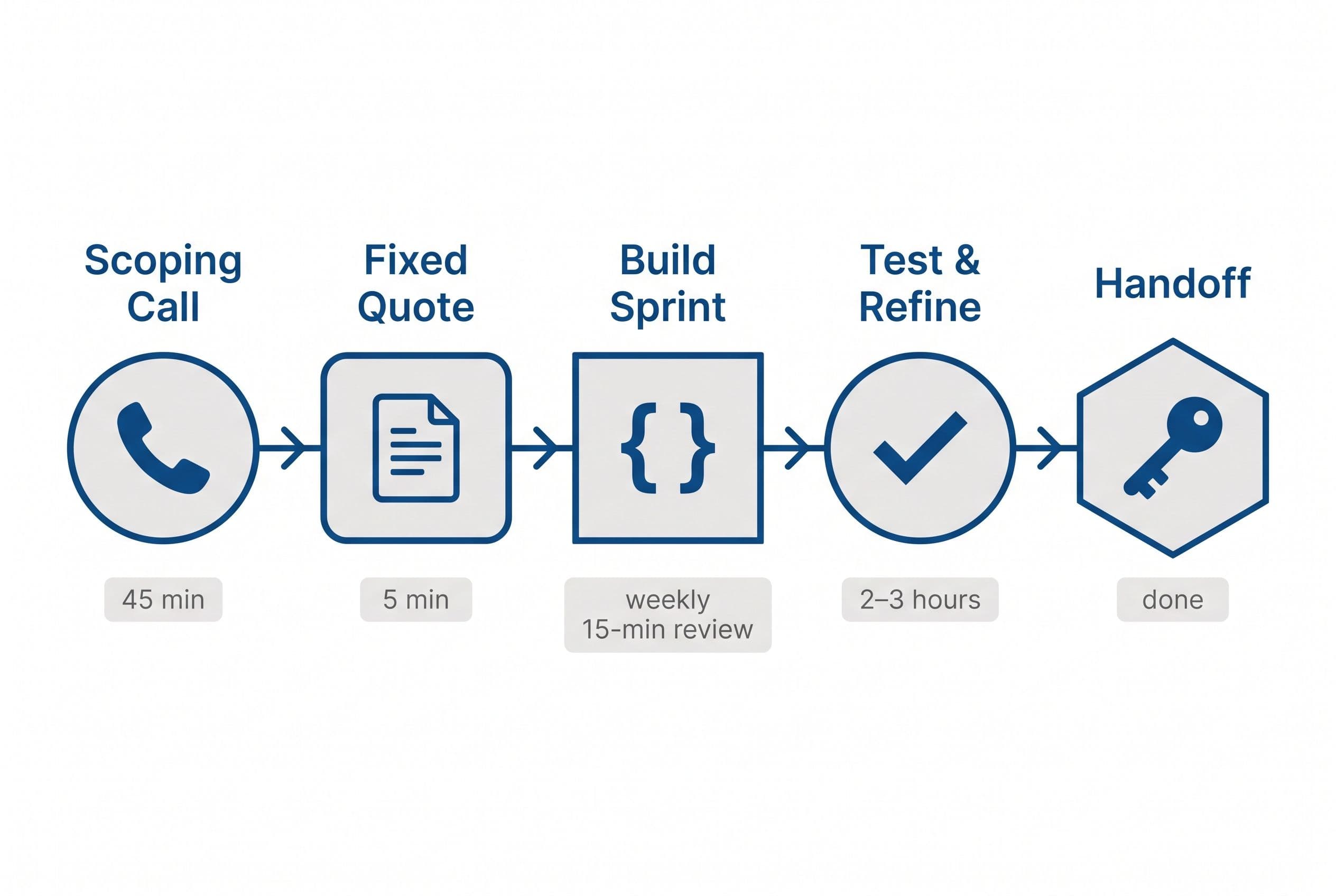
Agencies hand you a 12-page SOW with line items like "Discovery & Strategy: $8,000–$15,000." Here's what a real build breaks down to:
| Phase | What happens | Your involvement |
|---|---|---|
| Scoping call | I ask what the app needs to do, who uses it, and what it replaces. 30–45 minutes. | One call |
| Fixed quote | You get a single number and a delivery date. Not a range — a number. | Read an email |
| Build | I ship working software in a staging environment. Your code lives in your own repo from day one. | Weekly 15-min review |
| Test & refine | You click through, I fix what's off. | A few hours total |
| Handoff | Source code, documentation, deployment access. You own everything. | Done |
That's it. No "discovery phase" that costs $10K and produces a slide deck. No five-person team where three of them are in status meetings. A lot of agency projects drag out for months; mine are measured in weeks for this scope.
Your total time investment across the whole project is usually 3–5 hours — a scoping call, a couple of short weekly reviews, and a final test pass.
How This Played Out on a Real Build
I built a custom power dialer for a sales team that was paying about $30,000 a year for Kixie. They kept hitting walls — limited customization, clunky workflows, and a price tag that climbed with every seat they added. In outbound sales, speed to lead is the whole game, and the tool couldn't keep up.
What I shipped: a React-based dialer where reps can call one-on-one or blast up to 10 lines at once, connecting only when someone picks up. No per-seat licensing — the team scales without the price scaling with it. Custom lead lists assigned to any rep. Built-in automations plus Zapier webhooks to fire follow-ups and update other systems. SMS with pre-built templates, one-click voicemail drops, missed call and message management, and real analytics — call volume, connect rates, rep performance, conversion.
It came out faster, more powerful, and more flexible than the $30K/year tool it replaced. Built in weeks, owned outright, no per-seat SaaS license. They still pay for telephony usage (carrier minutes, SMS costs) and hosting, like you would with any communications tool — but the $30K/year licensing line item is gone. The reps spend less time clicking and more time closing.
That's the payback math that matters. They weren't just buying software — they were killing a $30K annual line item and getting a better product. Even at the top of our pricing range, the build pays for itself inside a year of licensing savings.
What the Same Money Gets You Elsewhere
Let's be honest about the alternatives:
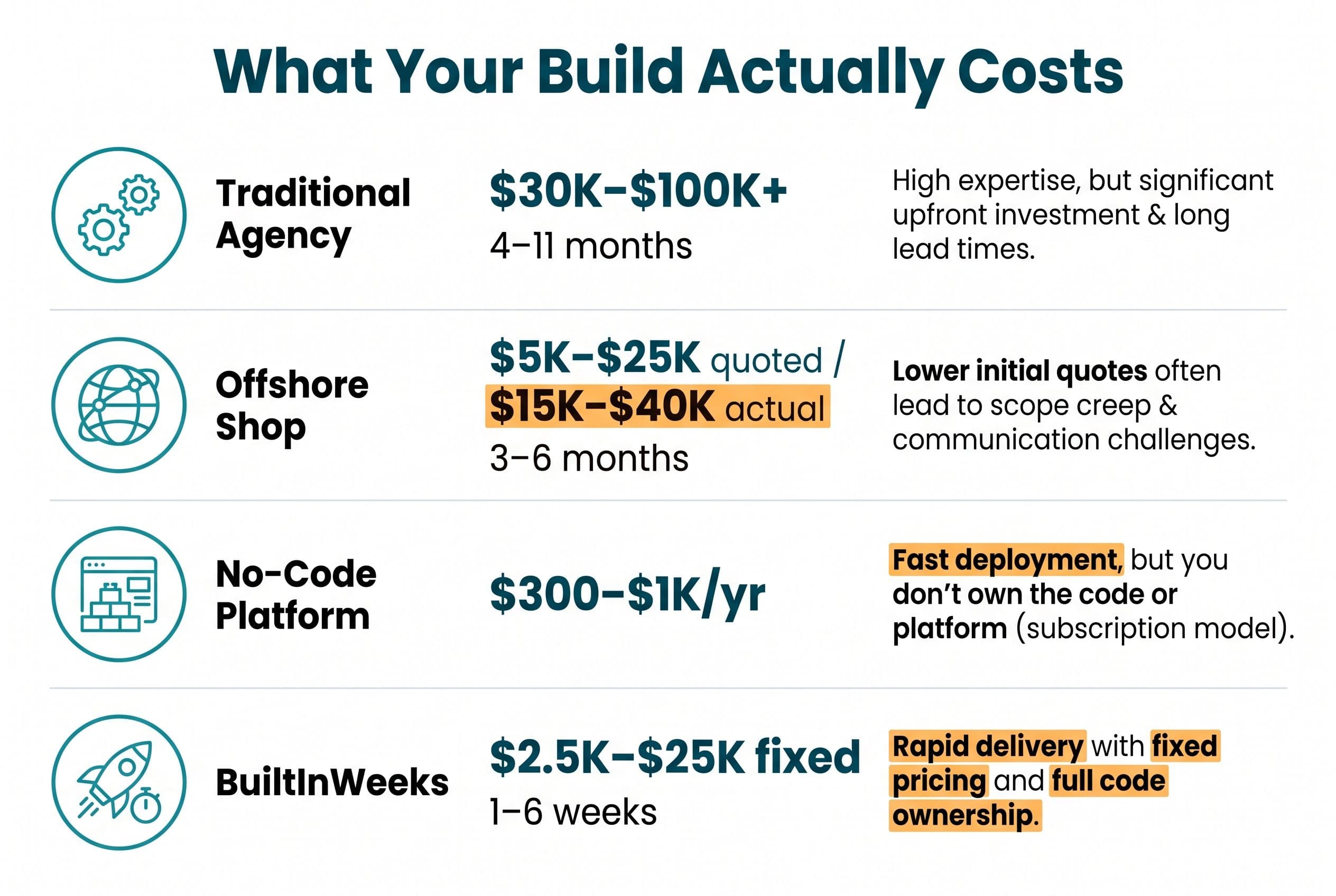
Traditional agency ($30K–$100K+). You'll get a team. A project manager, a designer, two developers, a QA person. Hourly rates on directory sites often range $25–$49/hour at the low end, and projects typically land in the $10,000–$49,999 range for reviewed builds. But hourly billing rewards slow work. Every meeting, every revision, every "let me check with the team" is billable time. The Standish Group's CHAOS Report has tracked software project outcomes for decades, and the pattern is consistent: most projects run over budget and over schedule.
Offshore shop ($5K–$25K quoted, $15K–$40K actual). The initial quote looks great. Then you discover the timezone gap means a one-sentence clarification takes 24 hours. Code quality is inconsistent. The rewrite costs as much as the original build. I've seen this pattern enough that I'd call it the norm, not the exception.
No-code platform (Bubble, FlutterFlow, Retool). AI-assisted no-code tools can bring a basic app build down to a few hundred dollars a year in platform fees. FlutterFlow's Basic plan runs $29–$39/month. For a simple internal tool, that might be the right call. But in practice, most no-code platforms lock you in — your data model, your workflows, and your runtime are tied to their platform, their pricing changes, their uptime. Some offer partial export, but real portability is limited. And when you hit a wall — and you usually hit a wall — the migration costs more than building it right the first time.
In-house hire ($80K–$150K/year). A full-time developer is the right move if you have ongoing development work that fills 40 hours a week, 50 weeks a year. For a single app? You're paying a salary, benefits, and management overhead to build one thing. That math doesn't work for most small and mid-sized businesses.
What Makes a Build Cheaper (and What Makes It Blow Up)
Cheaper:
- You know what you want. Not a 40-page spec — just a clear description of who uses it, what they do in it, and what it replaces.
- The integrations are modern. Stripe, Twilio, SendGrid, Zapier — documented APIs, sandbox environments, predictable work.
- You're replacing a SaaS tool with a focused custom app, not trying to rebuild Salesforce.
- One user role, or two at most.
More expensive:
- Complex business rules. "If the lead is in California AND the rep is on the West Coast team AND it's after 5pm local time, route to the overflow queue" — every conditional branch adds scope.
- Legacy integrations with undocumented APIs.
- Multi-tenancy — multiple organizations sharing one app with data isolation.
- Real-time features (live dashboards, collaborative editing, WebSocket connections).
- AI features that require prompt engineering, output validation, and model fallback logic.
The biggest budget killer isn't any single feature. It's ambiguity. "Make it like Slack but for our industry" is a six-figure project hiding in a sentence. "I need a messaging tool where our 15 field techs can send job updates to dispatchers with photo attachments" — that's a medium build.
Who Should NOT Use Our Estimator
I'll save you 90 seconds.
If your SaaS bill is under $3K/year, the payback math probably doesn't work. You'd be spending $5K+ to replace a $250/month tool. Unless the tool is genuinely broken and costing you revenue, keep the subscription.
If you're deep in a platform ecosystem, think hard. If your entire sales operation runs on HubSpot and every workflow, report, and automation is wired through it, ripping out one piece creates more problems than it solves. Sometimes the right answer is to keep the platform and build a custom tool that sits alongside it.
If you want a long-term embedded developer — someone in your Slack every day, attending standups, iterating continuously — that's a staff augmentation need, not a project. I scope fixed projects, build them, hand them off, and move on. If you need ongoing development, you need a hire or a retainer arrangement, and I'll tell you that on the scoping call.
If you're building a consumer-facing SaaS product that needs to scale to thousands of users with a complex billing system, onboarding flows, and a marketing site — that's a bigger animal. It might start as a BuiltInWeeks project (the MVP often fits), but the full vision probably exceeds the $25K ceiling.
How to Get Your Actual Number
The estimator at free project estimator takes about 90 seconds. Five questions about what you're building, how complex it is, and whether it needs integrations or AI features. Your price range shows up on screen immediately — no email required, no sales call, no "we'll get back to you."
If the range works for you, fill out the short form at the end. I'll review it and send a fixed quote within one business day. That quote is the price. Not a starting point for negotiation, not an estimate that balloons after "discovery." Fixed means fixed — overruns are my problem, not yours.
The code lives in your repo from day one. You own it at every point in the process. If you fire me halfway through, you still have everything that's been built. Any developer can pick it up.
I wrote up Build vs Buy Software separately — that's the version with the numbers in it.
Worth reading next: AI Workflow Automation, which takes the same question from the other end.
Worth reading next: Monday.com Alternative, which takes the same question from the other end.
There's a longer answer to that in Mobile App Development Cost Breakdown.
If that's the decision you're actually making, Estimate Software Development Cost goes deeper on it.
Want a real number for your own project?
Answer a few questions and get an instant price range and timeline. No call required, no obligation.
Get your instant estimateTalk through your software project with MattP.S. If you're paying more than $10K/year for a SaaS tool that frustrates you — Kixie, ServiceTitan, Jobber, whatever — run the estimator first. That's usually where the payback math is strongest: kill the subscription, own the tool, and break even inside a year.
Frequently asked questions
- How much does it cost to develop a custom app for a small business?
- It depends on scope, integrations, and whether AI features are involved. At BuiltInWeeks, fixed-price builds range from $2,500 to $25,000. Industry-wide, Clutch's 2026 data shows most reviewed app development projects fall between $10,000 and $49,999, while GoodFirms reports custom software projects typically run $30,000 to $100,000+.
- How does a fixed-price app development quote work?
- A fixed-price quote means you agree on a single number before work starts, and that number doesn't change. Any overruns or scope miscalculations are the developer's problem, not yours. At BuiltInWeeks, you get your price range from the online estimator in about 90 seconds, then a firm fixed quote within one business day after submitting your project details.
- How long does it take to build a custom app?
- At BuiltInWeeks, simple builds ship in 1–2 weeks, medium-complexity apps in 2–4 weeks, and advanced builds in 4–6 weeks. By comparison, Clutch's 2026 data reports the typical mobile app development timeline is about 11 months. AI-assisted development tools make the difference.
- Do I own the code if I hire someone to build my app?
- Not always — it depends on your contract. Many agencies retain IP rights or host the code on their infrastructure, creating lock-in. At BuiltInWeeks, the code lives in your own repository from day one. You own everything at every point in the process, and any developer can pick it up if you decide to move on.
- Is it cheaper to build a custom app or use a no-code platform?
- No-code platforms like Bubble or FlutterFlow can cost as little as $300–$1,000 a year for basic apps. But you don't own the code, you can't export it, and you're locked to the platform's pricing and limitations. If you outgrow it, migrating often costs more than building custom from the start. For apps that are central to your operations, custom is usually the better long-term investment.
What would software built for your business look like?
Replacing a subscription, fixing software that fell short, or adding AI to your workflow? Talk through the scope with Matt.
Part of these guides
Matt Brody
Founder, BuiltInWeeks
I build custom software for small and mid-sized businesses — the kind you own outright instead of renting by the seat. Fixed price, delivered in weeks, source code handed over at the end.
More about how I workKeep reading

Mobile App Development Cost Breakdown: $2,500–$25,000
I quote focused business apps at $2,500–$20,000, or up to $25,000 with AI features. Here's the line-by-line scope, failure handling, and three-year arithmetic I'd use before replacing a subscription.
Read more
Estimate Software Development Cost: $2,500–$25,000
My fixed-price builds run from $2,500 to $25,000, but the build price isn't the whole decision. I separate migration, hosting, APIs and maintenance, then compare that total with three more years of the software you're already paying for.
Read more
Software Project Cost Estimation: Why Quotes Vary 5x
A fivefold gap between software quotes usually means you're buying different scopes, different risk, or different staffing models. I’ll walk through a publishing workflow to show which costs belong in the quote—and which cheap estimates quietly leave out.
Read more