Estimate Software Development Cost: $2,500–$25,000

My build range starts at $2,500—not an email form
I estimate software development cost in two passes: the price to ship, then the cost to run it. My published fixed-price build envelope is $2,500–$25,000. Migration, hosting, paid APIs and maintenance need their own treatment before that number becomes a useful budget.
Here's the build side:
| Build level | Fixed-price range | Delivery window | Example scope |
|---|---|---|---|
| Simple | $2,500–$10,000 | 1–2 weeks | Landing page with CMS, focused CRUD app, basic dashboard |
| Medium | $5,000–$15,000 | 2–4 weeks | Multi-feature app, integrations, user roles |
| Advanced | $10,000–$20,000 | 4–6 weeks | Real-time features, multi-tenancy, complex rules |
AI features multiply the applicable range by 1.25, bringing the overall ceiling to $25,000. Using AI-assisted development to build your app isn't the same thing as putting AI features inside it.
The ranges overlap because a feature count isn't a specification. A dashboard pulling clean records from one database is different from a dashboard reconciling conflicting records across several systems.
My arithmetic is straightforward:
Three-year replacement budget = build + migration + 36 months of hosting and APIs + maintenance allowance.
That's the number I compare with keeping your current software. The wider guide to what custom software actually costs covers the budgeting questions around that calculation; here, I'll show how I turn the inputs into a scope I can quote.
My phonics app shows why counting screens misses the work
I built a reading app for my own family. My wife and I homeschool our four kids, and we'd already taught two to read when our five-year-old was ready.
The existing process meant working through more than a thousand pages of books and workbooks. It worked. But it was scattered, slow and hard to stay consistent with.
I built a web app with 50 structured lessons using a 100% phonics approach. A parent and child work together for about 15 minutes a day; it's not a hand-your-kid-a-screen product.
This is my real family project, not an anonymized client case study.
Here's why it belongs in a discussion about software project cost estimation: “a lesson screen” doesn't describe the scope. The app has over a dozen activity types, 49 original stories that get progressively harder, and hundreds of audio files. Kids can start wherever their skills already are, and they're reading their first story by lesson two.
Those are different kinds of work: lesson structure, activity behavior, content and audio. A quote based only on page count would miss the thing being built.
It shipped in weeks, replaced a shelf of workbooks with one clear path from knowing nothing to reading independently, and my family uses it every day. I haven't supplied a build price or workbook spending figure, so there's no honest dollar-payback claim to make here.
The useful lesson is scope, not an invented return: I need to price the complete activity someone can finish, including its content and rules—not just the screen they click.
Three more years of the current subscription has a price
Before I estimate software development cost for a replacement, I price staying put. Otherwise, we're comparing a visible build bill with an invisible stream of subscription charges and staff work.
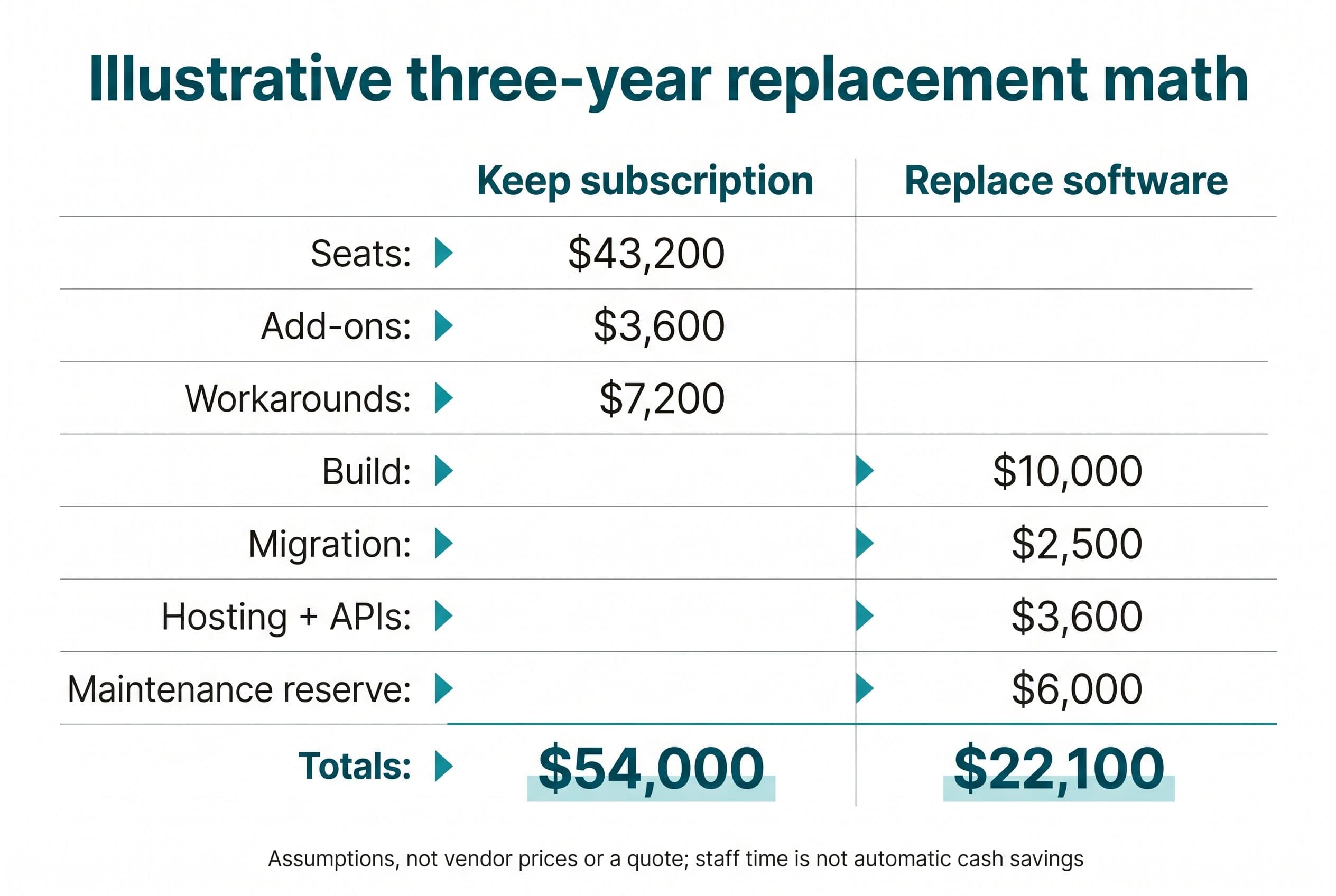
The following is illustrative arithmetic, not a client result, vendor price or quote. I'm assuming an unnamed subscription, unchanged headcount and no price increases. The replacement covers the same required workflow—not every feature in the subscription.
| Keep the current product: assumed input | Monthly cost | Three-year cost |
|---|---|---|
| 20 seats at an assumed $60 per seat | $1,200 | $43,200 |
| Add-ons | $100 | $3,600 |
| Workarounds: 5 hours at an assumed $40/hour | $200 | $7,200 |
| Total economic cost | $1,500 | $54,000 |
For the replacement side, I'll use these explicit planning assumptions:
| Replace it: assumed input | Budget treatment | Three-year cost |
|---|---|---|
| Build | One-time illustrative amount | $10,000 |
| Migration | One-time illustrative amount | $2,500 |
| Hosting | Assumed $50/month allowance | $1,800 |
| Paid APIs | Assumed $50/month allowance | $1,800 |
| Maintenance | Assumed $2,000/year reserve | $6,000 |
| Total replacement budget | $22,100 |
The build and migration together represent an illustrative $12,500 medium scope, not two commitments I've quoted. Hosting and API figures are generic budget placeholders, not prices for named services. The maintenance reserve isn't a BuiltInWeeks service price or a guarantee that every future change fits inside it.
Under these assumptions, the three-year difference is $31,900. Excluding staff time, the subscription costs $46,800, so the cash-budget difference is $24,700.
That distinction matters. Recovered staff hours aren't automatically payroll savings, and the model assumes the replacement removes the stated workaround. Parallel subscriptions during migration, retained tools and internal testing time would need adding if they apply.
I'd keep the SaaS when the bill is too small to repay the build, the product already handles the workflow, or leaving its ecosystem would break more than it fixes. Don't hire me to replace inexpensive software that's doing its job.
My three-year build-versus-buy comparison and exit checklist goes deeper into the costs that survive cancellation. Those surviving costs belong in both columns, not quietly erased from the replacement side.
How I estimate software development cost from workflows, connections and uncertainty
Once replacement looks worth investigating, I estimate software development cost around three variables. Not a wish list. Work that can be described and tested.
The workflow and its exceptions
I start with the event that begins the job and the result that finishes it: a customer submits a request, an employee approves it, an invoice goes out.
Then I identify who can do what and what happens when things go wrong. A user role can change permissions across the whole application. An approval rule can require notifications, an audit trail and a reversal path.
My scope names those behaviors. “Admin dashboard included” doesn't tell either of us enough.
The systems it has to talk to
A QuickBooks connection isn't one checkbox. I need to know which records move, which system is authoritative, how duplicates are handled and what happens after a failed transfer.
For payments, Stripe's documentation is where I'd check the relevant integration behavior before committing to scope. Webhooks, retries and reconciliation need an explicit place in the plan.
The same applies to data export. Having an export button doesn't establish that attachments, relationships and historical records will survive the move.
The unknowns I can remove before quoting
I want representative exports, API access details and examples of the difficult cases. Secrets don't belong in an intake form; credentials can be shared through an appropriate secure channel when needed.
Then I write acceptance criteria: the observable conditions that mean the feature is finished. For example, an authorized employee can approve a request, and an unauthorized employee can't—even by calling the endpoint directly.
I won't hide an untested dependency inside a confident fixed quote. If access to a necessary API hasn't been confirmed, I narrow the commitment or identify what must be verified first.
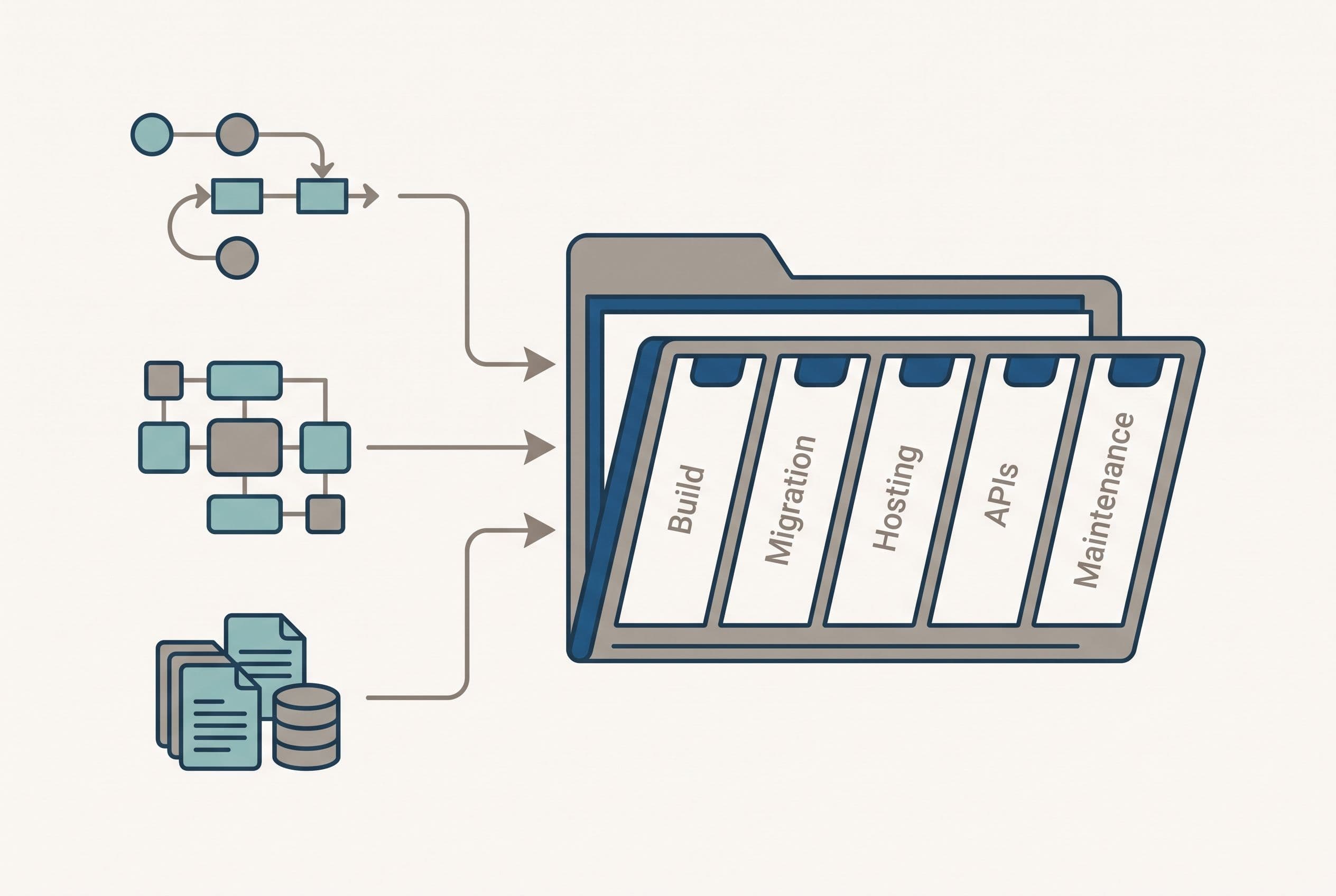
My estimate separates five costs that quotes blur together
Cost estimation for a software project gets slippery when “development” becomes a bucket for everything. I separate the costs because each one behaves differently after launch.
| Cost | What I account for | What changes the amount |
|---|---|---|
| Build | Screens, business rules, permissions, integrations, testing and launch | Workflow depth and exceptions |
| Migration | Export, cleanup, field mapping, trial import and reconciliation | Data quality and history retained |
| Hosting | Application runtime, database, storage and backups | Traffic, storage and operating requirements |
| APIs | Paid external services used by the app | Transactions, messages or other metered usage |
| Maintenance | Dependency updates, operational fixes and ongoing technical care | System complexity and support expectations |
I also separate defects covered by the agreed contract from new features. A broken agreed workflow and a newly requested approval process aren't the same category of work.
Migration can be included in the fixed build scope, but it should still be visible as work. Otherwise, “the app is done” can arrive while your staff are still cleaning spreadsheets.
For hosting, I might evaluate Next.js with Postgres or Supabase, depending on the application. Those names don't establish a monthly bill; capacity, backups and service choices do.
Maintenance deserves a real allowance rather than “we'll worry about that later.” My $2,000/year reserve above is illustrative, not a maintenance quote. I'd base the actual allowance on dependency updates, operational fixes, system complexity and support expectations; support hours and new development need defined terms.
Project cost estimation software can record these assumptions. It can't decide whether your customer records are clean enough to import.
The same limitation applies to software for cost estimation built around time tracking: recorded hours help explain past effort, but they don't resolve missing requirements. My fixed-price calculator breakdown explains how the initial range differs from a scoped commitment.
Keeping the first release narrow makes the quote dependable
My fastest route to a lower quote is to remove work—not pretend the same work takes less effort.
For a subscription replacement, I'd usually keep the required workflow, necessary history and essential connections. I'd defer speculative reports, rarely used legacy screens and features someone might want later.
That isn't permission to skip permissions, backups or testing. Those are part of shipping usable software.
The expensive surprises usually sit at boundaries: undocumented business rules, unavailable exports, conflicting records and outside systems nobody checked. Rebuilding disappointing software without identifying those problems just purchases a new version of the disappointment.
I also budget for your participation. I ask for a scoping call, a short weekly review and a final test pass, plus someone who can provide representative data and make decisions. That's the involvement pattern—not a promise that messy records require no staff effort.
The delivery bands are weeks, not quarters, for the scopes listed above. Missing access, delayed decisions or a changed scope can move the calendar; I don't count waiting for credentials as a completed integration.
An hourly rate isn't a replacement budget
How agencies estimate software projects matters as much as the rate they advertise. Estimated hours multiplied by a rate can be useful, but it's still an estimate unless the contract says otherwise.
I don't treat an agency's hourly rate as a fixed project price. I need to know who's doing the work and what the estimate leaves out.
Here's how I compare the purchasing models:
| Option | What the money buys | The trade I'd examine |
|---|---|---|
| Fixed-price build | A defined deliverable for an agreed amount | Scope changes need separate agreement |
| Time and materials | Developer time as requirements evolve | The final bill remains variable |
| Offshore hourly team | Engineering capacity at a different rate structure | Review, coordination and rewrite exposure |
| In-house developer | Continuing capacity and internal knowledge | An ongoing employment commitment |
| Existing SaaS | A maintained product you can keep using | Recurring charges and product constraints |
Fixed price vs time and materials isn't a morality contest. Open-ended product research can suit time and materials. A bounded replacement workflow is where I prefer fixed price.
What I reject is hourly billing that rewards slow work, agencies staffing five people on a two-person job, and months of paid discovery that produce a slide deck instead of a buildable scope. A cheap offshore rate also stops being cheap if the budget excludes the review and rewrite.
With my fixed price, overruns on the agreed scope are my problem, not yours. Scope additions get discussed rather than buried in the next invoice.
The code lives in your own repo from day one. The contract transfers ownership of the custom code and source to you on final payment; I keep only generic reusable components, and third-party libraries and services retain their own license terms.
Repo access isn't legal ownership. Once handed off, the source and handoff documentation let another developer take over without needing my permission.
“I need to know whether replacing this is worth it.”
That's the decision I'd want settled before discussing a stack or booking a long discovery engagement.
To estimate software development cost usefully, I need the workflow you're replacing, the people who use it, the required integrations and the data that has to move. The first range starts the budget discussion; the written scope establishes what the fixed quote actually covers.
My free project estimator at free project estimator shows the range on screen before it asks who you are. Calculators that hide the number to harvest an email aren't helping you budget.
“I need to know whether replacing this is worth it—not get another sales pitch.”
Answer five questions in the estimator—about ninety seconds—to see your range before any form, then submit your project details for a fixed quote back within one business day.
Want a real number for your own project?
Answer a few questions and get an instant price range and timeline. No call required, no obligation.
Get your instant estimateTalk through your software project with MattFrequently asked questions
- How do I estimate software development cost?
- I start with the required workflows, user roles, integrations and data migration, then define testable acceptance criteria. I separate the fixed build price from hosting, paid APIs and maintenance so the estimate covers both launch and ongoing operation.
- How much does BuiltInWeeks charge for custom software?
- My simple builds cost $2,500–$10,000 and take 1–2 weeks; medium builds cost $5,000–$15,000 and take 2–4 weeks. Advanced builds cost $10,000–$20,000 and take 4–6 weeks. AI features multiply the applicable range by 1.25, making the overall envelope $2,500–$25,000.
- Is fixed price better than time and materials for software development?
- I prefer fixed price for a defined workflow with clear acceptance criteria because agreed-scope overruns are my responsibility. Time and materials can fit exploratory work where requirements will keep changing, but the final bill remains variable.
- What costs should a software development estimate include?
- I account for build, migration, hosting, paid APIs and maintenance separately. I also identify any retained subscriptions, parallel-running costs and internal staff effort rather than treating them as free.
- When is keeping SaaS cheaper than building custom software?
- I'd keep SaaS when it already handles the workflow, its bill is too small to repay a replacement, or leaving its ecosystem creates costly dependencies. I compare three-year costs and keep recovered staff time separate from actual cash savings.
What would software built for your business look like?
Replacing a subscription, fixing software that fell short, or adding AI to your workflow? Talk through the scope with Matt.
Part of these guides
Matt Brody
Founder, BuiltInWeeks
I build custom software for small and mid-sized businesses — the kind you own outright instead of renting by the seat. Fixed price, delivered in weeks, source code handed over at the end.
More about how I workKeep reading

App Development Cost Calculator: $2.5K–$25K Fixed-Price Breakdown
Most app development cost calculators exist to harvest your email. Ours shows the range on screen in about 90 seconds. Here's how the pricing actually works, what moves the number, and why we quote fixed prices instead of hourly rates.
Read more
Mobile App Development Cost Breakdown: $2,500–$25,000
I quote focused business apps at $2,500–$20,000, or up to $25,000 with AI features. Here's the line-by-line scope, failure handling, and three-year arithmetic I'd use before replacing a subscription.
Read more
Custom Software for Small Business: 5 Red Flags When Hiring
Most small businesses that get burned by custom software didn't pick the wrong technology — they picked the wrong developer. Here are the five red flags I see over and over, and what to look for instead.
Read more