Project Estimation Software: Why Agencies Quote 5 Ways

Project estimation software can't make five quotes comparable
My published fixed-price builds run from $2,500 to $25,000, including the upper end for AI features. Project estimation software can narrow that range. It can't make five agencies agree on what they're delivering—or who's paying when something takes longer than expected.
Here's why software quotes vary: one agency prices hours, another sells a team for a month, another fixes the scope, another prices the supposed business value, and another charges for discovery before committing to anything.
Different deals. Sometimes different software entirely.
I'll use one clearly hypothetical workflow throughout: a U.S. service business receives requests, prepares estimates, gets an owner's approval, sends quotes, and hands accepted work to operations. Its subscription handles the quote itself, but staff still copy information between email, spreadsheets, and accounting.
That's the job I'd estimate—not “replace our software.”
For context, these are my published build bands:
| Build scope | Fixed-price range | Delivery window |
|---|---|---|
| Simple: focused CRUD app or basic dashboard | $2,500–$10,000 | 1–2 weeks |
| Medium: multiple features, integrations, user roles | $5,000–$15,000 | 2–4 weeks |
| Advanced: real-time features, multi-tenancy, complex rules | $10,000–$20,000 | 4–6 weeks |
AI features multiply the applicable range by 1.25. They're not automatically necessary for this workflow.
The overlap is intentional: complexity, not a screen count, determines the quote. My breakdown of what moves an app between these price bands covers the inputs behind that calculation.
“An estimating app” hides the work that changes the price
I know how misleading a short app description can be because I built a phonics reading app for my own family.
My wife and I homeschool our four kids. We'd already taught two to read, but preparing for our five-year-old meant working through more than a thousand pages of books and workbooks again.
I built a web app with 50 structured lessons using a 100% phonics approach. It's for a parent and child together, about 15 minutes a day—not handing a kid a screen. Children start wherever their skills already are and reach their first story by lesson two.
“Reading app” doesn't tell you that it includes over a dozen activity types, 49 original stories, and hundreds of audio files. Those details describe the work.
This is a real personal project, not an anonymized client case study. I built it in weeks, it replaced a shelf of workbooks with one clear path to independent reading, and my family uses it every day. I don't have a dollar payback figure to attach to it.
The same scoping problem applies to project estimation software. “Create and send estimates” might mean entering a total into a form. Or it might mean rate tables, revision history, approval thresholds, accounting handoffs, and recovery when an integration fails.
Here's how I'd break down our hypothetical request-to-quote workflow:
| Workflow step | Where the current setup fails | Replacement scope I'd price |
|---|---|---|
| Request arrives | Staff retype email details | Shared intake record with attachments |
| Estimate is drafted | Rates live in separate spreadsheets | Controlled rate table and line items |
| Owner reviews | Approval happens in a message thread | Draft, approved, and rejected states |
| Customer receives quote | Nobody knows which revision was sent | Saved versions and delivery status |
| Work is accepted | Operations re-enters the same information | Accepted-job handoff and accounting sync |
The big cost drivers are business rules, integration behavior, and data cleanup. A polished dashboard is rarely the hardest part.
When I compare proposals, I look for those three items before I look at the total.
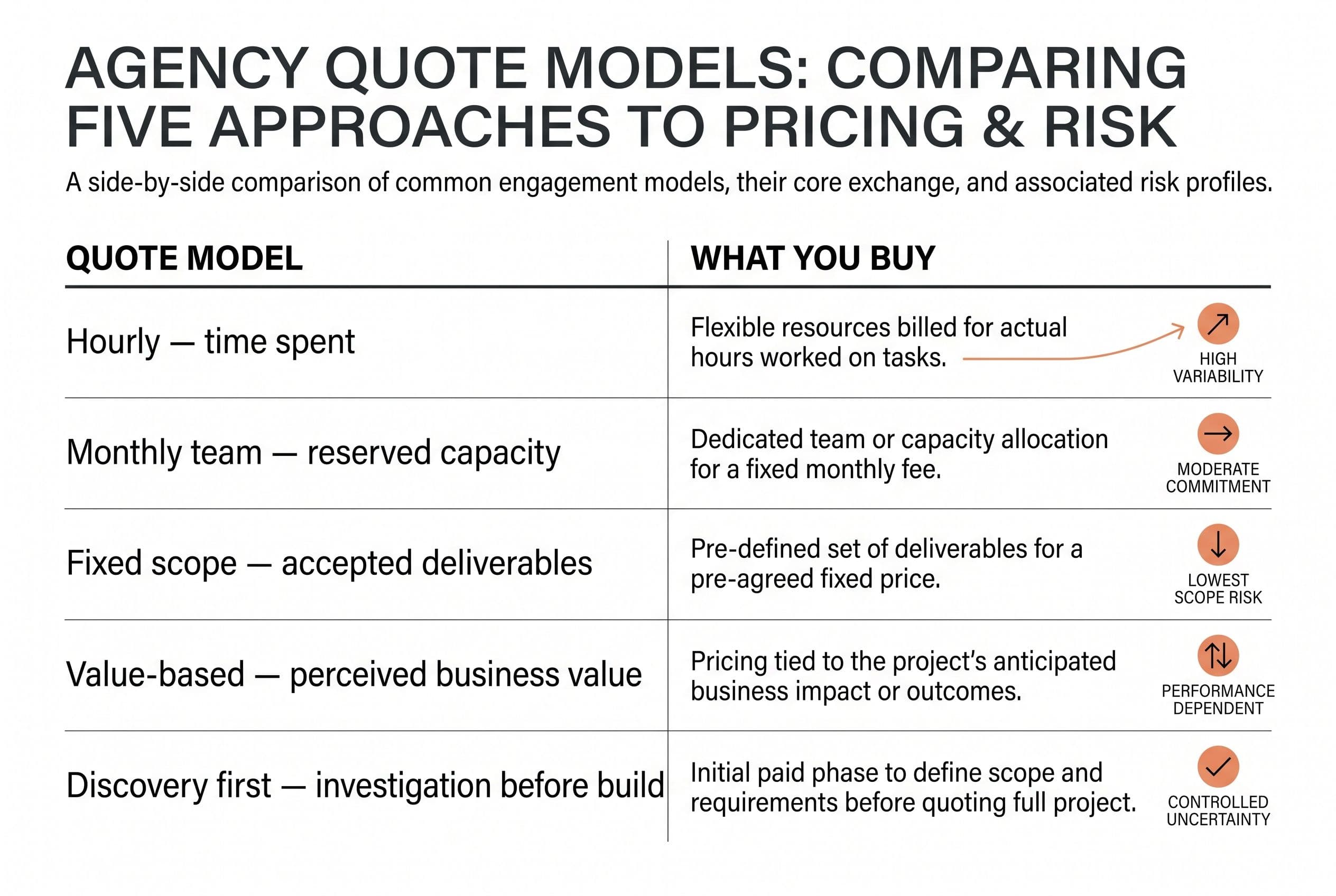
The five agency models price different risks
Estimation tools often calculate hours multiplied by rates. That's useful arithmetic, but it doesn't tell an owner whether the resulting number is a budget, a ceiling, or an opening bid.
I separate proposals this way:
| Quote model | What you're buying | Where your risk sits |
|---|---|---|
| Hourly or time-and-materials | Time spent working | More hours mean a bigger bill |
| Monthly team or retainer | Reserved capacity | A month can end without a finished workflow |
| Fixed-price scope | Agreed deliverables and acceptance tests | Missing scope becomes a change request |
| Value-based quote | A price tied to the seller's view of business value | Price may have little connection to build effort |
| Paid discovery, then build quote | Investigation before implementation | You can spend money without getting production software |
None is automatically dishonest. Unclear terms are the problem.
Hourly billing rewards slow work unless the contract adds meaningful controls. Staffing five people on a two-person job doesn't become good value because the project estimation software produces a detailed spreadsheet.
Paid discovery can make sense when nobody knows whether a critical integration is possible. Months of discovery that produce a slide deck and still no build range? I'd skip that.
For a market comparison, I'd treat Fireart Studio's offshore rate guide as a starting point for comparing hourly rates—not finished-project prices. Requirements, testing, handoff, and any rewrite still count.
I'd also separate effort estimation from a delivery commitment. Planning poker tools, like those discussed in TeamRetro's guide, help a team estimate effort; they don't make the team contractually responsible for shipping your accepted workflow at a fixed price.
I wouldn't buy an estimation tool just to compare proposals. I'd first normalize the deliverables, exclusions, acceptance tests, and ownership terms. Those are also the hiring red flags I'd check before paying a deposit.
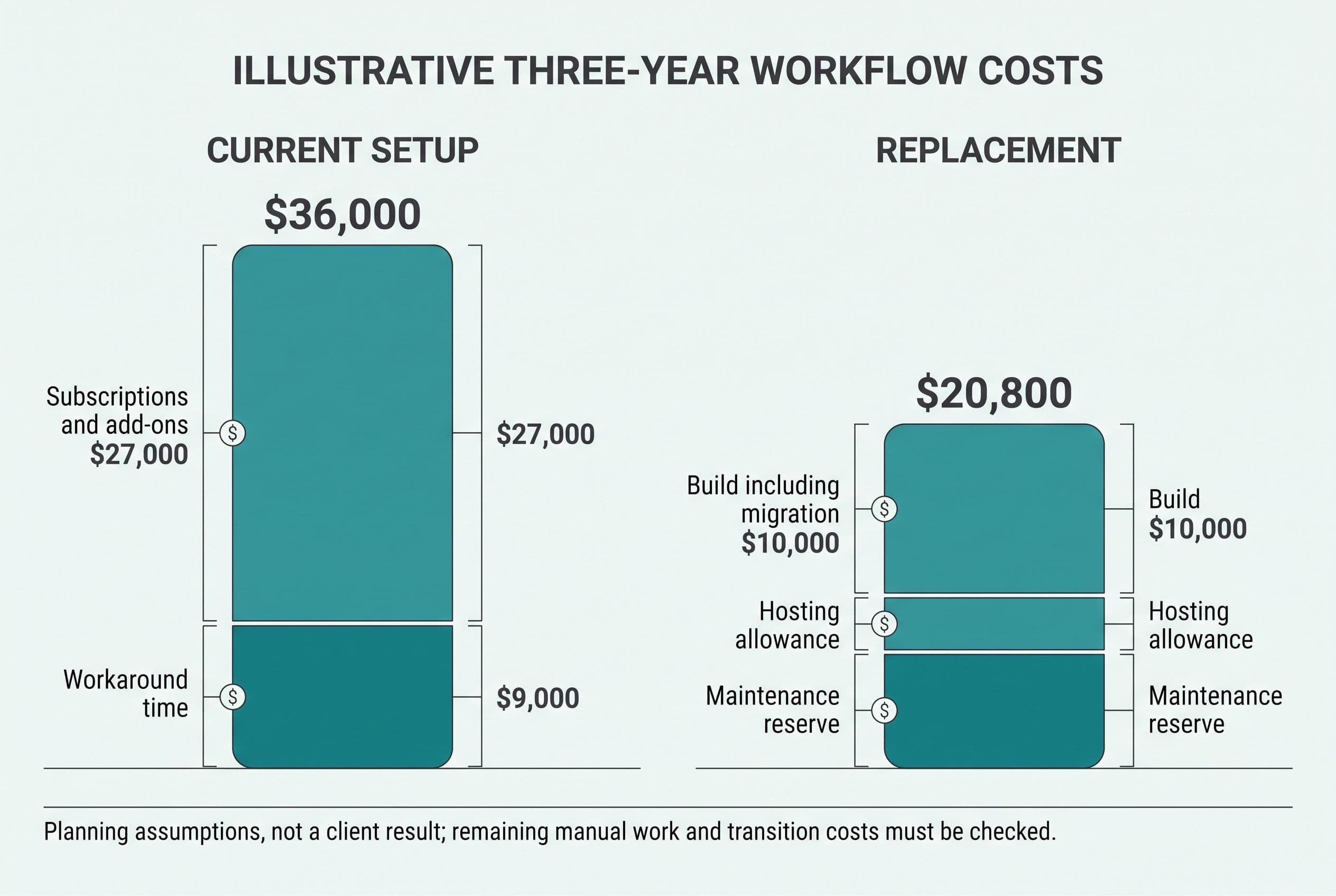
Keeping the broken quoting workflow costs $36,000 in this example
Before I recommend replacing anything, I price leaving it alone.
The following is illustrative arithmetic, not a client result, a named vendor's pricing, or a BuiltInWeeks quote. Assume the hypothetical business pays $600 per month for seats and $150 for add-ons. It also values the time spent copying records and chasing approvals at $250 per month.
For the replacement comparison, assume a $10,000 fixed build with the defined migration included. Hosting is a $100 monthly planning allowance; maintenance is a $200 monthly reserve, not a maintenance offer from me.
| Three-year cost | Keep current setup | Scoped replacement |
|---|---|---|
| Seat subscriptions: $600 × 36 | $21,600 | $0 for the retired subscription |
| Add-ons: $150 × 36 | $5,400 | $0 for the retired add-ons |
| Existing workaround time: $250 × 36 | $9,000 | No residual amount modeled; verify in practice |
| Custom build, including defined migration | $0 | $10,000 |
| Hosting allowance: $100 × 36 | Included in subscription assumption | $3,600 |
| Maintenance reserve: $200 × 36 | No separate reserve modeled | $7,200 |
| Modeled total | $36,000 | $20,800 |
The modeled difference is $15,200 over three years. But I wouldn't sell the whole difference as cash savings: $9,000 is the assigned value of staff time.
Ignoring that time entirely, the subscription side costs $27,000 against $20,800 for the replacement. That's a $6,200 cash-budget difference under these assumptions. The $10,000 build recovers against $450 in monthly subscription savings after hosting and maintenance allowances in roughly 23 months.
That calculation assumes the old subscription actually gets canceled. Parallel running, retained services, migration outside the agreed scope, and remaining manual work reduce the benefit. Staff still review quotes; the replacement isn't a zero-labor business.
Don't hire me to replace a cheap subscription that already handles your workflow. Staying with SaaS also wins if leaving its ecosystem breaks essential integrations or the savings can't cover migration and ongoing care.
This is where project estimation software earns its keep: showing assumptions beside the number. For the wider budget framework, I explain what custom software actually costs; for the decision beyond the initial quote, there's the three-year build-versus-buy comparison and exit checklist.
I’d quote the approval loop before adding AI
For this workflow, my first release would handle intake, estimate drafting, owner approval, delivery, and accepted-job handoff. I wouldn't start by rebuilding every report in the old product.
Here's what belongs in the scope behind the project estimation software output:
- Records and permissions: requests, customers, estimates, line items, and who can change rates.
- Approval rules: who reviews a draft, what sends it back, and what happens after revision.
- Delivery: the approved version sent to the customer, with a visible failure state.
- Integration: which records move into QuickBooks and which system controls each field.
- Migration: the specific data included, mapping rules, and rejected-record handling.
- Testing and handoff: acceptance checks, source access, deployment setup, and documentation.
I'd consider Next.js with Postgres for the app and its records. That's a possible stack, not a reason to quote more. The price follows the behavior the software must support.
An AI integration could extract requested services from an incoming email and prepare draft line items. I'd keep the original email beside the draft and flag missing information rather than letting the system invent it.
Human approval stays between the draft and the customer. Rates and totals come from controlled rules, not whatever a model happens to generate.
If extraction fails, the request stays available for manual entry. If sending fails, the estimate remains approved but unsent, with a retry action and a visible error. If QuickBooks is unavailable, the accepted quote stays saved locally while the handoff waits.
Webhooks need duplicate handling so a repeated event doesn't create a second job. API rate limits need a queue and a retry policy—not a spinner that leaves staff guessing.
That's why two bids for “QuickBooks integration” can be far apart. One prices the happy path. The other prices what happens on Tuesday when it breaks.
Migration and exceptions decide whether the quote survives
I'd move this workflow in stages, with explicit checks rather than a big overnight switch.
First, establish what can leave the old system
I'd inspect a sample data export before committing to migration scope. Customer records, estimate line items, attachments, and historical versions may not arrive together or in usable formats.
The owner also needs to decide what must stay editable. An archive of old estimates is a different job from recreating every historical approval and revision.
Next, run real-shaped cases in staging
I'd use a staging environment to test a straightforward quote, a rejected draft, a changed price, a duplicate event, and a failed accounting handoff.
The owner checks the business result. I handle the technical checks.
This is where I'd turn an estimate's assumption into an acceptance test: “An accepted estimate creates one handoff record, even if the acceptance event arrives again.” That's much more useful than “integration complete.”
Then, reconcile before switching
I'd compare imported record counts and estimate totals, review rejected rows, and agree on a cutover point. Staff need to know which system is authoritative so they don't update both.
I'd keep the old system available for reference during the agreed transition and document what triggers a rollback. Cancellation comes after the checks, not before them.
Clean exports and a narrow migration make the build cheaper. Missing attachments, inconsistent customer records, and undocumented pricing exceptions expand it. Project estimation software should surface those differences before a contract, not bury them in a contingency line nobody explains.
Put the $20,800 replacement beside your current bill
For our hypothetical workflow, the decision is $36,000 to keep the existing setup against a modeled $20,800 replacement over three years. Without counting staff time, it's $27,000 against $20,800.
Your numbers may say stay put. I'd rather find that out before building.
When the scope fits my published bands, I ship in weeks, not quarters. Your involvement is a scoping call, a short weekly review, and a final test pass; you'll also need to supply access, sample records, and decisions about approval rules. Messy data can demand more of your time, and I'd flag that before quoting.
For the agreed scope, fixed price means overruns are my problem, not yours. New scope gets a separate decision—not a surprise invoice.
The code lives in your own repo from day one. The contract transfers ownership of the custom code and source on final payment; I retain only generic reusable components, while third-party libraries and services keep their own license terms. With the source and handoff documentation, any developer can take over.
The free project estimation software at free project estimator is useful once those workflow boundaries are clear. Unlike calculators that hide the number to harvest emails, it shows the range before asking who you are.
Put your current bill beside your replacement budget in the estimator. It'll do the same sum for your own build in about ninety seconds, with the range on screen before any form. If the arithmetic lands, the same form returns a fixed quote within one business day.
Want a real number for your own project?
Answer a few questions and get an instant price range and timeline. No call required, no obligation.
Get your instant estimateTalk through your software project with MattFrequently asked questions
- Why do software development quotes vary so much?
- I look first at scope, staffing, billing model, and who carries overrun risk. An hourly estimate isn't the same commitment as a fixed-price contract. Integration failure handling, migration, and acceptance tests can also be included in one quote and missing from another.
- Can project estimation software give an accurate fixed quote?
- I use project estimation software to establish a range from defined inputs. A defensible fixed quote also needs agreed deliverables, exclusions, migration boundaries, and acceptance tests. A calculator can't discover undocumented business rules by itself.
- How much does BuiltInWeeks charge for custom software?
- My published fixed-price ranges are $2,500–$10,000 for simple builds, $5,000–$15,000 for medium builds, and $10,000–$20,000 for advanced builds. Delivery windows are 1–2, 2–4, and 4–6 weeks respectively. AI features multiply the applicable range by 1.25, making the overall envelope $2,500–$25,000.
- Should I replace subscription software with a custom app?
- I'd compare three years of subscriptions and workaround costs against the build, migration, hosting, maintenance, and transition costs. Staying with SaaS wins when it already fits, the bill is small, or essential ecosystem connections make leaving expensive. Savings only count once the old costs actually stop.
What would software built for your business look like?
Replacing a subscription, fixing software that fell short, or adding AI to your workflow? Talk through the scope with Matt.
Part of these guides
Matt Brody
Founder, BuiltInWeeks
I build custom software for small and mid-sized businesses — the kind you own outright instead of renting by the seat. Fixed price, delivered in weeks, source code handed over at the end.
More about how I workKeep reading

Estimate Software Development Cost: $2,500–$25,000
My fixed-price builds run from $2,500 to $25,000, but the build price isn't the whole decision. I separate migration, hosting, APIs and maintenance, then compare that total with three more years of the software you're already paying for.
Read more
Software Project Cost Estimation: Why Quotes Vary 5x
A fivefold gap between software quotes usually means you're buying different scopes, different risk, or different staffing models. I’ll walk through a publishing workflow to show which costs belong in the quote—and which cheap estimates quietly leave out.
Read more
Custom Software for Small Business: 5 Red Flags When Hiring
Most small businesses that get burned by custom software didn't pick the wrong technology — they picked the wrong developer. Here are the five red flags I see over and over, and what to look for instead.
Read more