Software Project Cost Estimation: Why Quotes Vary 5x

A 5x quote gap usually means five different assumptions
My published software project cost estimation ranges run from $2,500 to $20,000 before AI features, with delivery in 1–6 weeks depending on scope. AI features multiply the applicable range by 1.25, bringing the overall envelope to $2,500–$25,000.
That doesn't mean every project fits. It means I can show you the boundaries before asking you to sit through a sales call.
| Build tier | My fixed-price range | Delivery window | Scope examples |
|---|---|---|---|
| Simple | $2,500–$10,000 | 1–2 weeks | Landing page with CMS, focused CRUD app, basic dashboard |
| Medium | $5,000–$15,000 | 2–4 weeks | Multi-feature app, integrations, user roles |
| Advanced | $10,000–$20,000 | 4–6 weeks | Real-time features, multi-tenancy, complex rules |
When quotes differ by 5x, I don't start by deciding who's overpriced. I check whether one includes migration, approval rules, failed-job recovery, and handoff while another only covers the screens.
Then I check the commercial model. Hourly billing rewards more hours. An agency staffing five people on a two-person job has to recover those costs somewhere. Neither guarantees better software.
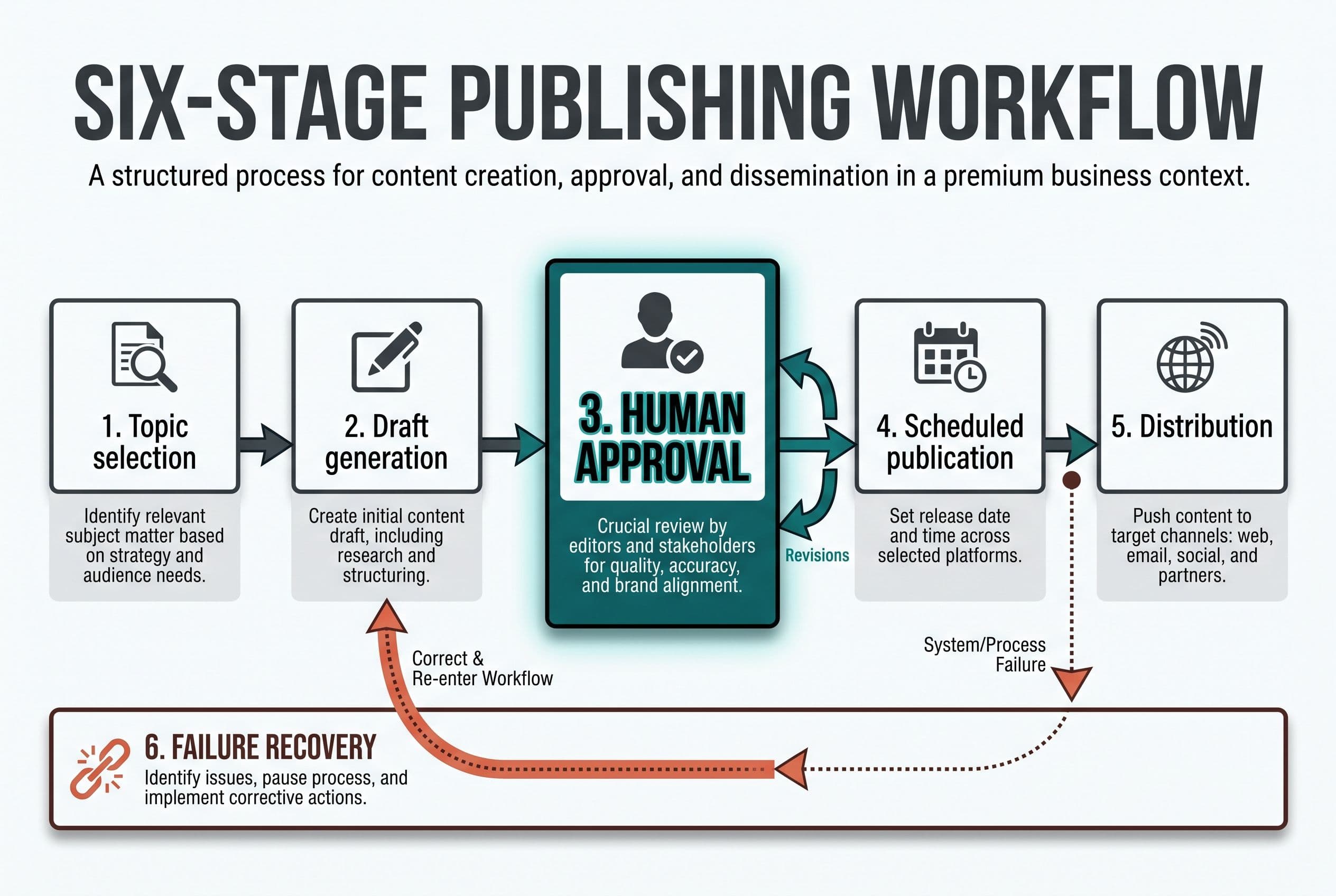
For a useful comparison, I'll follow one workflow: turning a keyword opportunity into an approved, published business blog post. It's a good example because “automate our blog” sounds small until someone has to specify what happens when publishing fails.
“Automate our blog” isn't a scope I can price responsibly
Here's the illustrative subscription workflow—not a client story. An owner picks topics in one tool, generates drafts in another, reviews them in a document, moves images into a CMS, schedules publication, and copies links into social channels.
The software fails at the handoffs. A revised draft doesn't replace the scheduled version. A post goes live without its images. Nobody knows whether a failed social push needs another attempt or would create a duplicate.
Those are different problems from “we need a better writing prompt.”
I built a real automated SEO blog platform that shows how much can hide inside that brief. This is a real, anonymized project; no build price or financial payback figures were supplied for publication.
The pipeline generates a dozen topic ideas at a time from Google Keyword data and ranks the opportunities. Claude writes 2,500-plus-word drafts against a custom voice profile, then Grok, Gemini, and ChatGPT review them for SEO. When any two agree on a change, Claude implements it.
Every post runs through Sapling.ai to check whether it reads as human-written. Image generation produces three or more images per post, publication can happen immediately or on a schedule, and Zapier pushes posts to Facebook and the Google Business profile.
I also built individual user action tracking, heatmaps, cohort analysis, and funnel tracking. The platform publishes on autopilot without a content team, with built-in content-performance analytics that go beyond Google Analytics alone.
That's the supplied result—not a promise of search rankings. A detector's assessment isn't proof that a human wrote something, either.
The payback question is the cost of the tools and content-team work displaced versus the build and ongoing operation. I can't calculate that project's payback without those figures. Inventing a savings number would make the example less useful, not more persuasive.
For your estimate, the lesson is simpler: drafting, multi-model review, publishing, distribution, and analytics are separate deliverables. A quote for drafting alone isn't a cheaper quote for that whole pipeline.
The expensive part is what happens after “generate”
I break software project cost estimation into three drivers: workflow rules, system boundaries, and the condition of your existing data.
Approval rules change what must be built
For the illustrative replacement, I'd scope human review before publication. Model agreement can recommend an edit; it shouldn't authorize a claim about your warranty, pricing, or regulated services.
I'd define an explicit progression: draft, awaiting review, approved, scheduled, published, or failed. Editing approved copy would send it back for approval rather than quietly changing what a reviewer signed off.
That requires permissions and stored approval history, not just a “Publish” button.
Integrations need a failure path
A Zapier connection can move a finished post into another channel. But the quote still needs to say what happens when credentials expire, API rate limits block a request, or the destination accepts a post without returning a clean response.
I'd require a visible error queue, controlled retries, and duplicate protection. Publishing the same article again because somebody clicked twice is a software defect, not an operator training problem.
The same boundary work applies outside publishing; I break down those handoffs in my guide to replacing repeated data entry with integrations.
Migration means preserving behavior, not just importing rows
Existing articles may have URLs, scheduled dates, images, categories, and internal links. A migration quote that says only “import content” leaves most of the job undefined.
I'd inspect a representative export before fixing that scope. Clean, complete exports make the job smaller. Missing assets and undocumented publishing rules make it larger.
Put approval, recovery, and migration on the quote
Here's the line-item breakdown I'd use for this publishing workflow. These are scope checks, not separately priced menu items; I quote the agreed build as a fixed total within the applicable tier.
| Quote line | What I'd specify | What a thin quote may omit |
|---|---|---|
| Topic intake | Keyword input, ranked ideas, selection step | Editing or rejecting suggestions |
| Draft generation | Voice profile, stored drafts, generation status | Failed requests and repeat charges |
| Review | Human approval, reviewer permissions, revision rules | Approval becoming stale after edits |
| Publication | Destination, schedule, media handling | Time-zone rules and duplicate protection |
| Distribution | Named channels and connection ownership | Partial success across channels |
| Migration | Agreed records, assets, URLs, reconciliation | Broken links or missing scheduled posts |
| Handoff | Source, deployment notes, recovery instructions | Dependence on the original builder |
This is why software estimates are wrong so often: the estimate counts the happy path, while the business needs the exception paths too.
Project cost estimation software can total those rows. It can't decide whether a rejected article needs a revision history or whether a failed publication should retry automatically.
For perspective, the supplied Toggl Track Starter pricing is $9 per user per month, billed annually. That's useful for collecting time data. It doesn't turn “connect our systems” into an acceptance test.
Whether you're buying project estimation software or using a spreadsheet, I care more about the assumptions beside the total than the number of decimal places. Searching for project estimate software won't fix an undefined deliverable.
The wider budgeting framework belongs in what custom software actually costs. For this workflow, every line should answer: what ships, how do we test it, and what's excluded?
Keeping the publishing stack also has a three-year price
Before recommending a replacement, I price doing nothing. Otherwise, cost estimation for a software project becomes a debate about a build invoice with no comparison attached.
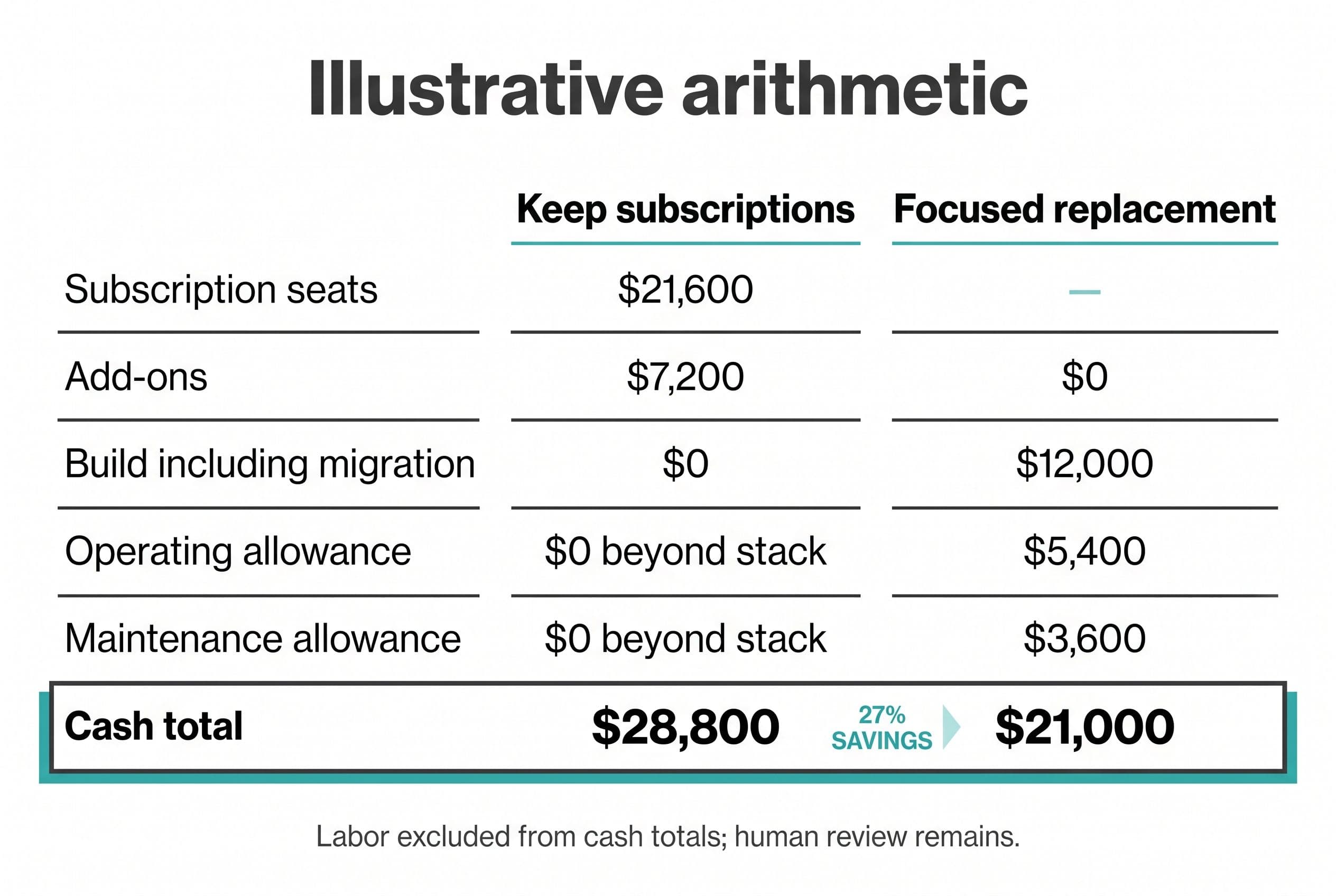
The following is illustrative arithmetic, not this project's results, a named vendor's pricing, or a hosting or maintenance quote. Assume an existing subscription stack costs $600 per month for seats and $200 for add-ons. Also assume manual handoffs consume five hours monthly, valued by the owner at $40 per hour.
For comparison, assume a scoped medium replacement costs $12,000 including migration. External operating and future-maintenance figures below are planning allowances, not BuiltInWeeks service prices.
| Three-year cost | Keep current subscriptions | Build a focused replacement |
|---|---|---|
| Subscription seats: $600 × 36 | $21,600 | $0 for replaced seats |
| Add-ons: $200 × 36 | $7,200 | $0 for replaced add-ons |
| Manual handoffs: 5 hours × $40 × 36 | $7,200 | Not counted as guaranteed savings |
| Fixed build, including scoped migration | $0 | $12,000 |
| Hosting, model APIs, and other services allowance: $150 × 36 | $0 beyond assumed stack | $5,400 |
| Future maintenance allowance: $100 × 36 | $0 beyond assumed stack | $3,600 |
| Cash-cost subtotal | $28,800 | $21,000 |
| Current workflow labor opportunity cost | $7,200 | Human review still required; measure separately |
On these assumptions, the replacement has a $7,800 cash-cost advantage over three years. I haven't claimed it removes the full labor cost: human review remains, and reduced busywork isn't automatically a payroll saving.
The subscription-minus-operating-cost difference is $550 monthly. Against the $12,000 initial build, that gives a simple cash break-even of roughly 22 months, before overlap costs or changes in usage.
Staying with SaaS wins when the bill is too small, the product already handles the workflow, or an ecosystem you can't leave makes replacement impractical. Don't hire me to recreate working software just because owning code sounds better.
I would also test a less comfortable scenario: subscriptions stay active during migration, model usage exceeds the allowance, or only part of the stack can be canceled. The comparison changes immediately. My three-year build-versus-buy checklist covers the exit costs that belong beside the build number.
A narrower publishing replacement beats a cheaper incomplete one
For this illustrative workflow, I'd start with one publication destination, one approval path, and visible failure handling. I'd defer custom heatmaps and cohort analysis unless those are part of the actual business decision.
The real platform included those analytics. Yours doesn't have to.
I'd move through the work in this order:
- Document the current handoffs. Identify who selects topics, approves claims, schedules posts, and fixes failures.
- Inspect the export and destination access. Check content, images, URLs, credentials, and API restrictions before committing to migration scope.
- Ship the approval path in a staging environment. Test permissions, rejected drafts, changed approvals, and scheduled publication without affecting the live site.
- Exercise failures deliberately. Test expired credentials, unavailable services, and repeat submissions. A failed job should remain visible and recoverable.
- Rehearse migration. Import a sample, compare records and assets, check links, and document how to return to the old setup.
- Cut over after a final test pass. Reconcile the remaining content and schedules, then cancel only the subscriptions the replacement actually covers.
I use AI-assisted development to ship production software in weeks instead of quarters. That changes how I build; it doesn't remove the need to test access controls or migration.
For a focused engagement, I'd plan your involvement around a scoping call, a short weekly review, and a final test pass. Your inputs are workflow decisions, access, representative data, and acceptance—not daily project management. Content-heavy migration may need extra review, which belongs in the scope rather than a surprise calendar invite.
The alternatives aren't automatically bad:
| Route | What you're buying | The trade I'd examine |
|---|---|---|
| Existing SaaS plus a small integration | Keep the working system; repair a handoff | Subscription costs and API restrictions remain |
| Fixed-price focused build | Agreed outcome and bounded implementation cost | Scope changes need separate agreement |
| Hourly agency | Capacity for work that may keep changing | You carry more overrun risk |
| Offshore team | Access to a different labor market | Handoff, acceptance, and rewrite responsibility still matter |
| In-house developer | Ongoing ownership of a changing backlog | Hiring and management are part of the commitment |
NextGen's 2026 agency-rate guide reports US blended engineering-pod rates of $140–$190 per hour. QArea's 2024 comparison lists Eastern European agency rates of $30–$80 per hour. Those are market benchmarks for others, not my prices or like-for-like project quotes.
A low hourly rate doesn't price the rewrite. A high rate doesn't prove competence. I'd compare the acceptance tests and handoff obligations first.
Settle the quote gap before anyone starts the clock
For useful software project cost estimation, I'd want a workflow description, representative data export, integration list, approval rules, and a clear definition of done. Those inputs let me separate a smaller first release from work that genuinely needs a larger scope.
I won't defend a discovery phase that bills for months and produces a slide deck before showing a range. Technical investigation can be necessary; withholding even a budget boundary isn't.
My free project estimator at free project estimator shows the range on screen before it ever asks who you are. The fixed-price calculator breakdown explains how scope moves between the published tiers.
With fixed price software development, overruns on the agreed scope are my problem, not yours. New scope gets a separate agreement—not a retroactive excuse for a larger invoice.
The code lives in your own repo from day one. The contract transfers ownership of the custom code and source on final payment; I keep only generic reusable components, and third-party libraries and services retain their own license terms. With the source and handoff documentation, another developer can take over.
That's a better comparison than five totals with five different meanings.
“We need to know whether replacing this software is worth it—and what it'll actually cost.”
Answer five questions in the estimator—about ninety seconds—to settle that decision: see the range before any form, then submit your project details for a fixed quote back within one business day.
Want a real number for your own project?
Answer a few questions and get an instant price range and timeline. No call required, no obligation.
Get your instant estimateTalk through your software project with MattFrequently asked questions
- Why do software development quotes vary so much?
- I usually find different assumptions about scope, migration, integrations, testing, and who carries overrun risk. I compare deliverables and acceptance tests before comparing the totals.
- How much does a custom software project cost?
- My published fixed-price ranges are $2,500–$10,000 for simple builds, $5,000–$15,000 for medium builds, and $10,000–$20,000 for advanced builds. AI features multiply the applicable range by 1.25, bringing the overall envelope to $2,500–$25,000. Delivery windows run from 1–6 weeks depending on the agreed scope.
- What should software project cost estimation include?
- I include workflow rules, user permissions, integrations, migration, failure handling, testing, and handoff. I also separate the build price from hosting, third-party usage, future maintenance, and the owner's review time.
- Does project estimation software make estimates accurate?
- I use structured inputs and explicit assumptions as the foundation. Estimation software can organize tasks and historical effort, but it can't resolve missing requirements or decide what counts as an accepted deliverable.
- Is fixed price software development better than hourly billing?
- I prefer fixed pricing for a defined outcome because overruns on the agreed scope are my responsibility. Hourly work can fit a changing backlog, but the buyer carries more cost uncertainty. New requirements still need a separate scope agreement under a fixed-price contract.
What would software built for your business look like?
Replacing a subscription, fixing software that fell short, or adding AI to your workflow? Talk through the scope with Matt.
Part of these guides
Matt Brody
Founder, BuiltInWeeks
I build custom software for small and mid-sized businesses — the kind you own outright instead of renting by the seat. Fixed price, delivered in weeks, source code handed over at the end.
More about how I workKeep reading

Estimate Software Development Cost: $2,500–$25,000
My fixed-price builds run from $2,500 to $25,000, but the build price isn't the whole decision. I separate migration, hosting, APIs and maintenance, then compare that total with three more years of the software you're already paying for.
Read more
Custom Software for Small Business: 5 Red Flags When Hiring
Most small businesses that get burned by custom software didn't pick the wrong technology — they picked the wrong developer. Here are the five red flags I see over and over, and what to look for instead.
Read more
Mobile App Development Cost Breakdown: $2,500–$25,000
I quote focused business apps at $2,500–$20,000, or up to $25,000 with AI features. Here's the line-by-line scope, failure handling, and three-year arithmetic I'd use before replacing a subscription.
Read more