Zoho Power Dialer: 3-Year Costs for Rental Callbacks

Zoho power dialer starts at $44 per seat in this comparison
Twenty seats cost $31,680 over three years before usage, CRM licensing, and other charges. That's the starting arithmetic I'd use to compare a Zoho power dialer subscription with owning rental callback queue software—not a claim that building is automatically cheaper.
Squaretalk's July 2026 pricing breakdown lists Zoho Voice Enterprise Telephony Basic at $34 per user per month, billed annually. CloudTalk's August 2026 breakdown lists the power dialer add-on at $10 per user per month for Basic and Standard plans. Before I'd use $44 in your budget, I'd check Zoho's current quote, plan eligibility, billing term, renewal terms, and whether the power dialer add-on is available on your specific Voice/CRM package.
Here's the seat math: $34 + $10 = $44 monthly per user; $44 × 20 users × 36 months = $31,680. At 10 users, that becomes $15,840. Neither figure includes your Zoho CRM subscription, phone usage, taxes, or other add-ons.
Put your actual seat count and subscription charges into the stack calculator before comparing them with a build.
Price your stack in two minutes
List the subscriptions you pay for and see what they cost over 3, 5 or 10 years next to owning the software. No email needed to see the number.
For a focused custom dialer for equipment rental, I'd start with my medium-build range: $5,000–$15,000, delivered in 2–4 weeks. That's for a scoped application with integrations and user roles, not a replacement for your entire phone system or rental management platform.
Complex branch rules, real-time features, or multi-tenancy can move it into my advanced range: $10,000–$20,000 over 4–6 weeks. Migration, ongoing infrastructure, and maintenance need their own treatment; I'll separate those below.
The useful question isn't whether custom software beats a Zoho power dialer on features. It's whether owning the callback workflow removes enough avoidable spending and manual work to justify the switch.
A callback queue needs a workflow, not a bigger contact list
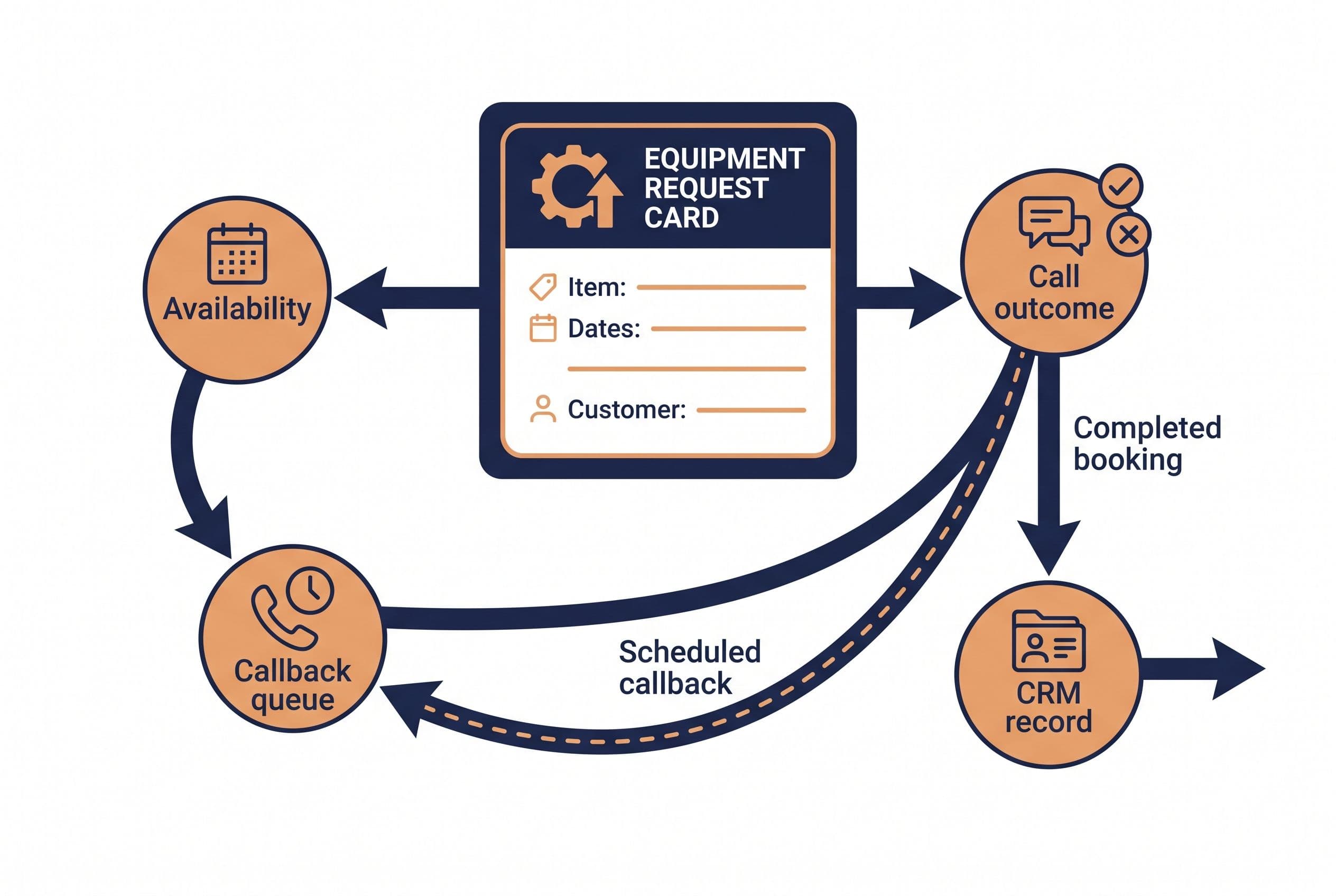
I'd scope rental callbacks around the equipment request: what the customer needs, which branch can supply it, when they need it, and when somebody should call again. A list of phone numbers doesn't capture that decision.
Equipment availability follow-up also needs a stop condition. Once a customer books, declines, or no longer needs the equipment, the queue should stop surfacing that request. Otherwise, faster dialing just creates faster mistakes.
My relevant build experience here is workflow automation, not a rental dialer case study. This is a real, anonymized project; it isn't evidence of rental-dialer savings.
I built an automated SEO publishing platform that takes Google Keyword data through topic selection, Claude drafting, and reviews by Grok, Gemini, and ChatGPT. When any two reviewers agree on a change, Claude implements it. The pipeline also includes Sapling.ai checks, generated images, scheduling, built-in analytics, and a Zapier integration that pushes posts to Facebook and the Google Business profile.
The result was automated publishing without a content team behind it. I don't have a disclosed build cost or previous operating bill for that project, so I won't invent a payback period.
The connection is the handoff logic. In that platform, review agreement determines the next action. In a rental callback queue, availability, customer response, and booking status would determine it. That's the part I'd investigate before selling you another dialing interface.
For a broader budgeting framework behind that distinction, I explain what custom software actually costs.
Availability rules and CRM write-backs move the quote
When I quote a Zoho CRM rental follow-up integration, three things move the build price most: the source of availability, the rules for calling, and the reliability of the CRM connection.
Availability comes first. Is equipment availability stored in a rental platform, a branch spreadsheet, or somebody's memory? An integration can retrieve a status. It can't make an unreliable status trustworthy.
I'd establish whether the callback screen shows confirmed availability or only a prompt to check. Those are different promises to your counter staff—and your customer.
Queue rules come next. I'd write down:
- What puts a rental request into the queue.
- Who owns it when multiple branches could fill it.
- What counts as an attempted call versus a completed conversation.
- When a callback becomes due again.
- What removes the request from future calling.
CRM write-backs are the third cost driver. A completed call might need an outcome, a note, an assigned owner, and a next action. I'd check the actual Zoho permissions, API rate limits, and available integration methods before fixing the scope.
Webhooks can pass events between systems where supported. They still need duplicate handling and a recovery path when a request fails. A call shouldn't disappear just because its CRM update didn't land.
That's the same boundary I cover in connecting systems without creating another round of duplicate entry. I want one clear owner for each record, not two applications quietly disagreeing.
I'd skip predictive dialing, AI call summaries, and a new CRM unless they're necessary to the business case. A focused callback workflow is a different job from rebuilding a contact center.
Keeping 20 seats costs $31,680 before the workaround
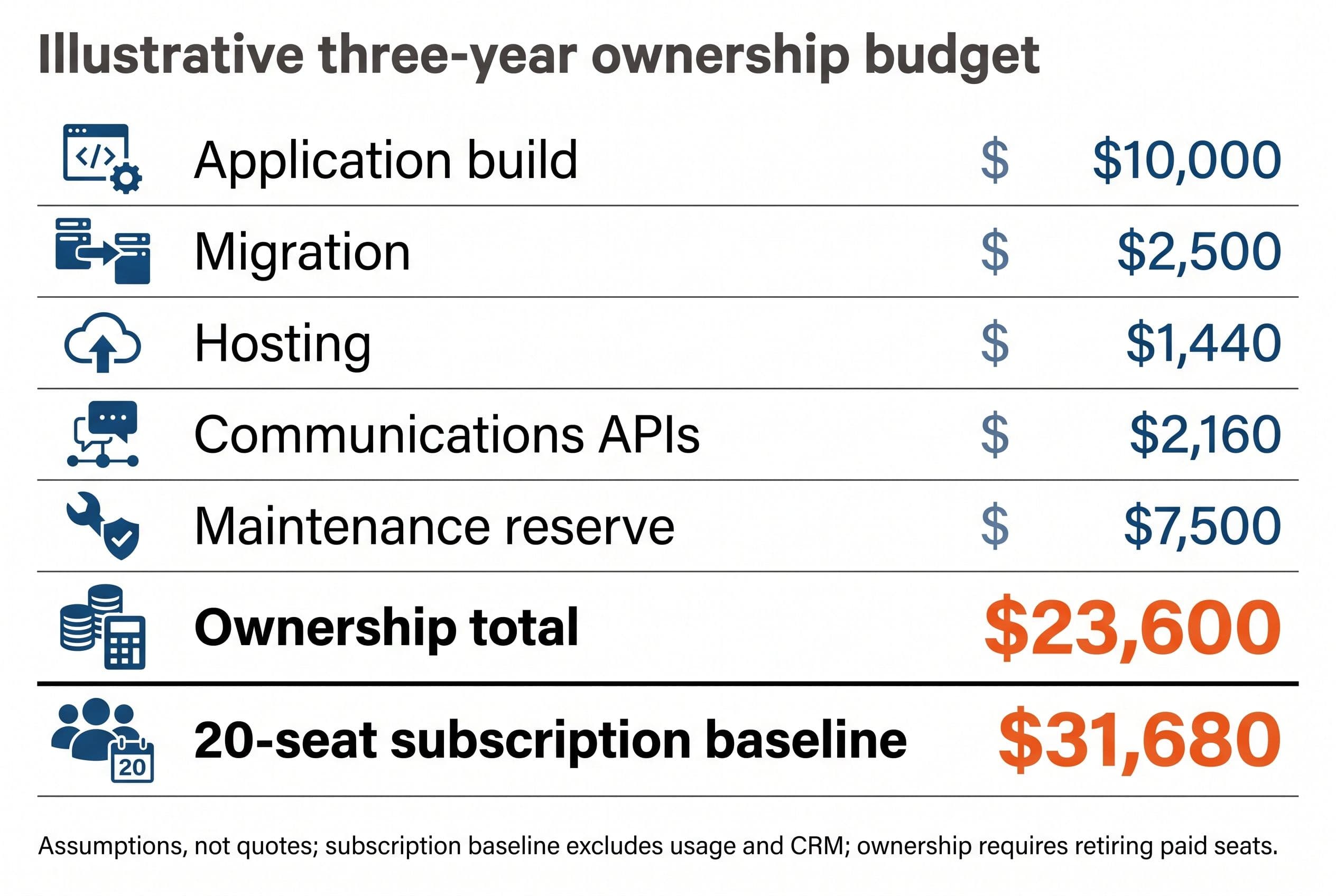
Here's an illustrative three-year budget, not a client result or a fixed quote. I'm using 20 users, unchanged published subscription rates, and a custom workflow that can genuinely replace those paid dialing seats.
For the custom side, I'm assuming a $10,000 application build and a separate $2,500 migration work package. Both are planning inputs within my published project ranges; the final scope determines whether those allocations hold.
I'm also reserving $40 monthly for hosting, $60 monthly for communications/API usage, and $2,500 annually for maintenance. Those are hypothetical budget allowances, not prices for any named provider or a maintenance offer. Usage and support requirements could change them.
| Three-year line item | Keep Zoho power dialer | Own the callback workflow |
|---|---|---|
| Voice Basic licenses: $34 × 20 × 36 | $24,480 | $0 only if fully retired |
| Dialer add-on: $10 × 20 × 36 | $7,200 | $0 only if fully retired |
| Application build | $0 | $10,000 assumed |
| Migration work package | $0 | $2,500 assumed |
| Hosting: $40 × 36 | Included or extra under your agreement | $1,440 allowance |
| Communications/API usage: $60 × 36 | Extra; use actual usage charges | $2,160 allowance |
| Maintenance: $2,500 × 3 | Contract-dependent | $7,500 reserve |
| Subtotal before exclusions | $31,680 plus unpriced charges | $23,600 budget |
I haven't charged Zoho a made-up usage rate to make the custom column win. Its usage charges remain unpriced here. CRM licenses, taxes, and any other retained systems also sit outside both totals; add actual differences before making the decision.
The visible gap is $8,080 over three years. That's a preliminary comparison, not guaranteed savings. If you must retain the Voice licenses for inbound calling or other functions, most of that proposed saving disappears.
The workaround deserves a line too. Suppose—purely for illustration—staff spend one avoidable hour each week rebuilding callback lists, valued internally at $30 an hour. Across 52 weeks and three years, that's $4,680 of staff capacity. It isn't cash savings unless you actually avoid an expense; otherwise, it's time available for other work.
Don't credit the build with recovering all of it before testing the workflow.
At 10 seats, the $15,840 subscription subtotal is below this $23,600 ownership budget. I'd keep the existing product if it handles your workflow, the bill is too small to repay the switch, or your Zoho ecosystem can't be separated without breaking useful processes. Don't hire me just to replace a subscription that already earns its keep.
Send the actual bill and I can check which charges a replacement could remove, rather than comparing two totals that buy different things.
Send us your software bill
Bring what you pay today. We'll tell you plainly whether a replacement would pay for itself, or whether you should keep renting.
The distinction between avoidable seats and retained licenses also drives the decision to rent a CRM or own its replacement. Seat creep matters only when the replacement actually lets you cancel seats.
I'd ship the callback loop before touching the business number
My smallest useful scope would be three working views: a callback queue, the customer's rental request, and the call outcome. I'd keep Zoho CRM if it's doing its job and replace only the layer causing the problem.
For a medium build, I'd target the published 2–4-week delivery window after agreeing the scope and confirming integration access. Phone-number porting or delayed access to an external system can affect go-live separately; I won't promise a carrier's completion date.
I'd break the work into this sequence:
- Map the records. Match customer IDs, rental requests, owners, and suppression preferences before importing anything.
- Build the queue. Show the reason for each callback and the availability information staff can actually trust.
- Wire up calling. Evaluate a service such as Twilio for the communications layer while keeping the workflow in the custom application.
- Write outcomes back. Record the result, next action, and any failed synchronization that needs attention.
- Test the exceptions. Cover duplicate requests, unanswered calls, stale availability, and a booking made while a callback is pending.
- Cut over with a fallback. Keep the existing path available until inbound and outbound behavior has been checked.
Business phone number migration is a separate dependency, not a checkbox at the bottom of the build. I'd confirm number control, porting eligibility, account details, routing requirements, and a fallback before changing service. My business-number porting checks explain the questions I'd settle first.
Your planned involvement is a scoping call, a short weekly review, and a final test pass. You'll also need to supply account access and approve the record mapping. I won't pretend I can decide your branch rules without you.
What makes owning cheaper—and what erases the saving
A narrow scope makes custom dialer ownership cost manageable. Keeping a working CRM, importing only needed records, and using straightforward callback rules avoids paying to reproduce software you already have.
A full historical-recording migration, different permissions at every branch, or replacing inbound telephony changes the job. I'd price those explicitly rather than hide them behind “integration included.”
Here's how I'd compare the purchasing options:
| Option | What you're buying | The trade I'd examine |
|---|---|---|
| Keep Zoho power dialer | An existing subscription and its supported workflow | Recurring seat costs versus avoiding a migration |
| Add a narrow custom queue | Rental-specific workflow around retained systems | Better fit, but potentially little license saving |
| Replace the dialing workflow | Custom application plus ongoing communications services | More control, with maintenance and service bills still attached |
| Hire an agency hourly | Development capacity against an evolving scope | A rate isn't a total project budget |
| Hire an employee | Ongoing internal development capacity | Appropriate for a continuing backlog, not automatically for one callback tool |
Hourly billing that rewards slow work is a bad match for a defined callback queue. So is paying for months of discovery before anyone will show you a range. I use AI-assisted development to shorten the build, then quote the agreed deliverables at a fixed price.
That doesn't remove the need for testing, maintenance, or communications services. Owning the application doesn't mean owning the telephone network.
I'd also question an offshore quote that excludes migration, testing, and handoff. Compare the whole job, including who fixes a failed CRM write-back after launch—not just the cheapest development line.
For an early scope check, the free project estimator at free project estimator shows the range on screen before it asks who you are. A calculator that hides its number until you've surrendered an email address isn't helping you budget.
The handoff must let another developer run your queue
My fixed price covers the agreed scope: overruns are my problem, not yours. If you add a branch workflow or a new integration, I'd price that change before building it.
The code lives in your own repository from day one. The contract transfers ownership of the custom code and source to you on final payment; I retain only generic reusable components, and third-party libraries and services keep their own license terms.
That's a legal distinction worth making. Repository access isn't the same thing as ownership before payment.
I'd hand over the source, deployment instructions, data mapping, environment configuration guidance, and integration recovery procedures. With the source and handoff documentation, another developer can take over without reverse-engineering how the callback queue works.
I'd also make account control part of acceptance. Your business should control the service accounts it needs to operate the application. Replacing per-seat licensing with a developer who alone holds the keys is a bad trade.
For a Zoho power dialer replacement, my final test isn't “can it place a call?” It's whether the right rental request appears, the outcome reaches the right record, and a booked customer stops appearing in the queue.
This week, pull your current phone-and-dialer bill and use the ninety-second estimator to price the replacement: range first, form second, then a fixed quote back inside a business day after submission—so you can decide whether switching earns its keep.
Want a real number for your own project?
Answer a few questions and get an instant price range and timeline. No call required, no obligation.
Get your instant estimateTalk through your software project with MattFrequently asked questions
- How much does Zoho power dialer cost for 20 users?
- Squaretalk's July 2026 breakdown lists Zoho Voice Enterprise Telephony Basic at $34 per user monthly, billed annually, and CloudTalk's August 2026 breakdown lists the power dialer add-on at $10 per user monthly. Together, that calculates to $880 monthly or $31,680 over three years for 20 users, before CRM licensing, usage, taxes, and other charges. Confirm your package and terms with the vendor.
- Can I keep Zoho CRM and build a custom rental callback queue?
- I'd check that option before proposing a CRM replacement. The scope depends on your available integration access, record mapping, availability source, and the call outcomes you need written back. Keeping the CRM may reduce migration work, but retained licenses aren't savings.
- What does a custom dialer for equipment rental cost?
- I'd initially assess a focused integrated callback application against my medium-build range of $5,000–$15,000 over 2–4 weeks. Complex real-time features or branch rules can put it in the advanced range of $10,000–$20,000 over 4–6 weeks. Migration, hosting, communications usage, and maintenance must be budgeted explicitly.
- Can I keep my business phone number when replacing a dialer?
- Possibly, but I'd confirm number control, porting eligibility, routing requirements, and provider procedures before committing to a cutover. Keep the existing service active until the migration and incoming-call behavior have been verified. A software delivery window isn't a guarantee of carrier porting time.
- When is keeping Zoho power dialer cheaper than owning software?
- Keeping it wins when the subscription is inexpensive relative to the full ownership budget, the existing workflow works, or the replacement can't retire the paid licenses. In this article's illustrative comparison, 10 seats cost $15,840 over three years before extras, below the $23,600 custom ownership budget. Compare actual usage, retained systems, and migration costs before deciding.
What would software built for your business look like?
Replacing a subscription, fixing software that fell short, or adding AI to your workflow? Talk through the scope with Matt.
Part of these guides
Matt Brody
Founder, BuiltInWeeks
I build custom software for small and mid-sized businesses — the kind you own outright instead of renting by the seat. Fixed price, delivered in weeks, source code handed over at the end.
More about how I workKeep reading

Integrated Business Management Software: Dental Costs
I'd budget $5,000–$15,000 for a scoped dental operations app with integrations—not a replacement for your entire clinical system. Here's how I separate the build from migration, hosting, API access and maintenance, then compare it with three more years of renting.
Read more
Aircall Alternative for Small Sales Team: Porting Checks
I'd pick the replacement only after checking whether your numbers, routing, and sales workflow can move safely. Here's the checklist I'd use before authorizing a port—and the three-year math that decides whether custom software belongs on your shortlist.
Read more
Launch27 Pricing: $5K–$20K to Own a Multi-Crew Booking App
Launch27 starts at $75/month; replacing it isn't automatically a better deal. I walk through a recurring cleaning booking, the migration risks, and the three-year math behind owning a multi-crew app.
Read more