Launch27 Pricing: $5K–$20K to Own a Multi-Crew Booking App

Launch27 costs $75 or $299 a month; ownership starts with scope
Launch27 pricing starts at $75/month for Base. I'd scope a focused custom replacement at $5,000–$15,000, or $10,000–$20,000 when crew availability and recurring-booking rules get complicated. Those are fixed-price build ranges, not a promise to reproduce every Launch27 feature.
According to Launch27's published pricing, verified in September 2026, Base includes unlimited users and bookings, customer and cleaner databases, and a basic branded booking form. Plus costs $299/month and includes booking invitations to teams, automatic card pre-authorization and charging, mobile app access, and a referral engine.
Here's the important correction: Base already includes unlimited users. I wouldn't sell you a replacement by pretending every cleaner adds another paid seat. That's a legitimate objection to some software, but it isn't the argument here.
| Option | Published subscription or my build range | Billing or delivery |
|---|---|---|
| Launch27 Base | $75/month or $765/year | Subscription |
| Launch27 Plus | $299/month or $3,049.80/year | Subscription |
| My medium build | $5,000–$15,000 | Fixed price; 2–4 weeks |
| My advanced build | $10,000–$20,000 | Fixed price; 4–6 weeks |
My medium range fits a bounded booking app with integrations and user roles. Complex scheduling rules push the work into advanced territory. Hosting, maintenance, messaging, and payment processing remain operating expenses after delivery.
For the wider budgeting context, I explain what custom software actually costs. Here, I'd make the decision around one workflow: a recurring cleaning appointment that needs a different crew, a different time, and a correct charge.
Follow the rescheduled clean, not the feature checklist
Here's an illustrative workflow—not a client story or a claim that Launch27 can't handle rescheduling.
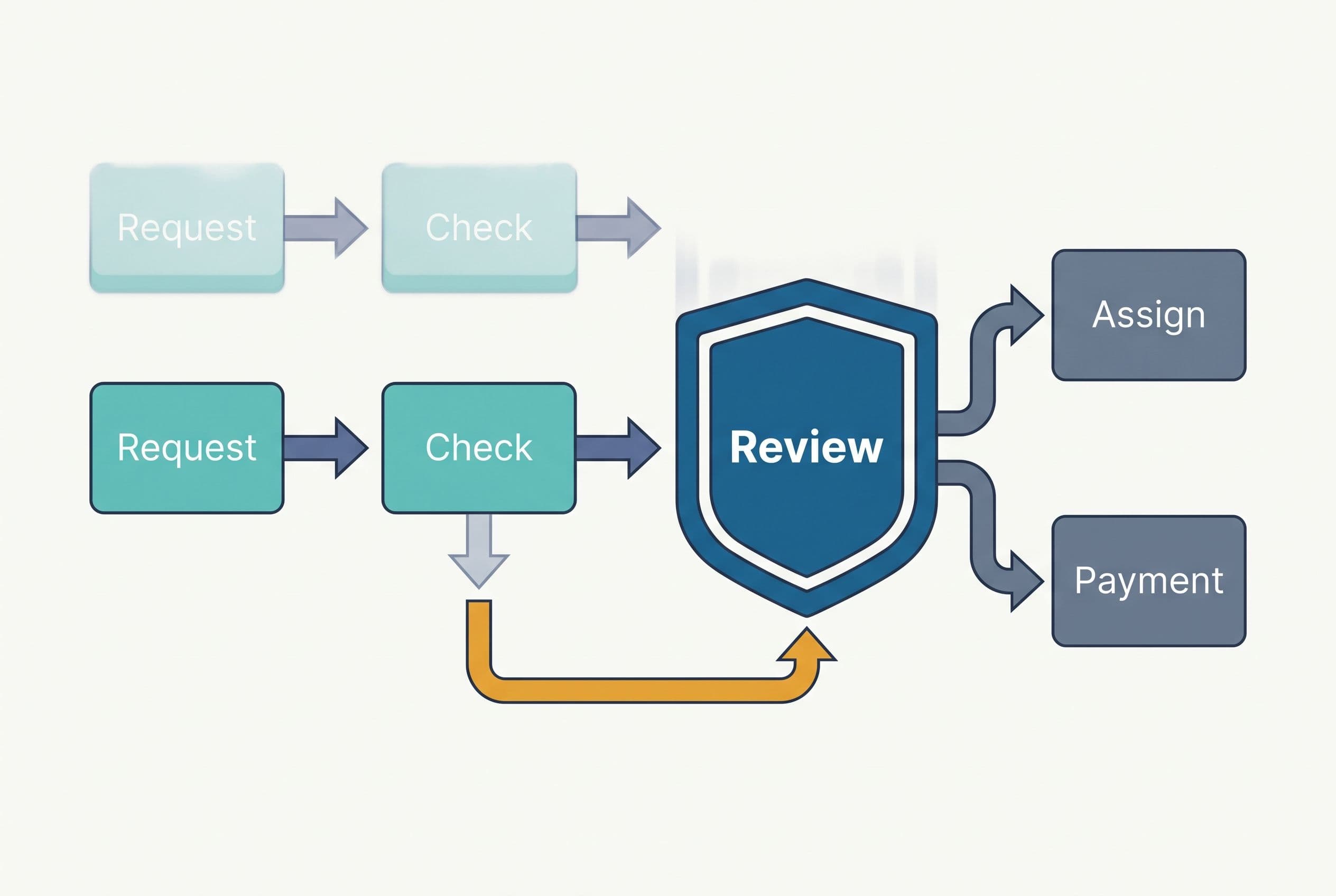
A customer moves a recurring Friday clean to Thursday. The usual crew isn't available. Someone in the office finds another crew, checks the service duration, confirms the address, and decides whether the change applies to this visit or the whole series.
Then payment enters the picture. Has a card already been authorized? Does the changed service have a different price? Which appointment should the eventual charge belong to?
The failure to look for is duplicate handling. If your office updates the booking, a separate crew spreadsheet, and a message thread, the software hasn't finished the job. It's handed the hard part back to a person.
I wouldn't assume that failure exists in your business. I'd ask you to walk me through a real reschedule and show where information gets re-entered or checked outside the system.
That's the same boundary question behind pricing a scheduler around its actual booking rules: displaying an open slot isn't the same as having the people, travel time, and equipment to fulfill it.
I have built a different kind of multi-step workflow: an automated SEO blog platform that moves from keyword research through drafting, review, publishing, and distribution. Claude writes the drafts; Grok, Gemini, and ChatGPT review them; when any two agree on a change, Claude implements it. A Zapier integration pushes published content to Facebook and the Google Business profile.
That's a real client project; the client is unnamed. It publishes without a content team, but I wasn't given its build price or a dollar savings figure, so I can't claim a payback period—and it isn't evidence of a cleaning booking deployment.
The relevant lesson is narrower. I built explicit rules for when work moves to the next step. In a booking system, I'd use explicit rules too, with a human approving ambiguous schedule changes rather than letting automation guess.
Launch27 pricing and the cost of keeping your workflow over three years
Before I propose a replacement, I'd price staying put. Launch27 pricing alone makes a strong case for renting if the product handles your work.
At unchanged published rates, Base costs $2,700 over three years on monthly billing, or $2,295 through three annual payments. Plus costs $10,764 monthly, or $9,149.40 through three annual payments.
Those are subscription calculations, not forecasts of future prices.
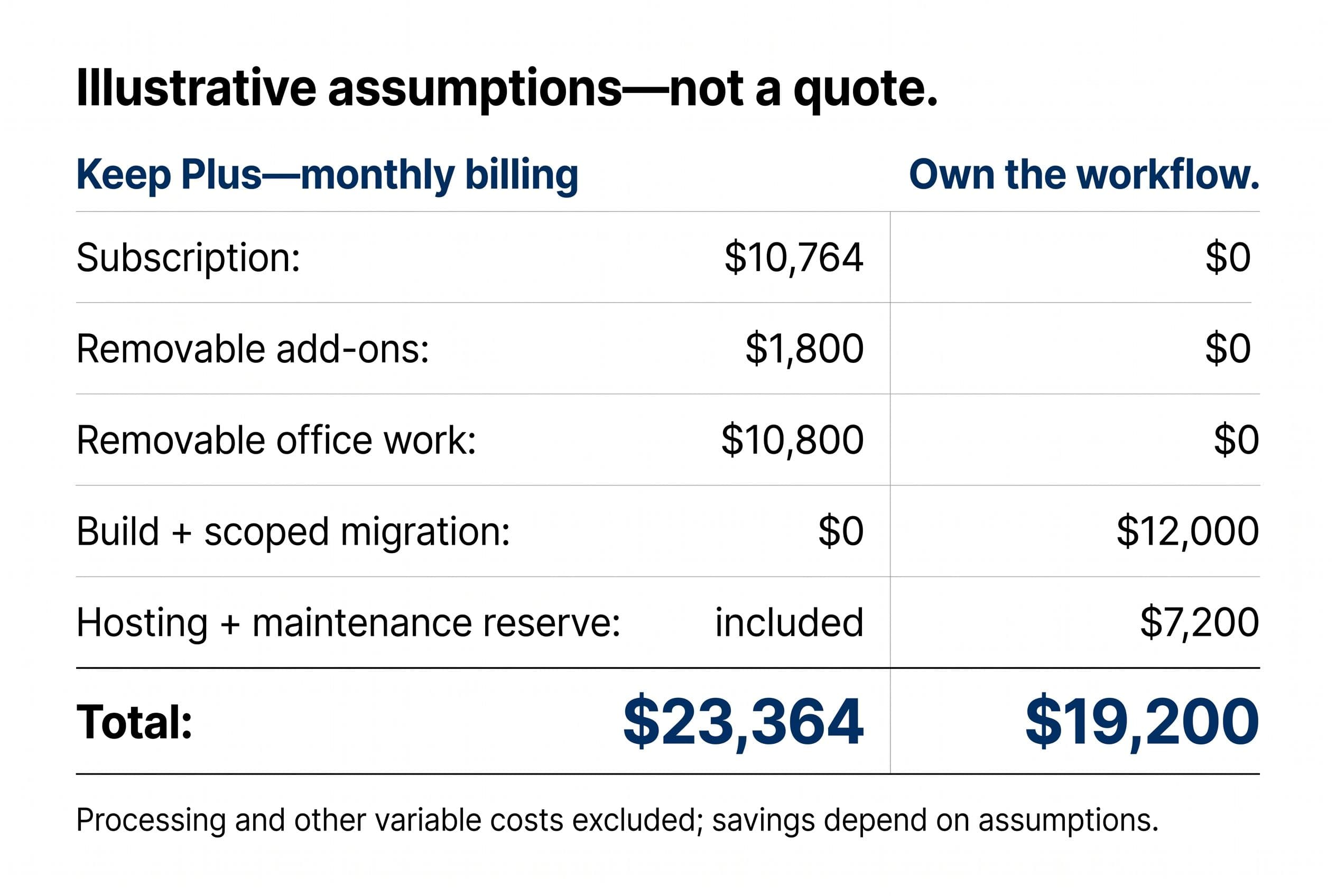
The replacement case needs more than that bill. Here's illustrative arithmetic, using assumed expenses—not a client result, a vendor price list, or an operating-cost quote from me.
| Three-year cost | Keep Plus, billed monthly | Own a focused replacement |
|---|---|---|
| Launch27 subscription | $10,764 | $0 after cutover |
| Assumed removable add-ons: $50/month | $1,800 | $0 |
| Assumed removable office work: $300/month | $10,800 | $0 |
| Illustrative fixed build, including scoped migration | $0 | $12,000 |
| Assumed hosting budget: $75/month | Included in subscription | $2,700 |
| Assumed maintenance reserve: $125/month | Included platform upkeep | $4,500 |
| Modeled total | $23,364 | $19,200 |
In that model, ownership costs $4,164 less over three years. Annual Plus billing narrows the difference to $2,549.40.
But the assumptions carry the argument. The add-ons must actually disappear. The office work must actually stop. Recovered employee time isn't automatically cash saved unless it reduces spending or supports useful additional work.
Payment processing is excluded from both columns because both paths still need it; I'd add any difference after checking the processor arrangement. Messaging, temporary subscription overlap, taxes, and future feature changes also need their own budget where applicable. The maintenance reserve isn't a guarantee that every future request fits inside it.
If your bill is small and Launch27 already handles the workflow, keep renting. Don't hire me to replace a working $75/month subscription just to say you own the code. Staying also wins when essential integrations or operating habits would be expensive to recreate.
I use the same discipline when comparing subscription costs with code ownership: count the costs that change, not every frustration in the business.
Crew rules, recurring series, and card handling move the quote
Once the three-year math survives, I'd investigate the scope. For Launch27 custom replacement cost, these are the biggest moving parts.
Crew availability is more than an empty calendar square
I'd establish whether bookings consume an individual cleaner, an entire crew, or a flexible group. Then I'd account for service duration, travel buffers, working areas, and any job-specific requirements.
A manual crew assignment screen is less work than automatic assignment across changing constraints. I'd start with manual assignment if the office can make that decision quickly.
The acceptance test matters: two customers attempting to book the last available slot must not both receive confirmation. That's a database and concurrency problem, not a prettier-calendar problem.
A recurring booking is a series plus its exceptions
I need separate rules for changing one visit and changing future visits. Skips, pauses, cancellations, price changes, and crew substitutions must preserve the right relationship to the series.
This is where recurring booking migration gets expensive. A customer export may be straightforward while a recurring schedule contains exceptions that don't fit the new model without interpretation.
I'd inspect sample exports before quoting. I won't assume Launch27 exposes every record or field needed through an export or API without checking your account's actual access.
Payment processor integration includes the bad days
I'd distinguish an appointment from an authorization, a charge, a refund, and a failed payment. They're related records, not interchangeable statuses.
For a Stripe integration, I'd design webhook handling so a repeated event doesn't create a repeated action. I'd also define what happens when a customer closes the browser, a network request times out, or the office changes the booking after authorization.
I wouldn't promise saved payment methods can migrate until the processor account, permissions, and transfer path are confirmed. A customer CSV isn't a portable card vault.
The quote should name the booking work, not hide it in discovery
Here's how I'd break out a multi-crew cleaning booking software scope. I wouldn't attach invented menu prices to each row; these pieces share data and rules, so the fixed total depends on how they fit together.
| Quote line item | What I'd define before committing |
|---|---|
| Customer booking | Services, duration, availability, confirmation, cancellation |
| Office dispatch | Crew assignment, conflicts, exceptions, manual overrides |
| Recurring series | Frequency, one-visit changes, future changes, pauses |
| Payments | Authorization, charging, refunds, failures, reconciliation |
| Migration | Included records, recurring exceptions, import rehearsal, cutover |
| Handoff | Source access, deployment details, operating instructions |
For a medium build, I'd quote $5,000–$15,000 over 2–4 weeks. For complex rules or real-time coordination, I'd use $10,000–$20,000 over 4–6 weeks. Processor approvals or unresolved data access can hold up go-live; I'd separate those dependencies from development work.
Cleaning booking migration costs belong in the written scope. In the earlier illustrative $12,000 build, migration is included—not a surprise invoice after the app is finished.
What makes it cheaper? A responsive web app instead of separate native apps, office-approved crew assignment, one payment processor, and migration of agreed active records rather than every historical artifact.
What makes it grow? Referral systems, payroll calculations, route planning, multiple brands, offline behavior, and undocumented recurring-booking exceptions. I'd skip those unless they're necessary to leave the current system.
Launch27 pricing also includes features you might never use. Rebuilding all of them is a bad trade.
An agency may bring broader staffing; it may also put five people on a two-person job. An offshore team may offer a lower hourly rate, but that doesn't settle who specifies the recurring rules, checks imports, or pays for a rewrite. I'd compare accepted scope and handoff terms, not just rates.
Months of paid discovery ending in a slide deck aren't progress toward a working booking system. Neither is hourly billing that rewards slow work.
Rehearse the Thursday move before customers touch it
For the common case, I'd build the replacement around that rescheduled recurring clean—not start with an AI assistant or an elaborate dashboard.
My preference would be a responsive Next.js app with Postgres storing bookings, crew assignments, recurring-series relationships, and payment references. The stack matters less than keeping those records explicit and testable.
Here's how I'd move the workflow across:
- Map the current booking. Document where the office checks availability, edits the series, contacts the crew, and handles payment. Mark every manual exception.
- Inspect migration inputs. Review customer, crew, service, future-booking, and recurring-series data. Flag missing fields and payment references before promising a clean import.
- Rehearse in a staging environment. Import a copy, compare counts and representative records, and test skipped visits, changed prices, and crew substitutions.
- Put exceptions in front of a person. Conflicts and uncertain mappings go into a review queue. They don't silently become confirmed appointments.
- Test failures deliberately. Retry a payment event, interrupt a booking request, and reject an unavailable crew assignment. Verify the office can see and recover the failed action.
- Cut over with one active writer. Establish which system controls bookings and charges, account for last-minute changes, and keep a documented recovery path. I wouldn't let both systems independently charge the same visit.
For human review, I'd give the office the proposed new date, crew, price, and affected visits before approval. The system can check constraints; a person resolves the exceptions.
If customers send free-form rescheduling requests, AI could draft the intended change for review. I wouldn't let it invent availability or independently approve a charge. AI features multiply my build range by 1.25, with my overall published envelope capped at $25,000; I'd leave them out unless the workload justifies them.
Your planned involvement would be a scoping call, a short weekly review, and a final test pass. I'd also need an accountable person to resolve migration exceptions. Dirty data can demand more of your time, and I'd rather say that before quoting.
Settle the Launch27 decision with your own booking rules
To turn the Launch27 pricing comparison into a fixed quote, I'd need your current plan and add-ons, a sample export, the processor arrangement, and examples of the reschedules your office finds difficult. I'd also need a clear list of features that must survive the move.
At BuiltInWeeks, fixed price means overruns on the agreed scope are my problem, not yours. New scope gets discussed before it changes the bill.
The code lives in your own repo from day one. The contract transfers ownership of the custom code and source on final payment; I keep only generic reusable components, and third-party libraries and services retain their license terms. With the source and handoff documentation, another developer can take over.
That's ownership with an exit path—not a claim that software never needs maintenance.
“I don't want to rebuild Launch27. I want to know whether owning the booking workflow will cost less than paying for it and fixing it by hand.”
Use the free project estimator at free project estimator to settle that question: five questions, about ninety seconds, and your range appears before any form asks who you are. Submit the scope for a fixed quote back within one business day.
Want a real number for your own project?
Answer a few questions and get an instant price range and timeline. No call required, no obligation.
Get your instant estimateTalk through your software project with MattFrequently asked questions
- How much does Launch27 cost in 2026?
- Launch27's pricing verified in September 2026 lists Base at $75/month or $765/year, and Plus at $299/month or $3,049.80/year. Base includes unlimited users and bookings. I'd confirm your required features and current terms before comparing it with a replacement.
- How much does a custom Launch27 replacement cost?
- I'd scope a focused replacement at $5,000–$15,000 over 2–4 weeks. Complex crew availability and recurring-booking rules can put it in my $10,000–$20,000 range over 4–6 weeks. Those are build ranges; operating expenses remain separate.
- Can recurring bookings and saved cards migrate from Launch27?
- I'd inspect the available exports and processor arrangement before promising either. Recurring bookings need their exceptions, pauses, and future changes checked—not just customer records copied. Saved payment methods depend on processor permissions and transfer support, not a standard customer CSV.
- What affects cleaning booking migration costs?
- I'd price migration around the included records, data quality, recurring-series exceptions, and payment references. Import rehearsals, reconciliation, and a cutover plan belong in the scope. I wouldn't quote migration from customer count alone.
- Is replacing Launch27 cheaper than keeping it?
- Not necessarily: at unchanged annual pricing, three years of Base costs $2,295 and Plus costs $9,149.40. A replacement also needs migration, hosting, and maintenance. I'd keep Launch27 when it handles the workflow and there's little additional spending or manual work to remove.
What would software built for your business look like?
Replacing a subscription, fixing software that fell short, or adding AI to your workflow? Talk through the scope with Matt.
Part of these guides
Matt Brody
Founder, BuiltInWeeks
I build custom software for small and mid-sized businesses — the kind you own outright instead of renting by the seat. Fixed price, delivered in weeks, source code handed over at the end.
More about how I workKeep reading

Monday.com Alternative: ROI Math for Teams Over 15
At 20 paid seats, Monday.com Pro works out to $4,560 a year using the published annual-billing rate. I walk through a quote-to-job workflow, the three-year replacement math, and the migration work that decides whether owning the software is worth it.
Read more
Alternative Calendly: Custom Scheduler Costs $2.5K–$20K
I price custom schedulers from $2,500–$20,000 before AI features, but replacing a cheap booking link rarely pays. Here's the arithmetic, the scope that moves the quote, and the recurring costs that don't disappear when you own the code.
Read more
Aircall Alternative for Small Sales Team: Porting Checks
I'd pick the replacement only after checking whether your numbers, routing, and sales workflow can move safely. Here's the checklist I'd use before authorizing a port—and the three-year math that decides whether custom software belongs on your shortlist.
Read more