Leaving monday.com: $5K–$15K Build, and Who Owns the Code

Your monday.com bill went up again. You hired someone, and they got a seat whether or not they ever open a board. If you're leaving monday.com for a custom replacement, most builds I'd scope fall in our medium tier: $5,000–$15,000, fixed, delivered in 2–4 weeks. That covers a multi-board workflow, user roles, and a few integrations.
If your all-in bill is only a few hundred dollars a month, renting probably wins, and I'll show you the math below. If it's more than that, keep reading, because the price usually isn't what goes wrong. Ownership is. The World Intellectual Property Organization puts it bluntly: when you hire an outside developer, in most places the developer keeps IP ownership unless a software development agreement assigns it to the client. So you can pay for a replacement in full and still not own it.
The five line items in a monday.com replacement
Most quotes give you one number. I'd rather show you how it splits, because most surprises come from the lines that aren't the build itself.
| Line item | What it covers | Figure used in this post | Where the number comes from |
|---|---|---|---|
| Build | Boards rebuilt as real screens, roles, automations, notifications | $5,000–$15,000 fixed | Our medium-tier pricing |
| Migration | Exporting boards, mapping columns to Postgres tables, checking row counts | Inside the fixed quote | I scope it as its own line, but I don't bill it separately |
| Hosting | Next.js app on Vercel, database on Supabase | Assumed $50/mo | Illustrative. Both are usage-based, so check your tier |
| APIs | SendGrid email, Twilio SMS, Slack webhooks | Assumed $25/mo | Illustrative. Usage-based, so it scales with volume, not headcount |
| Maintenance | Dependency updates, small changes, the odd fix | Assumed 10 hrs/yr at $150/hr | A high-end U.S. contractor rate. I picked a high one so the math doesn't flatter me |
Some notes on the assumptions. Hosting and API costs depend on usage, so a 15-person ops team pushing a few thousand records a month pays something very different from a team sending 50,000 SMS. The $50 and $25 are placeholders I'm using to do the arithmetic. They aren't quotes from Vercel or Twilio.
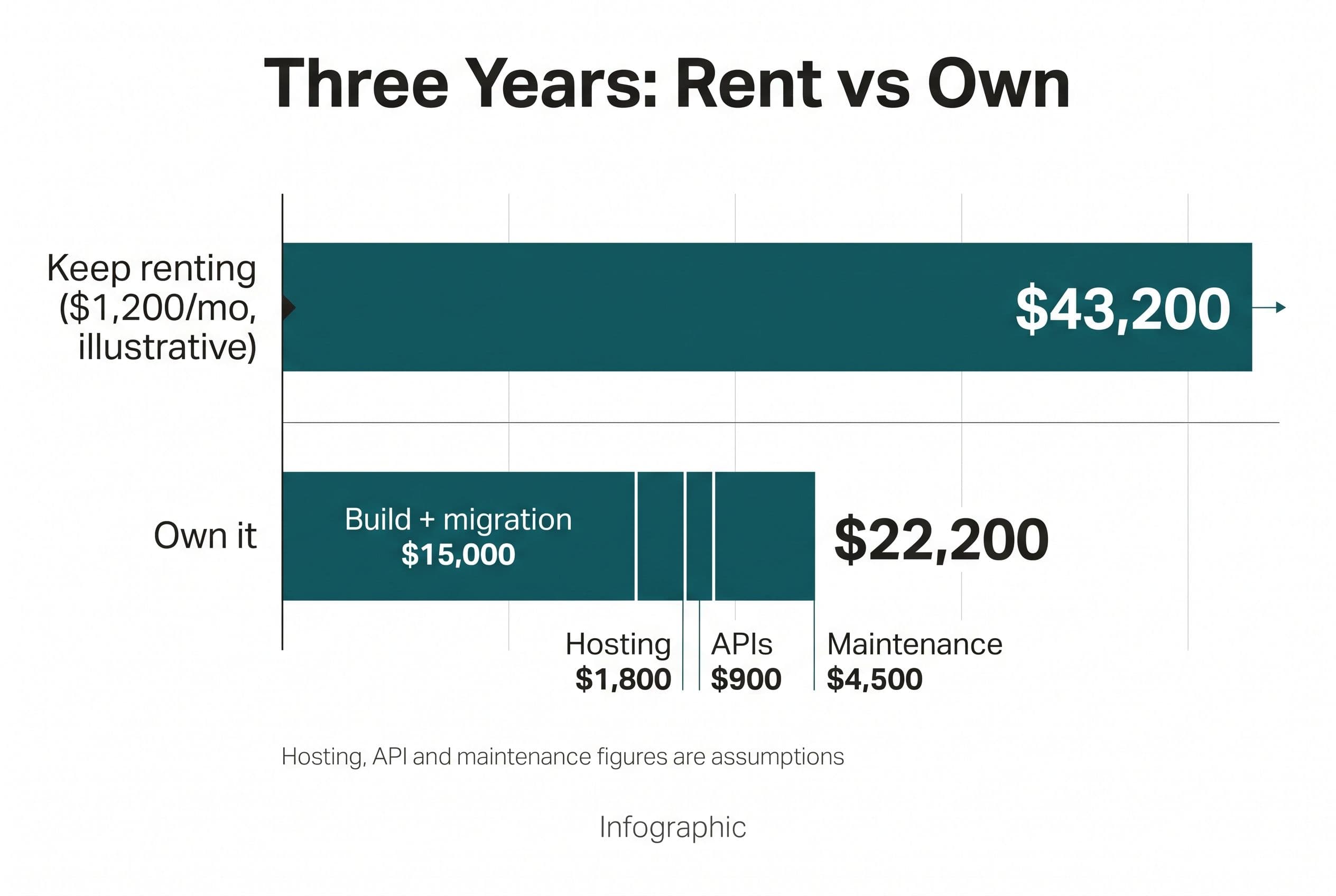
Over three years, those lines add up to:
- Top of range: $15,000 build + $1,800 hosting + $900 APIs + $4,500 maintenance = about $22,200
- Bottom of range: $5,000 + $1,800 + $900 + $4,500 = about $12,200
Now your side. monday.com charges per seat, and the bill goes up every time you hire, whether or not the new person ever opens a board. Add the Zapier plan you're paying for because native automations ran out, plus whatever add-ons you've picked up. That total is what you're actually spending. I broke this down by team size in the seat-by-seat math on monday.com's real cost.
If you don't want to dig the invoice out yet, put your seat count into the calculator below and get a rough number.
Price your stack in two minutes
List the subscriptions you pay for and see what they cost over 3, 5 or 10 years next to owning the software. No email needed to see the number.
What "owned outright" looked like on a $30K dialer
I'll be straight with you: I don't have a monday.com migration case study to show you yet. Here's the closest project I can point to. It wasn't a monday.com migration, but the ownership question was the same.
A sales team was paying about $30,000 a year for Kixie. The price kept going up, and the customization stopped short of what they needed. I built them a custom power dialer in React. Reps can call one lead at a time or dial up to 10 lines at once and connect only when someone picks up. It has unlimited users, custom lead lists, built-in automations, Zapier webhooks that fire follow-ups into their other systems, SMS templates, one-click voicemail drops, and real analytics. (A real client project; details generalized, numbers rounded, results vary.)
The build cost $10,000, a third of one year's licensing. It paid for itself in about four months.
For this post, the part that matters is how it ended up: owned outright, with zero monthly licensing fees. They still pay the carrier for minutes and texts, but that's usage, not seats. The client stopped paying rent on their own sales process, and no future license increase can touch it. If dialers are your problem rather than boards, here's how a Kixie replacement compares.
Three years of renting next to three years of owning
This is where the decision gets made. The renting column below uses illustrative invoices, not monday.com list prices. Replace them with your own all-in monthly bill.
One honest admission first: at a $400/mo bill, owning is close to a wash. At the bottom of my range, a $5,000 build costs $12,200 over three years, which saves you about $2,200 against renting. That's not worth the disruption for most teams. At the top of my range, renting wins outright. At $1,200 a month, it's a different conversation.
| Small team, $400/mo all-in | Growing team, $1,200/mo all-in | |
|---|---|---|
| Keep renting, 3 years | $14,400 | $43,200 |
| Hosting + APIs, 3 years (assumed) | $2,700 | $2,700 |
| Maintenance, 3 years (assumed) | $4,500 | $4,500 |
| Own it, bottom of range ($5,000 build), 3-year total | $12,200 | $12,200 |
| Own it, top of range ($15,000 build), 3-year total | $22,200 | $22,200 |
| Verdict | Close call at the bottom (~$2,200 saved). Keep renting at the top | Owning saves ~$21,000–$31,000 |
The renting column also leaves things out. It assumes your seat count stays flat for three years, which it won't if you're growing. It also assumes the vendor never changes its pricing, and you don't control that.
The break-even is simple. Spread over 36 months, owning costs about $617 a month at the top of our range and about $339 at the bottom. If your bill is under the number for the build you'd need, renting wins.
Here's when to keep monday.com: your all-in bill is a few hundred dollars a month, your team uses the product roughly as designed, or you're tied into monday.com's other products in a way you can't untangle. In those cases a replacement won't pay back, and I'll tell you so. For the team-size version of this calculation, I did the ROI math for teams over 15 seats.
If you want someone else to run your numbers, send me the bill. I'll read it and tell you whether a replacement pays back. If it doesn't, that's what I'll say.
Send us your software bill
Bring what you pay today. We'll tell you plainly whether a replacement would pay for itself, or whether you should keep renting.
The contract clauses that decide whose code it is
Back to the WIPO point. If you're hiring an outside developer and your contract doesn't assign the IP to you, you probably don't own it, however much you paid. The details vary by country and by whether the person is an employee or a contractor, which is exactly why you want it in writing. Here's what to look for. (I'm not a lawyer, so have yours read the final draft.)
An IP assignment tied to final payment
The contract should say that ownership of the custom code and source code transfers to you on final payment. That's how ours works. Before that, you have access but not legal ownership. Seeing the code in a repo doesn't make it yours. The assignment clause does.
A carve-out for the developer's reusable parts
Every developer reuses things: auth scaffolding, UI components, deploy scripts. We keep our generic reusable components. Everything written for your business transfers to you. A good contract states that line clearly. A vague contract creates a dispute three years later.
Third-party terms stay with third parties
React, Next.js, Postgres, and Supabase's client libraries all come with their own licenses. Stripe and Twilio keep their own terms of service. Nobody can "transfer" those to you, so be wary of a contract that sounds like it does.
Fixed price, with overruns on the builder
Scope creep is common, and somebody always pays for it. On an hourly contract, that's you. On a fixed price, it's me. That's the reason I quote fixed.
For the broader version of this list, including what to ask about testing, communication, and who's actually writing the code, read what to ask before you hire a developer.
Whose name is on the hosting bill
The contract is half of ownership. The other half is the accounts.
Watch for agencies that host a client's app on the agency's own cloud account and bill it back with a markup. The client technically owns the code, but the database, domain, and API keys are all logged in under the agency. Leaving means asking the agency for permission. That's vendor lock-in again, just with a different vendor.
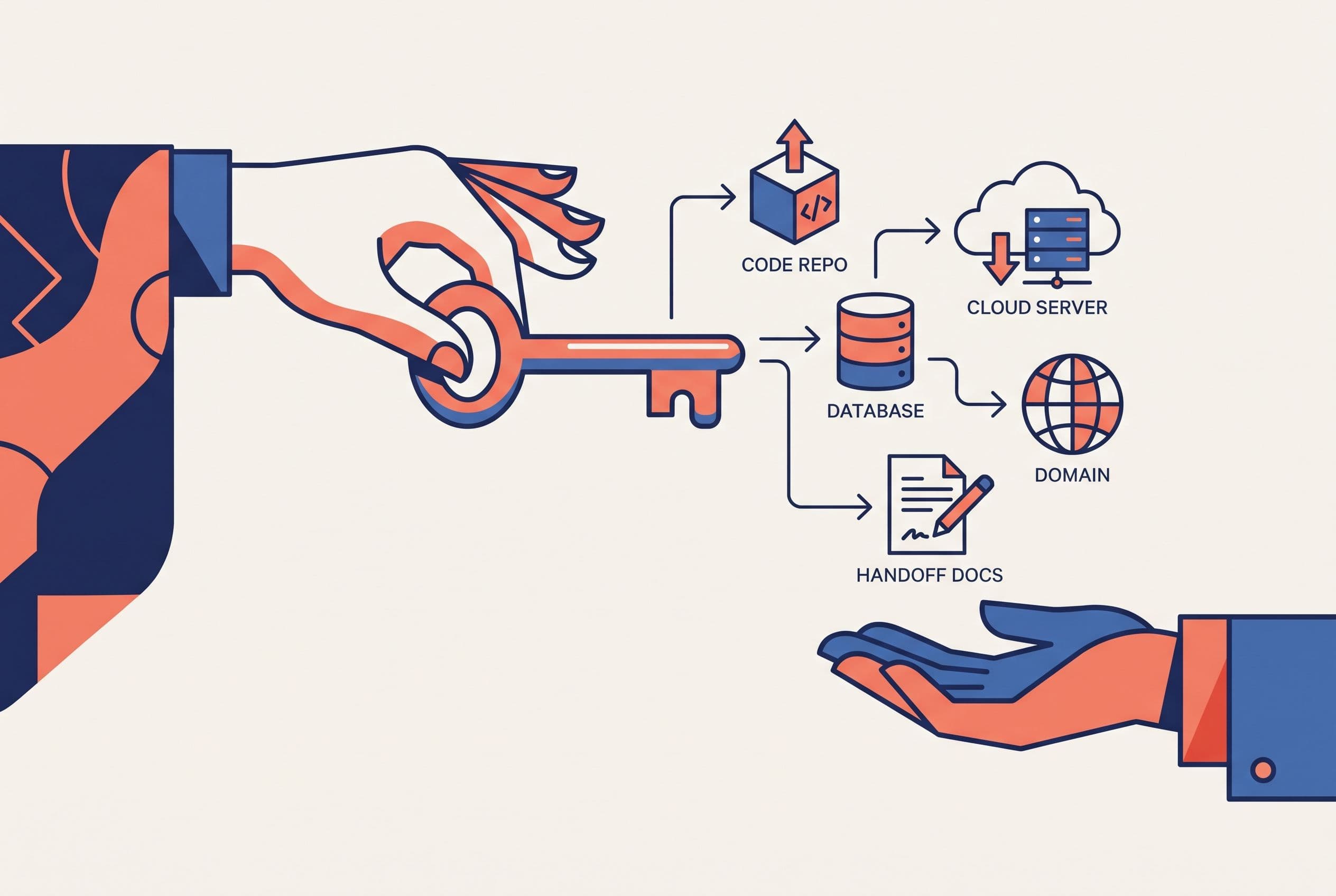
Client-owned hosting accounts solve this. Here's how I set it up:
- You create the Vercel, Supabase, GitHub, and domain registrar accounts, on your card.
- You create the Stripe, Twilio, and SendGrid accounts, so the API keys are yours.
- I get invited as a member and do the work.
- At handoff, you remove me.
The code lives in your repo from day one, so you can see every commit as it happens. Ownership of it transfers when the final invoice is paid.
The workflow software handover checklist
Use this list whether you hire me or someone else. If a developer won't agree to all of it, that's useful to know before you sign.
| Item | What "done" looks like |
|---|---|
| Source control | Repo in your GitHub organization, full commit history, not a zip file |
| IP assignment | Signed, transferring custom code and source on final payment |
| Hosting | Vercel and Supabase projects billed to your account |
| Domain and DNS | Registrar account in your company's name |
| Secrets | Every API key in an account you own. Environment variables listed in the docs |
| Data migration | Each monday.com board exported, mapped, and reconciled. Row counts match |
| Staging environment | A separate copy for testing changes, with deploy steps written down |
| Handoff documentation | Setup, deploy, data model, every integration and webhook explained |
| Access removal | Developer access revoked after sign-off, and you're the one who revokes it |
The migration row needs the most care. Exporting monday.com boards gets you the rows, but check what your plan's export includes for files, update threads, and activity history before you assume it's all coming across. Spot-checking a few records by eye isn't enough. Reconcile the counts table by table. On my builds, if the row counts don't match, the migration isn't done, and finishing it is still inside the fixed price. If you've done an Airtable migration, it's a similar job, and I walked through it in what replacing Airtable costs, migration included.
What moves your number up or down
Cheaper:
- Rebuild the three boards your team actually uses, not all 40 that have piled up.
- Drop the automations nobody would miss. Go through the list before scoping. You'll probably find a few.
- Use built-in tools where they're good enough, like Slack webhooks for notifications instead of a custom alert system.
More expensive:
- Migrating years of file attachments and comment threads.
- Integrations with systems that don't have a usable API.
- Client-facing portals, multi-tenancy, or real-time collaboration. That moves you into our advanced tier, $10,000–$20,000 over 4–6 weeks. The tiers overlap on purpose, but in practice an advanced build lands in the upper part of the medium range or above it.
- AI features such as auto-triage or summarization, which multiply the range by 1.25. On a $10,000 build, that's $12,500. The extra goes into testing, because AI output needs more checking before I'd hand it over.
What the same money buys elsewhere
| Option | How it's billed | Who owns the code by default | Who pays the overrun |
|---|---|---|---|
| U.S. agency / contractor | Hourly, at the top of the market | Usually the developer, unless assigned | You |
| Clutch-listed firms | Hourly, rates vary widely | Usually the developer, unless assigned | You |
| Toptal freelancer | Hourly, plus platform fees | Depends on the contract | You |
| Offshore | Hourly, lower rates | Usually the developer, unless assigned | You, plus the rewrite |
| Fixed-price build (us) | $5K–$15K for this scope | You, on final payment | Us |
Hourly billing pays the developer more the longer the work takes. On a traditional timeline, a departmental app with roles, workflow, and integrations can easily run for months. My range for this kind of build is 2–4 weeks. Your involvement is a scoping call, a short weekly review, and a final test pass.
This isn't for everyone. If you want a developer embedded on your team for years, attending standups and owning the roadmap, hire one. That isn't what I do. I build the thing, hand it off with documentation, and you or anyone you choose can take it from there.
Pull the invoice and list three screens this week
You don't need to decide whether you're leaving monday.com yet. Do one thing this week: pull your last monday.com invoice, add whatever you pay Zapier on top, and write down the three screens your team actually uses all day. That's enough to price a replacement.
Then put it into free project estimator. It takes about ninety seconds. It shows the price range on screen before it asks who you are, and a fixed quote comes back within a business day. If the numbers say keep renting, the quote will say so. Once you have that, you'll know whether to keep renting or switch to something you own. If you're still comparing options, here's how the monday.com alternatives line up.
P.S. If one board accounts for most of your seats (usually a pipeline or an intake queue), price that board on its own first. It usually has the shortest payback.
Want a real number for your own project?
Answer a few questions and get an instant price range and timeline. No call required, no obligation.
Get your instant estimateTalk through your software project with MattFrequently asked questions
- Who owns the code if I pay a developer to replace monday.com?
- Not automatically you. WIPO notes the developer retains IP ownership unless a software development agreement assigns it to the client. Make sure your contract transfers the custom code and source code to you on final payment, and have a lawyer read it.
- How much does it cost to replace monday.com with custom software?
- Most monday.com replacements fit a medium-scope build of $5,000–$15,000 fixed, delivered in 2–4 weeks. Add hosting, API usage, and a small maintenance budget. In our illustrative math, that comes to roughly $12,200–$22,200 over three years.
- When should I stay on monday.com instead of building a replacement?
- Stay if your all-in bill is a few hundred dollars a month, your team uses the product roughly as designed, or you're tied into its ecosystem. In our three-year math, owning only wins once your bill clears roughly $340–$620 a month, depending on build size.
- What should be on a workflow software handover checklist?
- The repo in your own GitHub organization, a signed IP assignment, and hosting and domain accounts billed to you. Also API keys in accounts you own, a reconciled data migration, a documented staging environment, and written handoff documentation. You should be the one who removes the developer's access at sign-off.
- Should hosting accounts be in my name or the developer's?
- Yours. Create the Vercel, Supabase, domain, Stripe, and Twilio accounts on your own card and invite the developer as a member. If the developer hosts the app on their account, you're dependent on them even if the contract says you own the code.
What would software built for your business look like?
Replacing a subscription, fixing software that fell short, or adding AI to your workflow? Talk through the scope with Matt.
Part of these guides
Matt Brody
Founder, BuiltInWeeks
I build custom software for small and mid-sized businesses — the kind you own outright instead of renting by the seat. Fixed price, delivered in weeks, source code handed over at the end.
More about how I workKeep reading

Monday.com Too Expensive? $3K–$17K Over 3 Years, by Seats
At 8 users, monday.com probably isn't too expensive. At 25 users on Pro, the 3-year bill is in the same range as building your own app. Here's the seat math, the checklist I'd run before canceling anything, and the conditions where you should just keep paying.
Read more
Monday.com Alternative: ROI Math for Teams Over 15
At 20 paid seats, Monday.com Pro works out to $4,560 a year using the published annual-billing rate. I walk through a quote-to-job workflow, the three-year replacement math, and the migration work that decides whether owning the software is worth it.
Read more
Launch27 vs ZenMaid: Flat $150/mo or Per-Cleaner Fees?
Launch27 charges a flat monthly fee. ZenMaid charges a base fee plus a fee for every cleaner you add. Here's a checklist for choosing between them, the three-year math on each, and the specific cases where owning your own booking system beats both.
Read more