A monday.com alternative that fits your process exactly.
Boards, statuses, automations and a dashboard for the weekly meeting — configured to approximate how your team works, priced per seat, and re-approximated every time the process changes. We build the process itself, once, and your company owns the result.
We've replaced a $30,000-a-year subscription with software its owner controls, delivered in weeks. A work management platform is the same trade.
What every monday.com alternative has in common
Another board tool.
The same columns with different names, the same per-seat price, and the same colleagues who log in twice a month but still count as seats.
Software that matches the process.
Configuration is how a generic tool apologises for not being yours. Past a certain amount of it, having yours is both cheaper and considerably less annoying.
What an owned workflow looks like
One client's whole content operation runs on software we built them: topic research, drafting in their voice, a multi-model review step, scheduling, publishing, distribution and an analytics suite. It's a workflow with stages and automation — the thing a board is meant to represent — except it does the work rather than tracking it.
For another client we rebuilt a $30,000-a-year subscription as software they own. Different department, same trade: stop renting an approximation of your process and own the real one.
See a workflow built as software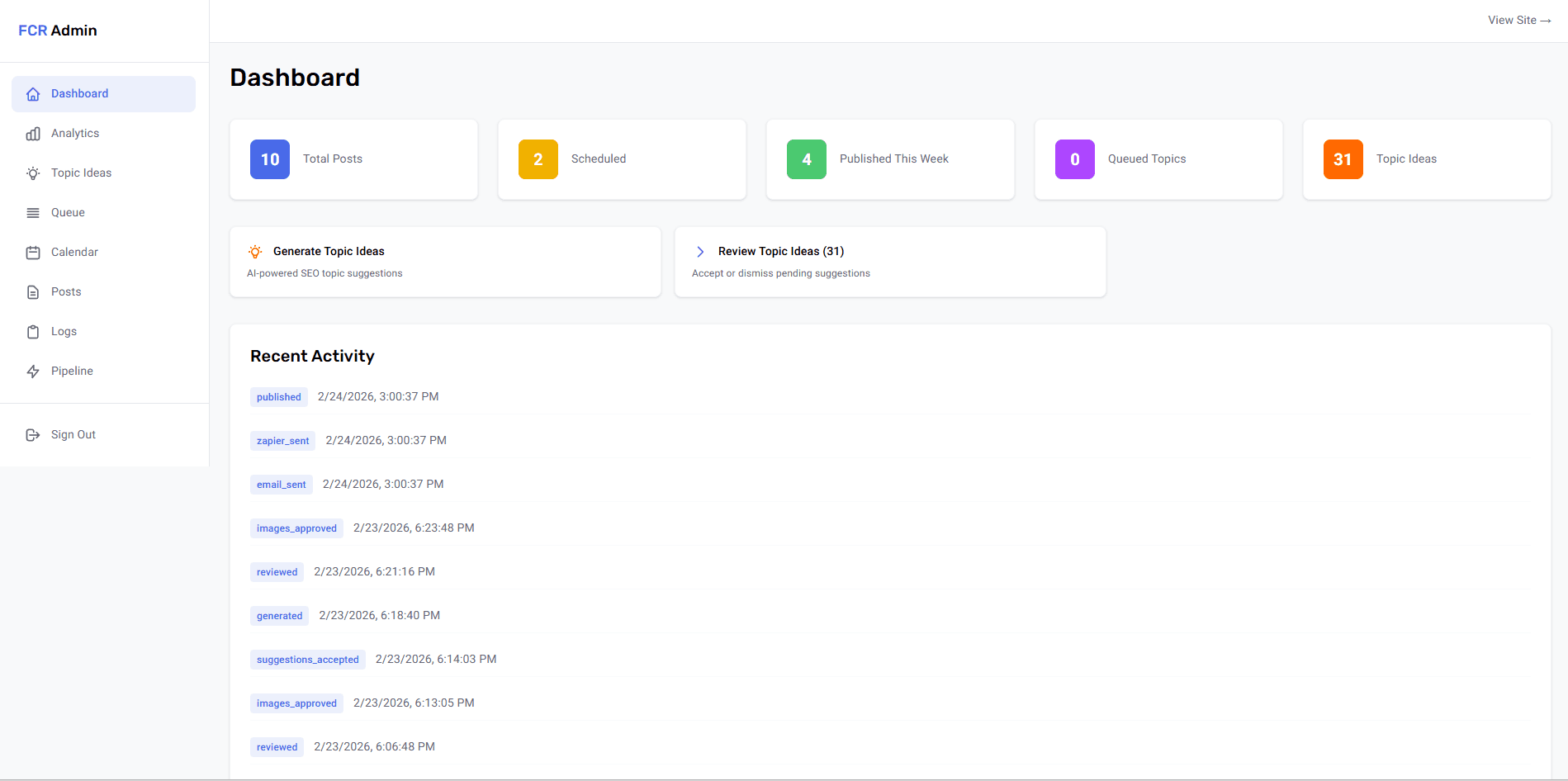
Ownership
Two ways to own it
Both end the same way — with software that belongs to you instead of a login you keep paying for.
Own it outright
One flat build fee. When it ships, the repositories, the accounts, and the documentation are handed to you. Run it on your own infrastructure, hand it to your own developer, change anything you want.
Own it, we run it
The same build and the same handoff, plus optional hosting, fixes, and updates so nobody on your team has to babysit it. Cancel any month you like and keep the software.
Either way, you own the code. The care plan is a convenience, never a leash.
What operations leads ask
Can we export our boards and items?
Yes, and the export is usually more useful than people expect — the columns and statuses you've evolved over two years are a fairly complete description of your process, which is exactly what we build from.
How do occasional users work without seats?
They just log in. Because there's no per-seat licence, the finance person who checks one dashboard monthly and the contractor who updates two items a week cost the same as everyone else: nothing.
Will it connect to Slack, email and our spreadsheets?
Yes, and to the internal systems no marketplace has a connector for. Notifications and syncs are built for your stack rather than assembled from whatever integrations happen to exist.
Can we move one team at a time?
That's the usual approach. Build for the team with the clearest process, run it alongside monday.com, and move the others once the first group stops opening the old boards.
What if our process changes next quarter?
You own the code, so it changes with you. The optional care plan exists for exactly this and cancels any time — but even without it, any developer you trust can pick it up.
Also paying for Airtable, Calendly or Kixie?
Most businesses are renting more than one. The argument is the same every time — and so is the fix.
Airtable alternative
A base your company would panic to lose isn't a spreadsheet. It's an app you're renting by the editor.
Own it insteadCalendly alternative
The booking page is never the real job. Everything after the invite is where owning starts to pay.
Own it insteadKixie alternative
The one we have already shipped: a $30,000-a-year Kixie plan, replaced by a dialer the client owns.
Own it insteadSee what your workflow as software would cost.
Five questions about how your team actually works, and a real range in about 60 seconds.
Or take a free 30-minute fit call — no card, no deck, and a straight answer about whether owning this beats renting it.