Launch27 vs ZenMaid: Flat $150/mo or Per-Cleaner Fees?

Launch27 vs ZenMaid mostly comes down to one line on each pricing page. Launch27 charges a flat monthly fee no matter how many people you add. ZenMaid charges a base fee plus a fee for every cleaner on your team. The booking forms, the scheduling and the texting all sit on top of that.
So you're really deciding how your software bill should behave as you hire. Here's the side-by-side, using only published plan terms:
| Launch27 | ZenMaid | |
|---|---|---|
| Built around | The customer-facing online booking form | Scheduling and running a residential maid service |
| Pricing model | Flat monthly. Unlimited users and bookings | Base fee + per-cleaner fee + SMS bundles |
| Entry price | Base: $75/mo (Launch27 branding on your booking form) | Starter: $19/mo, capped at 40 appointments a month |
| Realistic plan | Pro: $150/mo (unbranded form, Google Calendar, SMS) | Pro Max: $49/mo + about $24 per cleaner |
| At 10 cleaners | $150/mo | About $289/mo, before SMS |
| Texting | Included on Pro (check the plan page for any volume limits) | Sold separately (e.g., $14 per 125 messages) |
| Where it pinches | You need Pro to drop their branding and get SMS | The bill climbs with every hire |
| What leaving costs | Export clients, rebuild your booking form, re-point your site | Export clients, rebuild recurring schedules, retrain crews |
Prices checked October 2026 on Launch27's pricing page and ZenMaid's pricing page. Both vendors have changed their plans before, so check again before you sign. If a number moves, the break-even below moves with it.
My quick verdict, by buyer:
- Owner-operator with a handful of cleaners, mostly recurring houses: ZenMaid. It's cheapest while the crew is small.
- Five or more cleaners, a lot of new business coming through the website: Launch27 Pro. Flat pricing wins once you're past about four cleaners (illustrative arithmetic: $49 + 4 × $24 = $145, just under Launch27's $150. The fifth cleaner tips it).
- Multiple crews, a workflow neither tool models, and a stack of add-ons holding it together: price a custom build before you renew anything.
Launch27 is a booking form that sells, priced like a utility
Launch27 makes the most sense when your booking form is your sales team. A customer picks the service, the frequency and the extras, sees a price and books, all without calling you.
The pricing is the honest part. Unlimited users and unlimited bookings on both plans. Hire your eleventh cleaner and the bill doesn't move. That's rare in field-service software and it's a real point in Launch27's favor.
The catch is the $75 Base plan. It puts Launch27's branding on your booking form, and Google Calendar and SMS only come with Pro. If you care about looking like your own business, you'll end up on Pro at $150 a month, so budget for that, not $75.
I've already broken down what it costs to own a multi-crew booking app instead of renting Launch27, so I won't repeat it all here. The short version: at $150 a month flat, Launch27 is hard to beat on subscription cost alone.
ZenMaid fits the day-to-day maid service, and it's priced per cleaner
ZenMaid is built for the owner who thinks in cleaners, houses and recurring cleaning appointments: the every-other-Tuesday client and the cleaner who's always assigned there. If that's your business and your team is small, it's a sensible pick.
Then the per-cleaner fees start adding up. Using ZenMaid's published Pro Max pricing ($49 base, about $24 per cleaner), here's the illustrative math:
- 5 cleaners: $49 + $120 = $169/mo
- 10 cleaners: $49 + $240 = $289/mo
- 20 cleaners: $49 + $480 = $529/mo
- Texting on top: $14 per 125 messages
That's per-seat licensing for a cleaning company. Your software bill tracks your headcount, not your revenue per job. And Starter's 40-appointment monthly cap doesn't last long once you have even two full-time cleaners.
If you want to see what your own team size and tool stack add up to over a few years, plug them in here. No form, no call:
Price your stack in two minutes
List the subscriptions you pay for and see what they cost over 3, 5 or 10 years next to owning the software. No email needed to see the number.
I've seen seat-based pricing push a business to replace a tool before, in a different industry. One client was paying about $30,000 a year for Kixie, a sales dialer, and kept running into limits: not much customization, clunky workflows and a price that kept climbing. I built them a custom power dialer in React with unlimited users, lead lists assigned to any rep, Zapier webhooks to fire follow-ups, SMS templates and real analytics on connect rates and rep performance. The build cost $10,000, a third of one year of the Kixie licensing, and paid for itself in about four months. (That's a real client project. Details are generalized, numbers rounded, and results vary.) Here's how that kind of Kixie replacement is scoped.
Different industry, same pricing mechanic. But look at the size of that bill. $30,000 a year is nowhere near what most cleaning companies pay ZenMaid or Launch27, and that changes the answer. Keep it in mind for the rest of this post.
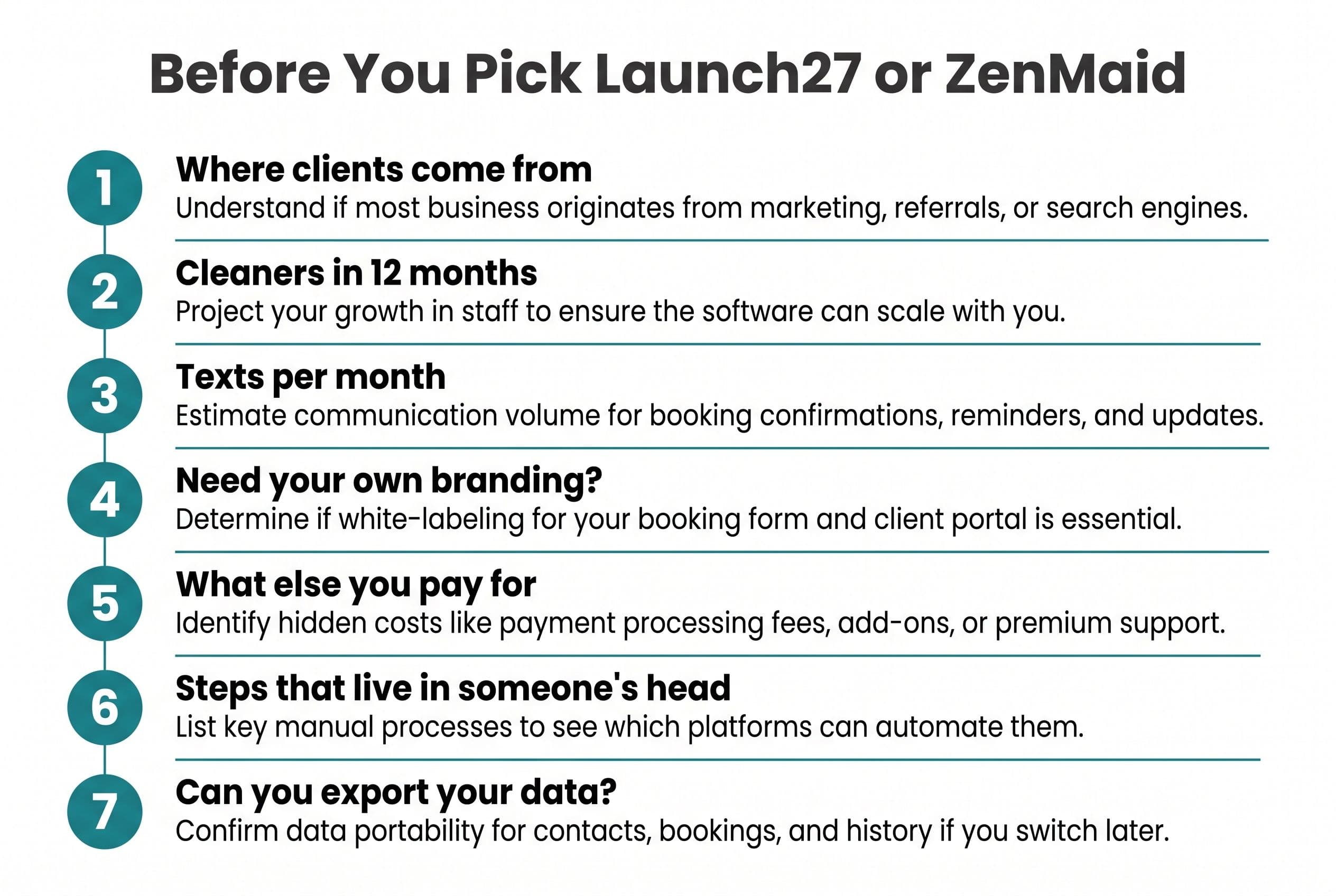
Seven questions to answer before you sign up for either
Answer these on paper before you start a trial. It's easy to pick on demo polish and regret it once the first renewal or the next hire hits.
- Where do new clients actually come from? If most come from your website at 10pm, Launch27's booking form earns its keep. If most come from referrals and phone calls and stay recurring, ZenMaid's scheduling side matters more.
- How many cleaners will you have in 12 months? Not today. Multiply that number by $24 and add $49. That's your ZenMaid Pro Max bill next year.
- How many texts do you send a month? Count reminders, "on my way" messages and rebooking nudges per client, then multiply. On ZenMaid that's a separate line item.
- Do you need your own branding on the booking form? If yes, Launch27 costs $150, not $75.
- What else are you paying for to make it work? Zapier, a separate time-tracking app, a spreadsheet the office manager uses for cleaning crew assignment. Add all of it to the subscription. That's the real bill.
- What step only exists in someone's head? Which crew handles which neighborhood, how move-out add-ons get priced, where the alarm codes live. If that knowledge only lives with one person and neither tool has a place for it, you'll feel it in year two.
- Can you get your data out? During the trial, run a data export. Check that you get clients, recurring schedules and job notes, not just names and emails.
Questions 5 and 6 decide whether you're comparing two subscriptions or comparing a subscription with owning your system. My guess is most owners skip them.
When owning your booking system beats both
A custom cleaning booking workflow is the right answer for a narrow set of businesses. Here's what that set looks like:
- You run multiple crews with assignment rules. Team leads, two-person teams for deep cleans, keyholders, pet-allergy restrictions. You're doing it by hand because neither tool models it the way you work.
- Your total software bill, not just the booking tool, is several hundred dollars a month or more. That means the booking subscription, SMS bundles, Zapier, a second scheduler and whatever else you've bolted on. Payback math needs a real bill to work against (illustrative: a $10,000 build replacing $500 a month pays back in 20 months, before hosting).
- Your pricing doesn't fit a form. Commercial square-footage quotes mixed with residential flat rates, or custom add-on logic, so every non-standard job turns into a phone call.
- You've already left one platform and don't want to do it again. If you've gone from Housecall Pro to something else and you're shopping again, the problem is renting someone else's version of your workflow. I made the same argument for cleaning companies looking for a Housecall Pro alternative.
And here's who shouldn't call me about this. If your whole software bill is Launch27 Pro at $150 a month and it does what you need, keep it. A build won't pay back in any timeframe you'd care about. The same goes if you're a three-cleaner shop on ZenMaid growing a cleaner a year, or if what you really want is a developer on staff tweaking things every week. That's a hire, not a fixed-price project.
The question underneath all of this is owning your software instead of renting it, and for a lot of cleaning companies under ten people, the honest answer is to keep renting.
What three more years of Launch27 vs ZenMaid actually costs
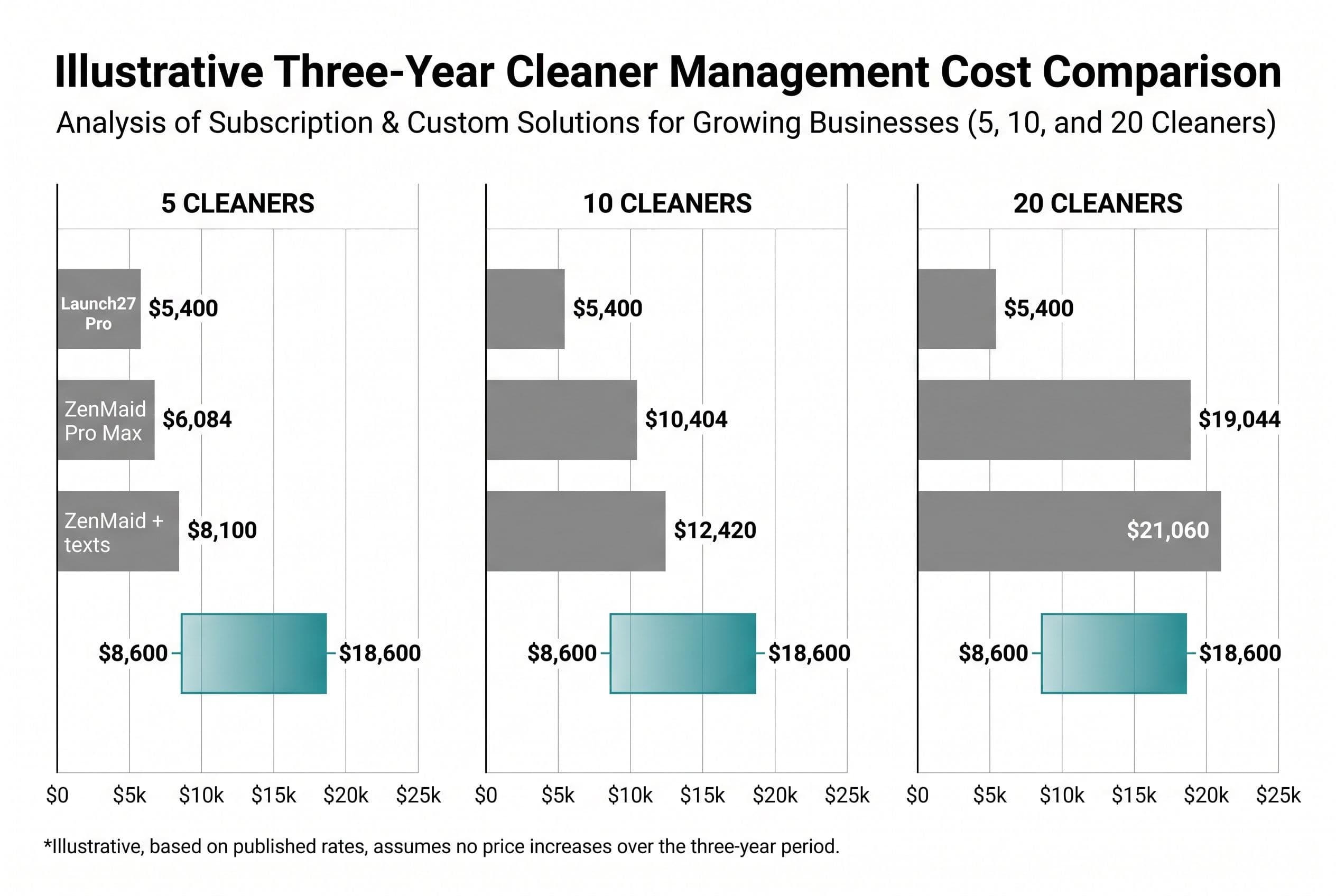
This is where you decide. Below are three years of each option at three team sizes. This is illustrative arithmetic: published rates, no price increases assumed. The custom column uses my medium-build range ($5,000–$15,000) plus my own labeled assumption of about $100 a month for hosting, text-message usage and upkeep.
| Team size (3 years) | Launch27 Pro | ZenMaid Pro Max | ZenMaid + ~500 texts/mo* | Custom build + migration + hosting |
|---|---|---|---|---|
| 5 cleaners | $5,400 | $6,084 | $8,100 | $8,600–$18,600 |
| 10 cleaners | $5,400 | $10,404 | $12,420 | $8,600–$18,600 |
| 20 cleaners | $5,400 | $19,044 | $21,060 | $8,600–$18,600 |
*500 texts a month = four $14 bundles = $56/mo, or $2,016 over three years. Your volume will differ.
Here's how I read that table:
- Launch27 Pro beats a custom build on subscription cost at every size. If it fits your workflow, that's the end of it. A build only beats Launch27 when you're paying for workarounds around it, or losing office hours to things it can't do.
- ZenMaid at 10 cleaners is roughly a tie with the low end of a build over three years. That's no reason to switch on its own.
- ZenMaid at 20 cleaners with regular texting costs more than most medium builds over three years. In year four, the subscription keeps billing and the build doesn't.
- The hidden column is labor. If someone spends hours every week fixing crew assignments or re-entering bookings, price those hours at what you pay that person and add them to the rental side.
Doing nothing has a cost too. It's the bill above, plus whatever the workarounds cost, renewed every year and growing with every hire.
Not sure which row you're in? Send me what you actually pay:
Send us your software bill
Bring what you pay today. We'll tell you plainly whether a replacement would pay for itself, or whether you should keep renting.
What I'd build instead, and how much of your time it takes
For a cleaning company this isn't a marketplace app. Search "cleaning app development cost" and you'll find guides quoting far more than a focused booking system costs. Those numbers are for a consumer marketplace with two-sided apps. You don't need that. You need your own booking and dispatch system.
Here's what a typical build includes:
- A public booking form with your pricing rules: frequency discounts, add-ons, square footage.
- Stripe for card-on-file and charge-after-clean, so nobody chases payment.
- A recurring-appointment engine that handles skips, holidays and "move me to Thursday this week."
- A crew assignment board that knows your rules, not a generic calendar.
- Twilio texts for reminders and "on my way," paid at usage rates instead of bundles.
- A phone-friendly cleaner view with today's houses, notes and access codes.
- Import of your existing clients and schedules from Launch27 or ZenMaid. How clean that goes depends on what each tool actually lets you export, which is why question 7 matters.
The stack is Next.js, Postgres on Supabase, and a QuickBooks sync if you want one. With integrations and user roles, that's a medium build: $5,000–$15,000, 2–4 weeks. Multi-location with complex dispatch rules is advanced: $10,000–$20,000, 4–6 weeks. If all you need is the customer-facing piece, a custom scheduler on its own is a smaller job.
What moves you around inside that range? Mostly three things: how messy your recurrence rules are, whether you want the QuickBooks sync, and how clean your export is. Heavy assignment rules plus QuickBooks usually push it toward the advanced tier. And two things run on someone else's clock, not mine. US carriers make every business sender register for A2P 10DLC before texts go live, and Intuit reviews QuickBooks apps before they can connect to a real company file. I start both on day one, but they can add a week or two to go-live no matter how fast the code ships.
Compare that to the alternatives. US agencies bill by the hour and usually charge for a discovery phase before you see a number. The cheapest offshore shops look like a bargain until you're paying someone else to rewrite it. And a full-time in-house developer costs more in salary every single year than a fixed-price build costs once. That's a bad trade for a booking system.
What it takes from you: one scoping call, a short weekly review while I build, and a final test pass where your office manager and a couple of cleaners try to break it. That's it.
How the risk is split: the price is fixed, so overruns are my problem. The code lives in your own repo from day one. On final payment, the contract transfers ownership of the custom code and source to you. I keep only my generic reusable components, and third-party services like Stripe and Twilio keep their own terms. You get handoff documentation, so any developer can take over without calling me.
My pick for each kind of cleaning company
- Solo to four cleaners, mostly recurring residential: ZenMaid. Don't overthink it.
- Five-plus cleaners, website-driven bookings, workflow fits a standard form: Launch27 Pro. Flat $150 is a good deal and I'd tell you that on a call.
- Ten-plus cleaners on ZenMaid, texting heavily, adding hires every quarter: run the three-year math on your real numbers. A build likely wins in year three or four.
- Multiple crews, rules that live in someone's head, and Zapier or a spreadsheet holding everything together: that's when owning it beats both.
Your next steps, in order:
- Answer the seven questions above with real numbers.
- Add up your full monthly bill, including SMS, Zapier and anything else you bolted on.
- Find your row in the three-year table.
- If you're in the custom column, get a range before you renew.
You'll probably end up saying something like this to your partner: "We're paying more every time we hire, and we still do crew assignments by hand. Let's find out if owning this pays back before we renew." The estimator answers that. It's five questions and takes about ninety seconds, and the price range shows on screen before you fill in any form. Send it through and you'll get a fixed quote back within one business day.
P.S. If you're on ZenMaid and your cleaner count is about to jump, run the numbers before the next hire, not after. That's when the per-cleaner fee adds up fastest.
Want a real number for your own project?
Answer a few questions and get an instant price range and timeline. No call required, no obligation.
Get your instant estimateTalk through your software project with MattFrequently asked questions
- Is Launch27 or ZenMaid cheaper for a cleaning business?
- ZenMaid is cheaper for very small teams, starting at $19/month on Starter. Pro Max charges a $49 base plus roughly $24 per cleaner, so once you pass about four cleaners it costs more than Launch27 Pro's flat $150/month, and that's before ZenMaid's separate SMS bundles.
- Does ZenMaid charge per cleaner?
- Yes. ZenMaid's published pricing adds a per-cleaner fee on top of the base plan, for example about $24 per cleaner per month on Pro Max, plus separate SMS bundles. A 10-person team runs around $289/month before texting.
- What's the difference between Launch27 Base and Pro?
- Both include unlimited users and bookings. The $75/month Base plan shows Launch27 branding on your booking form. The $150/month Pro plan removes that branding and adds Google Calendar integration and SMS.
- How much does a custom cleaning booking system cost?
- At BuiltInWeeks, a booking system with recurring appointments, crew assignment, Stripe payments and text reminders is typically a medium build at $5,000–$15,000, delivered in 2–4 weeks. Multi-location setups with complex dispatch rules run $10,000–$20,000 over 4–6 weeks. The price is fixed, and ownership of the custom code transfers to you on final payment.
- When should a cleaning company build its own booking software instead of using Launch27 or ZenMaid?
- When your total software bill, including SMS, Zapier and other add-ons, is several hundred dollars a month or more, when you run multiple crews with assignment rules neither tool handles, or when your pricing doesn't fit a standard form. If Launch27 Pro at $150/month already does what you need, keep it, because a build won't pay back.
What would software built for your business look like?
Replacing a subscription, fixing software that fell short, or adding AI to your workflow? Talk through the scope with Matt.
Matt Brody
Founder, BuiltInWeeks
I build custom software for small and mid-sized businesses — the kind you own outright instead of renting by the seat. Fixed price, delivered in weeks, source code handed over at the end.
More about how I workKeep reading

Launch27 Pricing: $5K–$20K to Own a Multi-Crew Booking App
Launch27 starts at $75/month; replacing it isn't automatically a better deal. I walk through a recurring cleaning booking, the migration risks, and the three-year math behind owning a multi-crew app.
Read more
Housecall Pro Alternative for Cleaning Business: $5K–$15K
I'd replace Housecall Pro only after checking whether a cheaper subscription handles your cleaning schedule. Here's the decision checklist, a $5,000–$15,000 custom V1 scope, and the three-year arithmetic that separates a useful build from an expensive detour.
Read more
Airtable Alternative for Small Business: AI Intake Checks
I'd replace the document workflow before replacing every Airtable base. Here's how I decide whether AI intake deserves a custom build—and what has to stay under human control.
Read more