Housecall Pro Alternative for Cleaning Business: $5K–$15K

Replace Housecall Pro—or just replace the workaround?
I'd buy cleaning-specific software before I'd build it—unless your crew rules are the reason the software keeps disappointing you. A focused custom app with recurring bookings, integrations, and user roles fits my medium-build range: $5,000–$15,000, delivered in 2–4 weeks, depending on the agreed scope.
If you're looking for a housecall pro alternative for cleaning business operations, that’s the decision: rent a better-fitting product, keep your current system and fix one gap, or own the scheduling workflow outright.
I'd start with your actual invoice. As illustrative arithmetic, not Housecall Pro pricing, a $500 monthly subscription plus $100 in add-ons costs $7,200 a year before anyone fixes a schedule by hand.
Put your own subscription and add-on totals through the stack calculator before comparing replacement quotes.
Price your stack in two minutes
List the subscriptions you pay for and see what they cost over 3, 5 or 10 years next to owning the software. No email needed to see the number.
My first-pass checklist is short:
- Stay put if the product handles your work and the frustration is fixable through setup.
- Switch subscriptions if another product passes your real scheduling tests for less money.
- Build one missing piece if the core system works but availability or recurrence doesn't.
- Replace the workflow if the rules are specific, the bill supports the math, and you can get your data out.
I've built the last option in a different industry. I replaced a roughly $30,000-a-year Kixie sales dialer subscription with a custom power dialer in React for $10,000. It supported unlimited users, custom lead lists, and automations with Zapier webhooks, among other calling features.
This is a real, anonymized client project; the figures are approximate, and results vary.
The build paid for itself in about four months against the licensing it replaced. It shipped in weeks, was owned outright, and had zero monthly licensing fees. That doesn't mean operating software is free—and it doesn't prove a cleaning app will have the same payback.
It proves the question is worth calculating. My broader Housecall Pro replacement options are a starting point, but I'd make this decision using your crew rules, not a feature-count contest.
Check whether your calendar understands a cleaning crew
A calendar can show an open appointment without having enough people to deliver it. That's the difference I'd investigate first.
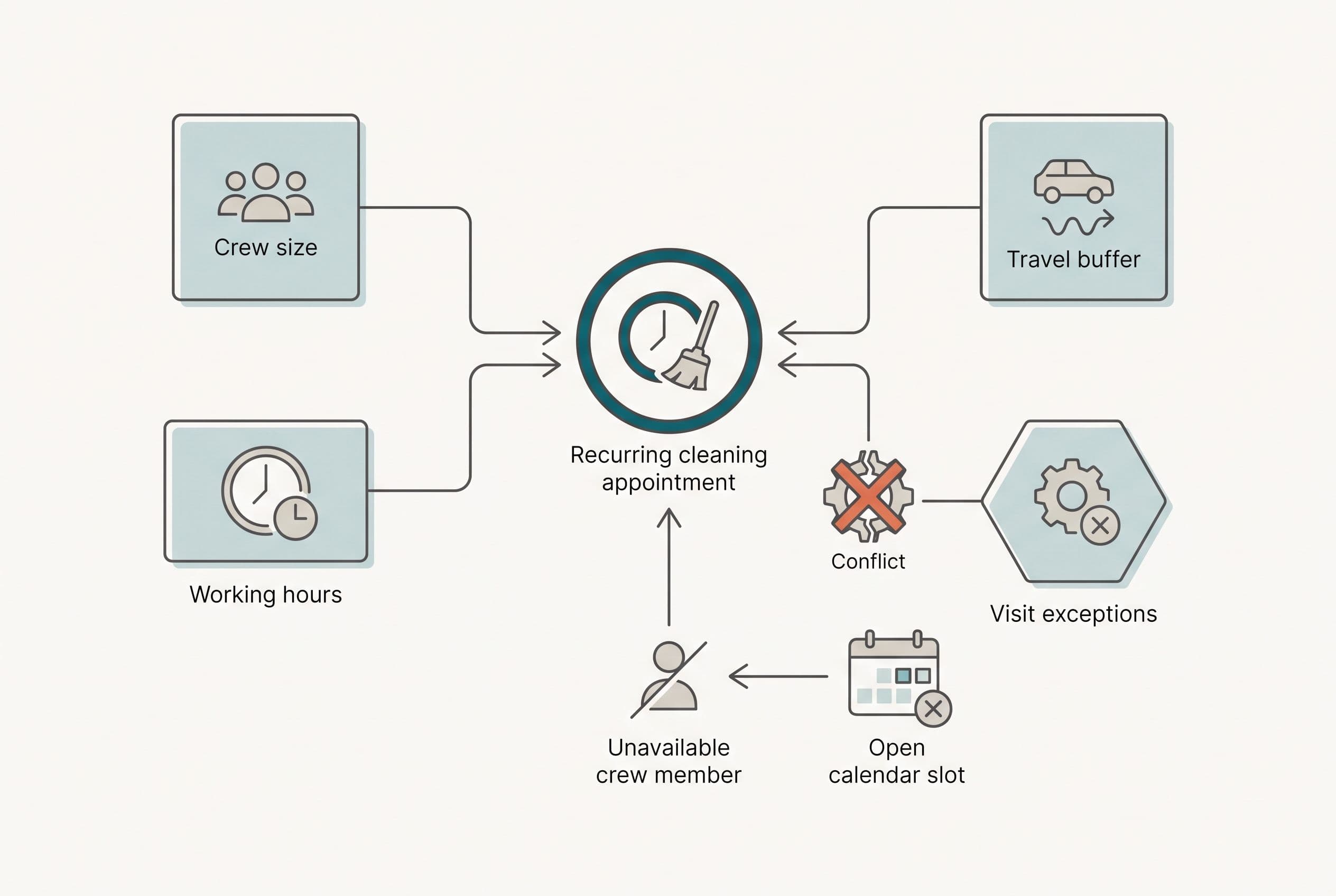
For custom cleaning crew scheduling, availability isn't just whether someone has a blank afternoon. It's whether the right combination of cleaners can reach the property, work for the required duration, and still make the next appointment.
I'd write your crew scheduling requirements as tests:
- Can a booking require a crew rather than one available person?
- Does travel time block the gap between properties?
- Can an absence change one visit without rewriting the recurring series?
- Can you preserve a preferred cleaner without promising someone who's unavailable?
- Can an office manager override an assignment—and see what conflict that creates?
- Does moving an appointment preserve property instructions and customer preferences?
“Every other Tuesday” isn't a complete scheduling rule. What happens after a skipped holiday? Does the next visit keep its original date or restart the interval? Does changing the duration affect one visit or every future visit?
Those answers belong in recurring cleaning booking software before the booking form gets polished.
For cleaning team availability tracking, I'd also separate working hours, approved time off, existing assignments, and travel buffers. One editable “available” switch hides too much.
I'd run these tests in your current software before declaring it broken. A missing configuration and a missing capability require different fixes. The same distinction matters when deciding whether a basic scheduler needs replacing: a booking link isn't automatically a resource-allocation system.
Price three more years of subscriptions and schedule repairs
Before choosing the replacement, I'd calculate the cost of leaving things alone. Otherwise, a custom quote is just a large number sitting beside a deceptively small monthly bill.
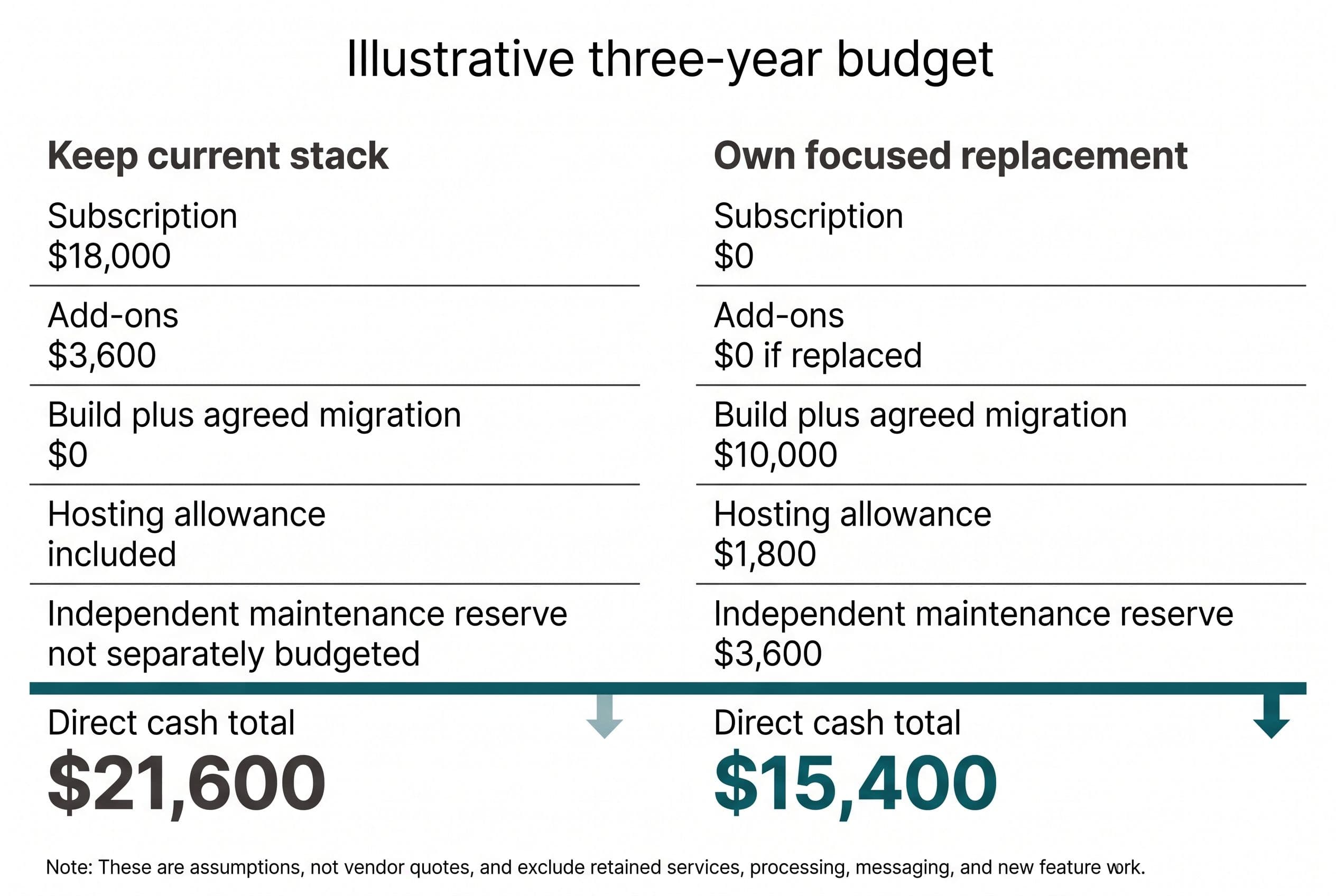
Here's illustrative budgeting arithmetic—not a Housecall Pro quote, a client result, or a maintenance offer. Assume your current subscription costs $500 a month, add-ons cost $100, and schedule repairs take two office hours a week valued at $25 an hour.
For the custom option, assume a $10,000 fixed-scope build that includes an agreed migration. The hosting allowance and independent maintenance reserve below are planning assumptions, not published service prices.
| Three-year line item | Keep the current stack | Own a focused replacement |
|---|---|---|
| Subscription: $500 × 36 months | $18,000 | $0 for replaced licensing |
| Add-ons: $100 × 36 months | $3,600 | $0, only if genuinely replaced |
| Build and agreed migration | $0 | $10,000 |
| Hosting allowance: $50 × 36 months | Included here in subscription | $1,800 |
| Independent maintenance reserve: $100 × 36 months | Not separately budgeted here | $3,600 |
| Direct cash budget | $21,600 | $15,400 |
| Existing workaround time: 2 × $25 × 52 × 3 | $7,800 | Not assumed eliminated |
That's a $6,200 direct-cash difference before counting any recovered office time. The current path reaches $29,400 when the assumed workaround time is included, but I wouldn't claim that whole difference as savings: some scheduling work survives any software change.
The custom column also excludes payment-processing fees, messaging usage, retained subscriptions, and new feature work. Add those where applicable. A reserve can run out; it isn't a promise that nothing expensive will break.
Staying with SaaS wins when the bill is small, the product already handles your workflow, or replacing its connected ecosystem costs more than you save. I wouldn't take this build just to replace an inexpensive booking form with another booking form.
If your hiring plan changes the subscription bill, I'd extend the same calculation using the seat-growth payback method, while checking your actual contract rather than assuming every vendor charges per seat.
Send the bill with the add-ons included, and I'll assess whether replacement has a believable payback.
Send us your software bill
Bring what you pay today. We'll tell you plainly whether a replacement would pay for itself, or whether you should keep renting.
Test cleaning subscriptions before buying a custom V1
A housecall pro alternative for cleaning business scheduling doesn't have to be custom. I'd shortlist products against the checklist above, then test the awkward appointments—not just the happy-path demo.
These are supplied published pricing snapshots from 2026, not guaranteed checkout prices. I'd verify the linked pages before deciding; pricing, billing terms, included users, message bundles, and plan limits can change.
| Option | Published starting point | What I'd check before choosing it |
|---|---|---|
| Launch27 Base | $75/month; unlimited users and bookings, customer and cleaner databases, basic booking form, and portals | Whether its assignment and recurrence rules match your crews |
| ZenMaid Starter | $19/month; intended for up to 40 appointments/month | Appointment volume, added-user charges, and messaging costs |
| BookingKoala Starter | $27/month; up to 5 providers, core scheduling, payment processing, and customer dashboards | Provider limits and what happens when your team grows |
| Custom focused V1 | $5,000–$15,000 fixed build price for a medium scope; 2–4 weeks | Whether the missing rules justify building and maintaining them |
Launch27's published pricing, as supplied for February 2026, makes an important point: unlimited users aren't exclusive to custom software. I'd never sell ownership by pretending every subscription punishes hiring.
The supplied June 2026 ZenMaid pricing information lists additional users at approximately $4, $14, or $24 per month depending on plan, with SMS bundles starting at $14 for 125 messages. I'd price the actual team and message volume, not the headline.
The June 2026 BookingKoala pricing snapshot puts its Starter plan at $27 a month. If that plan handles your operation, the subscription arithmetic is hard for a custom build to beat.
My test procedure is practical: create a recurring customer, skip one visit, remove a cleaner from availability, and try moving the appointment into a tight travel window. Ask the vendor to demonstrate any step you can't complete.
I'd reject a candidate when a mandatory rule fails. I'd keep it when the rule works, even if the interface isn't my favorite. For the wider trade between maintenance responsibility and subscription dependence, I'd use the guide to owning your software instead of renting it.
Scope the V1 around one recurring visit and its exceptions
If the subscriptions fail your tests, here's how I'd scope a cleaning service booking app without rebuilding an entire field-service suite.
First, choose the boundary. Is this replacing scheduling only, or scheduling plus customer bookings and payments? If accounting already works in QuickBooks, I'd assess the required connection rather than build a ledger.
My initial V1 checklist would cover:
- Customer and property records: service address, access instructions, preferences, and agreed service duration.
- Recurring visit rules: frequency, exceptions, skips, cancellations, and changes to future visits.
- Crew assignment: required headcount, working hours, absences, and conflict warnings.
- Office schedule: unassigned visits, reassignment, and an explicit override trail.
- Cleaner view: assigned work and only the customer details needed to complete it.
- Booking intake: a request or confirmed booking, depending on whether capacity can be checked reliably.
I'd start with request-to-book if your assignment rules still need dispatcher judgment. Instant confirmation is a bad trade when it sells capacity you don't have.
Stripe payments or Twilio reminders can fit a build, but they aren't free extras. They introduce service charges, failure handling, and integration work that must be in the scope. I'd also define what happens when a payment succeeds but a booking update fails.
I wouldn't put payroll, elaborate route planning, a customer loyalty system, and every historical report into the first release. That's how a focused replacement becomes a second unfinished software problem.
The medium-build range remains $5,000–$15,000 over 2–4 weeks. If the agreed requirements involve complex rules or real-time coordination that move it into an advanced build, my published range is $10,000–$20,000 over 4–6 weeks. I'd flag that before quoting, not halfway through delivery.
Move recurring bookings without moving the same mistakes
Before development, I'd ask you for a sample data export—not production credentials—and a list of what absolutely must survive the move.
The handoff packet should include:
- Current invoices, add-ons, renewal dates, and cancellation terms.
- Export samples for customers, properties, future visits, and recurring schedules.
- Your crew rules, including the exceptions that currently require office intervention.
- Roles and permissions, especially access to property entry instructions.
- Integrations you must retain and the reports used to run the business.
- Acceptance tests showing what “ready to go live” means.
I'd confirm export coverage and any API access before committing to migration. If future recurrence rules aren't available in the export, recreating them is work—not a detail to hide inside “import customers.”
Then I'd test the agreed workflows in a staging environment, reconcile imported records, and choose a cutover boundary. One system should be responsible for live scheduling at a time; duplicate confirmations are avoidable trouble.
Your expected involvement is a scoping call, a short weekly review, and a final test pass, plus supplying the records and decisions above. I won't pretend missing data cleans itself.
Fixed price means overruns on the agreed scope are my problem, not yours. New requirements need a separate agreement. Hourly billing that rewards slow work isn't the model I use.
The code lives in your own repo from day one. On final payment, the contract transfers ownership of the custom code and source to you; I keep only generic reusable components, and third-party libraries and services retain their own license terms. With the source and handoff documentation, another developer can take over.
Put your cleaning bill beside the $15,400 example
I'd make the final decision with three checks: the candidate passes your crew rules, migration is possible, and the three-year cost beats the alternative you would actually keep. Failing any one of those is a reason to pause.
In the illustration, owning the focused replacement costs $15,400 over three years, including the stated operating allowances, against $21,600 in subscription and add-on payments. Your invoice may produce the opposite answer.
Run your current bill beside your proposed V1 in the free project estimator at free project estimator: it does the same sum for your build in about ninety seconds, with the range on screen before any form; if the arithmetic lands, submit that same form for a fixed quote within one business day and leave with a number you can make a decision on.
Want a real number for your own project?
Answer a few questions and get an instant price range and timeline. No call required, no obligation.
Get your instant estimateTalk through your software project with MattFrequently asked questions
- What is the best Housecall Pro alternative for a cleaning business?
- I'd first test cleaning-focused subscriptions such as Launch27, ZenMaid, and BookingKoala against your recurring visits, crew assignments, and absence rules. Custom software makes sense when those rules don't fit the available products and the three-year replacement math works.
- How much does custom cleaning crew scheduling software cost?
- My medium-build range is $5,000–$15,000 over 2–4 weeks for an agreed scope with multiple features, integrations, and user roles. Complex rules or real-time features can move the project into my advanced range of $10,000–$20,000 over 4–6 weeks. Hosting, third-party usage, and ongoing maintenance need separate budgeting.
- Can recurring cleaning booking software handle cleaner absences?
- I'd require it to distinguish working hours, approved absences, assignments, and travel buffers. Test whether removing a cleaner creates a visible conflict and whether reassigning one visit leaves the rest of the recurring series unchanged.
- Can I move my Housecall Pro data into a custom cleaning app?
- I'd inspect your available exports and confirm any required API access before promising migration. Customer records, future appointments, recurrence rules, and attachments may require different handling. The quote should state exactly which data is included.
What would software built for your business look like?
Replacing a subscription, fixing software that fell short, or adding AI to your workflow? Talk through the scope with Matt.
Matt Brody
Founder, BuiltInWeeks
I build custom software for small and mid-sized businesses — the kind you own outright instead of renting by the seat. Fixed price, delivered in weeks, source code handed over at the end.
More about how I workKeep reading

Launch27 Pricing: $5K–$20K to Own a Multi-Crew Booking App
Launch27 starts at $75/month; replacing it isn't automatically a better deal. I walk through a recurring cleaning booking, the migration risks, and the three-year math behind owning a multi-crew app.
Read more
Alternative Calendly: Custom Scheduler Costs $2.5K–$20K
I price custom schedulers from $2,500–$20,000 before AI features, but replacing a cheap booking link rarely pays. Here's the arithmetic, the scope that moves the quote, and the recurring costs that don't disappear when you own the code.
Read more
Jobber Alternative for HVAC Contractors: Fix Dispatch
I'd replace the dispatch rules before I'd replace your entire field-service system. Here's my checklist for deciding whether to keep Jobber, add a focused scheduling tool, or build software you own.
Read more