Leaving GoHighLevel: A 7-Step Cutover With No Lost Leads

Canceling GoHighLevel takes a few clicks. What goes wrong is the week after. A lead fills out your form and never gets a text back. Or worse, someone who replied STOP eight months ago gets a text.
Here's the short answer: export consent before you export anything else, run the old and new follow-up side by side, and move your phone numbers last. If you do it in that order, you don't lose anyone. Most people go the other way: contacts first, rebuild later, cancel on the renewal date. That way loses leads, and you never find out which ones.
This is for owners who mostly use a pipeline, follow-up texts and a calendar, and not much else. If you resell GHL to clients, you should almost certainly stay, and the first section tells you why. If you're still here after that, the rest is the order of operations.
Check this before you touch a single export
Plenty of businesses shouldn't leave GoHighLevel. Run through these before you spend a dollar.
Stay if any of these are true:
- You're an agency reselling GHL sub-accounts to clients. The white-label product is the reason you're paying. If you replaced it, you'd be building a platform, not a follow-up system, and that's a different budget and a different conversation.
- Your all-in bill is small. If one account on an entry plan covers everything you do, the payback math won't work. I'll show you why below.
- You actually use most of it. That means funnels, sites, calendars, reputation requests and memberships, all live and all earning. Replacing five working modules costs more than replacing one.
- Nobody on your side can own the cutover for a few weeks. In its 2026 write-up, Pipeline AI Solutions says data migrations typically take 2 to 6 weeks, and the biggest factor in the timeline is how fast access and decisions come from the client side. If you can't answer questions within a day, wait for a quieter quarter.
Leave if these sound familiar:
- You really use three things: a pipeline, SMS/email follow-up sequences and a calendar. You pay for everything else.
- Your workflows have grown into a tangle that only one person understands, and that person is busy.
- You've wired Zapier and a couple of other tools around it so it'll do what your business actually needs.
- Your metered messaging and phone usage keeps climbing with volume, on top of the platform fee.
Now do the math that actually decides this. Pull your last three invoices. Add up the platform fee, the metered SMS, call and email usage, and every tool you bolted on to cover what GHL doesn't do. Average that and multiply by 36. That's what staying costs over three years. For most owners it's the first time they've seen the number all in one place. (Keep the usage figure separate as you go. You'll need to pull it back out when you compare against a build below.)
If you'd rather not do that by hand, the calculator below runs it for your stack. There's no form and no call.
Price your stack in two minutes
List the subscriptions you pay for and see what they cost over 3, 5 or 10 years next to owning the software. No email needed to see the number.
The dialer that paid for itself in about four months
The best evidence I have for this decision didn't come from a GoHighLevel account. It came from Kixie. The problem was the same one, though: a rented tool sitting between a lead and the first call or text, and in outbound sales, speed to lead is the whole game. (This is a real client project. I've generalized the details and rounded the numbers, and your results will vary.)
The business was paying about $30,000 a year for Kixie. They kept running into limited customization and clunky workflows, and the price kept going up. I built them a custom power dialer in React that dials up to 10 lines at once and only connects when someone picks up, with SMS templates, voicemail drops, Zapier webhooks and real analytics on connect rates and rep performance, for unlimited users.
The build cost $10,000, a third of one year's licensing, so it paid for itself in about four months. There's no monthly license fee now. The client owns it outright, and the reps spend less time clicking and more time closing. If you're weighing the same move off a dialer, I've laid out what replacing Kixie looks like separately.
A dialer isn't a GHL exit, and I won't pretend it's the same job. What carries over is the build side: follow-up software isn't exotic. It's a contacts table, a queue of scheduled messages, a few webhooks, and the Twilio and SendGrid APIs underneath. If you've got one person who can own a Postgres database and a Twilio account, you could try this yourself. If you don't, the build still isn't the hard part. The move is, and that's what the rest of this post covers.
Why follow-up breaks mid-move: your workflows hold state
Here's the part most people miss when leaving GoHighLevel. A GHL workflow isn't just a list of settings. It's live state. At any moment, some contacts are sitting on day 3 of a 14-day nurture, waiting on a timer, waiting on a tag, or waiting for an appointment reminder to fire.
In my experience, a contact CSV export doesn't tell you where each person is inside each workflow. And as far as I've seen, snapshots only move workflows from one GHL account to another, so they don't help you leave. GHL's export and API features do change, so check what yours actually includes before you trust it. But plan as if the position data stays behind. So when you switch off the old account:
- Everyone mid-sequence just stops getting messages, with no error and no alert.
- Tag-triggered automations stop firing, because nothing in the new system knows those tags meant anything.
- Appointment reminders for bookings already on the calendar never go out.
- Per-channel DND flags can get flattened or dropped when contacts are re-imported.
That's where gaps come from. It isn't bad software on either side. The old system is holding commitments you never wrote down. The playbook below gets them written down and lets them finish.
Consent is the one export you can't redo
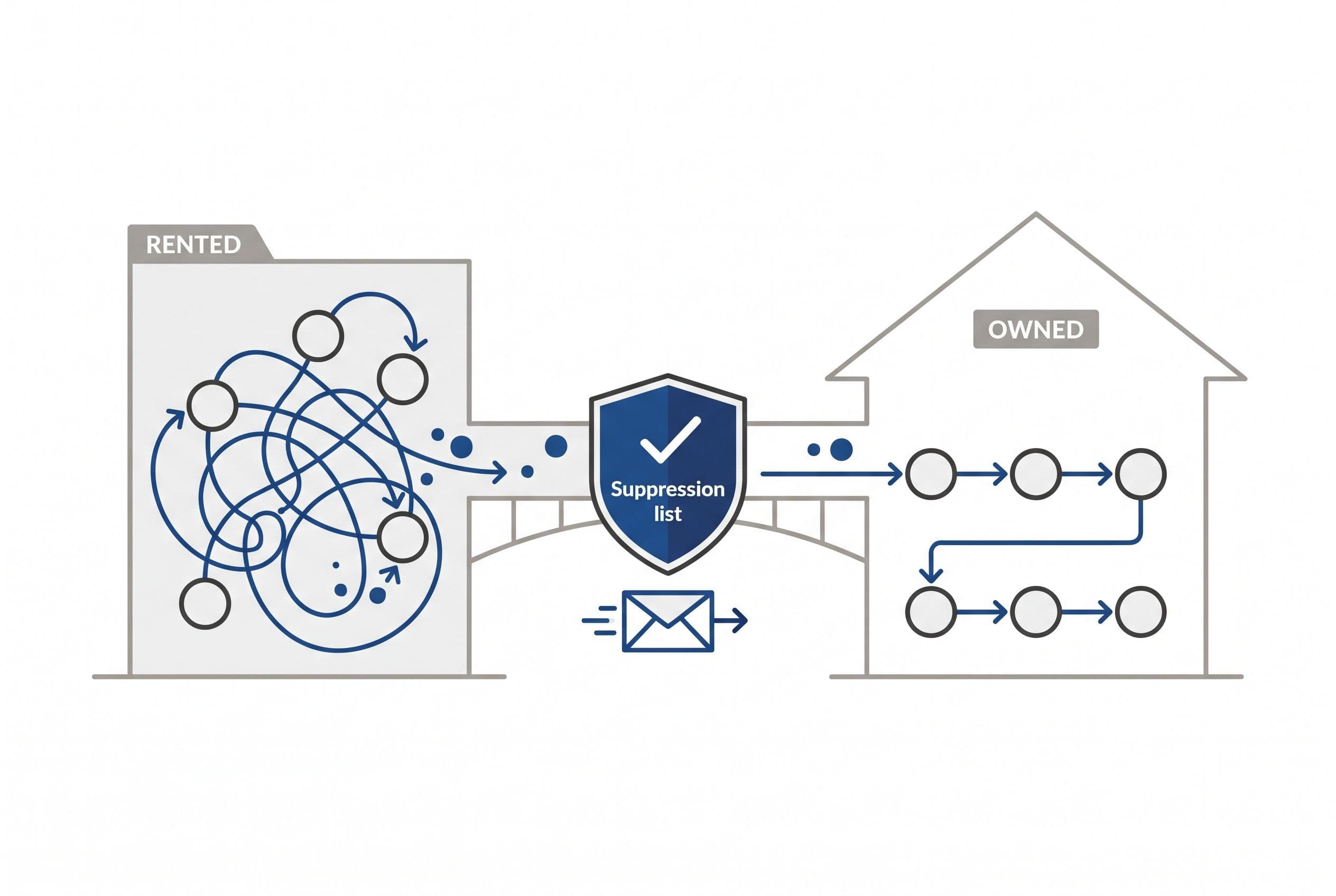
You can re-import contacts. You can rebuild a workflow. You can't un-send a text to someone who opted out. So marketing consent data migration comes first, before contacts, before pipelines, before anything else.
Here's what to pull and what to check it for:
| What to export | Why it matters | What to check |
|---|---|---|
| DND status, per channel (SMS, email, calls) | Someone who opted out of texts may still want email | Did the export keep the channel, or flatten it into a single yes/no? |
| STOP / opt-out replies | That's your SMS suppression list | Does every opted-out number appear, including ones attached to deleted contacts? |
| Email unsubscribes and hard bounces | Mailing them hurts deliverability and breaks the rules | Is each one tied to an address, not just a contact ID? |
| Opt-in source and timestamp | Your proof of consent if anyone ever disputes it | Which form, which date, and what the form said at the time |
| Contacts deleted in GHL | Deleting a contact can delete its opt-out with it | Keep the suppression record even when the contact is gone |
The rule I build every replacement around: message suppression lists load into the new system and get enforced in code before the first message can send. A person never edits that check. Every outbound text and email checks the list at send time, not at import time.
To be clear about what that buys you: the system enforces your consent records. It doesn't make you compliant. TCPA and CAN-SPAM obligations stay with your business, whatever software you run.
Two more things take a long time, so start them on day one, not in week three. If you're moving SMS to your own Twilio account, you'll need A2P 10DLC brand and campaign registration with the carriers, and that review isn't instant. If you're moving email to SendGrid, authenticate your sending domain early so your first real send doesn't go to spam.
Three years of staying vs. three years of owning
This is where the decision gets made. Below is illustrative arithmetic, not a GoHighLevel price quote. I've used two example monthly bills: platform fee plus add-ons plus the bolted-on tools, with metered usage taken out.
That last part matters. Messaging usage (the per-text, per-call and per-email cost) is left out of both sides, because you pay carriers either way. So before you put your own number in, subtract the usage you kept separate in the invoice exercise. Otherwise the stay side looks bigger than it really is.
| Three-year cost | Stay: $500/mo | Stay: $2,000/mo | Custom build |
|---|---|---|---|
| Subscription, 36 months | $18,000 | $72,000 | — |
| Build (fixed price) | — | — | $10,000–$15,000 |
| Migration of contacts, deals, consent | — | — | $1,500–$3,500 |
| Hosting, illustrative $50–$100/mo | — | — | $1,800–$3,600 |
| Upkeep at 15–20% of build per year | — | — | $4,500–$9,000 |
| Total | $18,000 | $72,000 | $17,800–$31,100 |
Where these numbers come from: the build range is our own published pricing. A lead follow-up system with a pipeline, sequences, user roles and integrations is a medium build, $5,000–$15,000 over 2–4 weeks. Multi-location logic or real-time features push it into advanced, $10,000–$20,000. The migration line is Handled Agency's 2026 figure: plan for $1,500–$3,500 done-for-you if your data is at all messy. The upkeep line uses the 15–20%-of-build-per-year support figure from Rorix Technologies (2026).
The build column also leaves out one cost: the overlap month (or more) you'll keep paying GHL during the parallel run. And the bolted-on tools in the stay columns don't all disappear with a build. Some of them you'll keep.
Read the left column honestly. At $500 a month, building costs about the same as staying at the very best, and up to roughly $13,000 more at the top of the range. Add the overlap and it's worse. That's not worth the disruption. Stay. Stay too if you're an agency living on the white-label resale, or if GHL already handles your workflow and the only complaint is that the interface is cluttered. Renting is the right call in those cases.
a rental business choosing between a dialer subscription and its own callback tool
At $2,000 a month the math flips hard. Staying costs roughly $41,000–$54,000 more over three years than owning, and that's before any price increase. An overlap month barely dents that. The same logic holds if your big bill is a dialer instead (here's the same math run on a dialer subscription). The size of the bill decides it, not the features.
What about switching to another subscription? HubSpot's 2026 pricing puts Sales Hub Professional at $100 per seat per month with a five-seat floor, plus a mandatory $1,500 onboarding fee. ActiveCampaign's Plus plan runs $179 a month at 5,000 contacts. Those are fine products. But you'd still do the full migration, still rebuild every workflow, and still rent, so you'd be paying the switching cost without ever getting the ownership. If you want the longer argument, I've written about owning your software instead of renting it in depth.
Here's how the risk works if you do build: the price is fixed, so overruns are mine. And GHL stays on during the overlap, so nothing stops until the new system has proven itself. If you're near the line and just want a straight read on whether to stay, send me the bill.
Send us your software bill
Bring what you pay today. We'll tell you plainly whether a replacement would pay for itself, or whether you should keep renting.
The 7-step GoHighLevel migration, in order
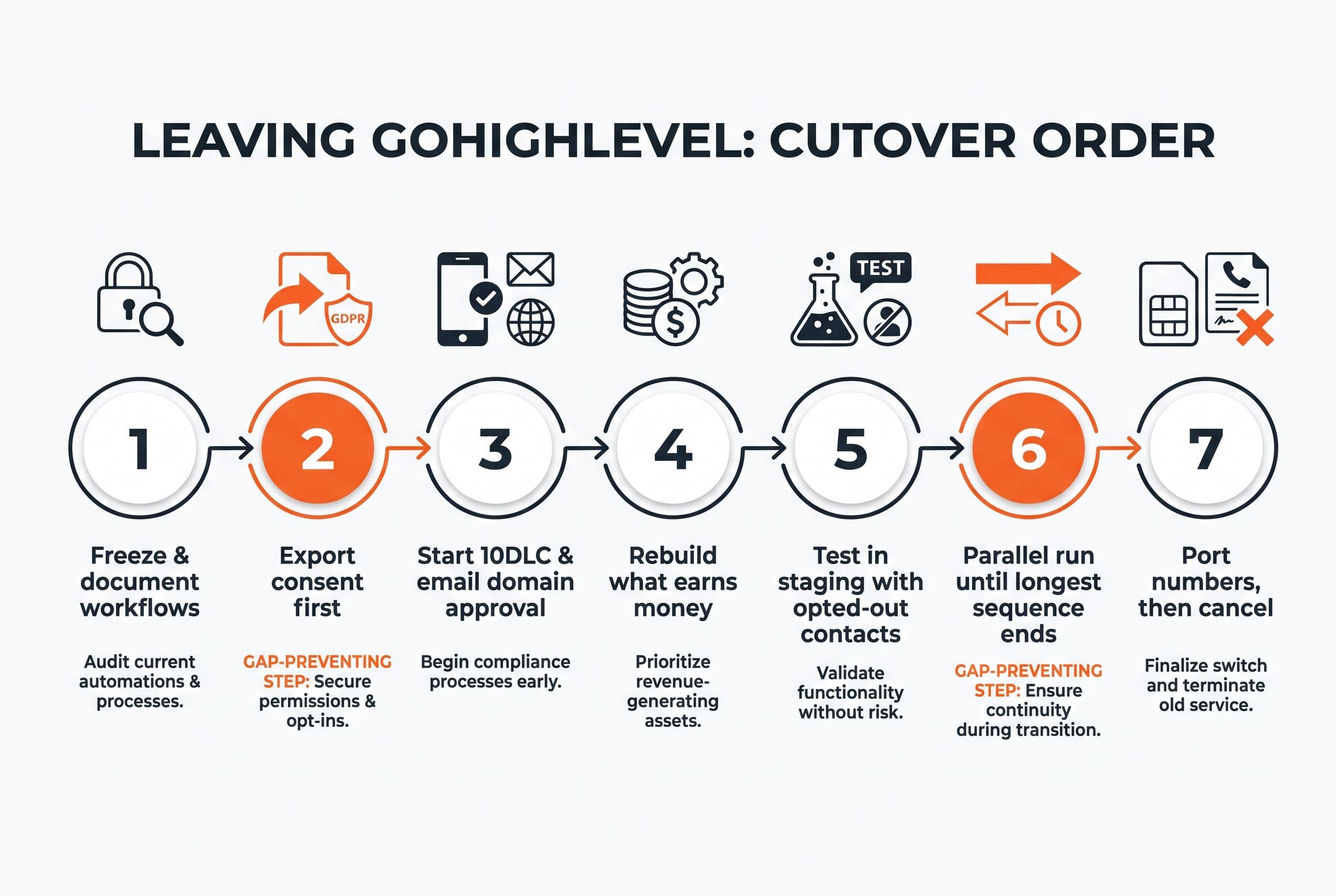
This is the GoHighLevel workflow migration I'd run for a typical small team. The order matters more than the speed.
- Freeze and document. No more workflow edits in GHL. For every live workflow, write down the trigger, each step, each wait and each exit condition. Screenshots are fine. Note your longest sequence length, because it decides step 6.
- Export consent, then everything else. Pull the suppression data from the table above first. Then contacts, custom fields, opportunities and pipeline stages, notes and calendar bookings. Check what your export really includes. Message history is usually where people find something missing.
- Start the slow approvals. Do 10DLC registration and email domain authentication now. They run in the background while the build happens.
- Rebuild only what earns money. Usually that's a Postgres database, a Next.js app, form webhooks feeding a lead queue, scheduled SMS and email through Twilio and SendGrid, and a pipeline view. Twenty workflows tend to shrink to five once someone asks which ones actually book appointments.
- Test in staging with nasty data. Automation cutover testing means seeding test contacts that are opted out of SMS but not email, have no phone number, booked twice, or replied STOP mid-sequence. The test passes when the opted-out contact receives nothing.
- Run both systems in parallel. On cutover day, every new lead goes to the new system. Contacts already mid-sequence in GHL finish there, with nothing new entering. Keep GHL running until your longest sequence has played out. That overlap month costs you one more bill, and it's what stops the gaps.
- Port numbers last, then cancel. Once nothing is left sending from GHL, move the phone numbers, then turn GHL off. Porting has its own traps (account PINs, the authorized name on the account, timing). I walked through them in the porting checks for leaving Aircall, and the same list applies here.
What to hand your developer so the move doesn't stall
Whoever builds the lead follow-up replacement, me or anyone else, will move twice as fast with this packet on day one:
- Admin access to the GHL account, plus a list of who currently owns logins for your domain, your DNS and your phone numbers.
- The workflow inventory from step 1, with each workflow marked keep, merge or kill.
- The consent export, untouched, in its own file.
- Your top three follow-up sequences written in plain English: who gets what, when, and what stops it.
- Every integration that touches GHL today: forms, Zapier zaps, Stripe, QuickBooks, your booking page.
- One decision-maker who can answer a question the same day.
Here's what your side actually looks like when I build it: a scoping call, a short weekly review, and a final test pass where you try to break the opted-out contact. On a medium build that's two to four weeks of build time, and your total involvement is a few hours. The full cutover runs longer than the build, though. 10DLC approval and the parallel run sit on top, and the parallel run lasts as long as your longest sequence. Plan for both.
The risk sits with me, not you. The price is fixed, so if it runs over, that's my problem. The code lives in your own repository from the first commit. When you make the final payment, the contract transfers ownership of the custom code and source to you. I keep only my generic reusable components, and third-party services like Twilio keep their own terms. Your Twilio, SendGrid and hosting accounts, and the 10DLC registration, should all be in your name, not mine, so nothing's stuck with me if we part ways. You get handoff documentation, so any developer can pick it up after me. For the full picture of what replacing GHL can include, see the GoHighLevel alternative breakdown.
One thing to be straight about: if you want someone embedded with your team for years, tweaking workflows every week, I'm the wrong hire. Hire in-house or keep a platform that lets your marketer click around. I build it, hand it off and you own it. That's the trade.
Your next move
Run the project estimator. It's five questions and about ninety seconds, and you see your price range before any form asks who you are. If the number beats what you're paying GoHighLevel now, send it over and you'll have a fixed quote inside one business day. That's the only step.
P.S. One free thing, whatever you decide: export your per-channel DND and opt-out list today, even if you never leave. It's the one record you can't rebuild, and right now it only exists inside someone else's software.
Want a real number for your own project?
Answer a few questions and get an instant price range and timeline. No call required, no obligation.
Get your instant estimateTalk through your software project with MattFrequently asked questions
- Can I export my workflows out of GoHighLevel?
- Not in a form another platform can import. Snapshots only move workflows between GoHighLevel accounts. Before you leave, document each workflow's trigger, steps, waits and exit conditions by hand (screenshots work), and use that inventory to rebuild in the new system.
- How do I keep opt-outs and DND settings when leaving GoHighLevel?
- Export consent data first: per-channel DND status, STOP replies, email unsubscribes, bounces, and opt-in source and timestamps. Load them into the new system as a suppression list that gets checked in code every time a message sends. Keep suppression records even for contacts you've deleted.
- How long does it take to migrate off GoHighLevel?
- A focused lead follow-up replacement is usually a 2–4 week build. Plan an overlap period after that so contacts already mid-sequence can finish inside GoHighLevel. Pipeline AI Solutions (2026) puts typical data migrations at 2 to 6 weeks, and says the biggest factor is how quickly the client provides access and decisions.
- Can I keep my phone numbers if I leave GoHighLevel?
- Usually, yes, through a port request with your new carrier. Confirm the port-out process with GoHighLevel support before you cancel anything. Port the numbers last, after nothing is sending from the old account, and start A2P 10DLC registration on the new provider early because the carrier review takes time.
- How much does it cost to replace GoHighLevel with custom software?
- A lead follow-up system with a pipeline, SMS and email sequences, user roles and integrations typically falls in our medium range of $5,000–$15,000 at a fixed price, delivered in 2–4 weeks. Add data migration, which Handled Agency (2026) puts at $1,500–$3,500 done-for-you for messy data, plus hosting and upkeep. If your all-in GoHighLevel bill is small, staying is often cheaper.
What would software built for your business look like?
Replacing a subscription, fixing software that fell short, or adding AI to your workflow? Talk through the scope with Matt.
Matt Brody
Founder, BuiltInWeeks
I build custom software for small and mid-sized businesses — the kind you own outright instead of renting by the seat. Fixed price, delivered in weeks, source code handed over at the end.
More about how I workKeep reading

Cost to Replace GoHighLevel: $10K–$25K, Then the Cutover
Replacing GoHighLevel with software you own costs $10K–$25K and takes 2–6 weeks to build. The build isn't the hard part. Getting your data, conversation history and phone numbers out is, and some businesses shouldn't leave at all. Here's the checklist, the three-year math, and the cutover plan.
Read more
Leaving Buildertrend? Save Change Orders Before You Cancel
If you're leaving Buildertrend, the risk isn't the new software. It's the signed change orders and job files you lose on the day you cancel. Here's the checklist I'd use: when to stay, what to export, the acceptance checks to run before you cancel, and what three years of each path costs.
Read more
Leaving monday.com: $5K–$15K Build, and Who Owns the Code
Most monday.com replacements I'd scope come in as a $5K–$15K fixed-price build over 2–4 weeks. The price is the easy part. If your contract doesn't assign the code to you, the developer keeps it. Here are the line items, the three-year math, and the handover checklist.
Read more