Best Auto Repair Shop Software: 6 Picks Traced on One RO
We build custom software, and for most single-location shops our advice on auto repair shop software is simple: don't hire us. Buy a flat per-shop subscription. Tekmetric's Start plan is $179/month billed annually with unlimited users, according to its pricing page (read November 11, 2026). That's hard to beat for a five-bay shop with an ordinary workflow.
That answer changes when your shop isn't ordinary. Maybe you run several locations, or your seat count keeps growing. Maybe half of your workflow happens in a spreadsheet the software never touches. So below we compare five real products and one custom build on the same columns. Then we follow one repair order through all of them and do the three-year math with each vendor's published prices.
| Who it fits | Pricing model (published) | Workflow it handles best | Where it falls short for a shop | |
|---|---|---|---|---|
| A custom build you own | Multi-location shops, odd workflows (fleet, mobile, towing, parts resale), owners tired of renting | Flat fee, quoted after a short call, plus hosting and maintenance | Whatever your RO actually looks like, including the steps no product covers | You pay up front, you need a developer for changes, and it's overkill for a simple single shop |
| Tekmetric | Single shops that want unlimited users at one price | Per shop: Start plan $179/mo annual, $199/mo month-to-month, unlimited users | The standard RO flow with no seat math | Entry plan. Higher plans add features, so check which tier your must-haves sit in |
| Shopmonkey | Small shops with three or fewer people in the system | Per shop plus seats: Basic $215/mo annual, $239/mo monthly, 3 licenses included, $20/mo per extra license, $500 one-time migration fee | Small-crew front counter and bay workflow | Seat creep: every extra tech or service writer adds a license |
| Shop-Ware | Shops that want unlimited users and plan to stay at one location | Per location: Startup $251/mo annual, $279/mo monthly, unlimited users | Unlimited-user operation at a single site | Per-location pricing means the bill doubles the day you open shop two |
| Shop Boss | Budget-minded shops that want one flat number | Flat rate: Gold $199/mo, unlimited repair orders and users | Predictable cost no matter how many ROs you write | One flat plan. Confirm the features you need are in Gold before you sign |
| Mitchell 1 | Shops already living in Mitchell 1's repair information | Not in our research. Get a written quote | Shop management that sits next to Mitchell 1's ProDemand repair data | Pricing isn't on our sheet, so compare it on a written quote and on export terms |
Pricing from each vendor's public pricing page on the dates noted in this post. Pricing and plan features change, so re-check the live pricing page and confirm which tier holds the features you need before you sign. Every per-shop and per-location plan here is priced for one shop, so ask each vendor in writing what a second location costs.
Disclosure: we build custom software for a living, so row one is our own work. To keep the rest fair, we used only the vendors' public pricing and packages pages, gave every row the same columns, and below we say plainly who should just buy each product and stop reading.
Quick verdicts:
- One shop, a growing crew: Tekmetric or Shop Boss. Unlimited users means hiring doesn't raise the bill.
- One shop, two or three people total: Shopmonkey's 3 included licenses fit.
- Heavy repair-information user: get a Mitchell 1 quote before anything else.
- Two or more locations, or a workflow none of these handle: that's where owning it starts to pay.
Here's the seat math in practice. A Shopmonkey shop with six people in the system pays for three extra licenses, which adds $60/month on top of the $215 base. That's $275/month before you count anything you've bolted on. Want to see this math with your own invoices? Enter what you pay now. If the three-year number looks bad, the next step is a short call. Tell us what you run today, and we'll show you a free demo of your replacement on Zoom before you pay anything.
Price your stack in two minutes
List the subscriptions you pay for and see what they cost over 3, 5 or 10 years next to owning the software. No email needed to see the number.
The checklist before you sign any shop software
Go through these in order. A "no" on any of the first three removes a product from your list.
- Can you export everything, in a format you can open? That means customers, vehicles, every RO, every invoice, and inspection photos. If export is "contact support," that's vendor lock-in, and it gets worse every year your history piles up.
- Does the price stay the same when you hire? Per-seat licensing charges you for growing. Per-shop pricing doesn't, at least until you open a second shop.
- Does it talk to your books? If your bookkeeper lives in QuickBooks, confirm the sync on a demo with your own data before you sign anything.
- What does a second location cost? On a per-location plan the answer is "the whole subscription again," and per-shop plans usually work the same way. Get it in writing.
- Which tier holds your must-haves? Entry plans are entry plans. Price the tier you'll actually end up on.
- What happens to your photos? Inspection photos are a lot of your shop's proof. Find out where they live and whether they come with you when you leave.
Disqualifiers, plain and simple: no full data export, a migration fee with no written scope, or a contract that auto-renews annually with no exit window. Walk away from any of those.
Follow one repair order through each system
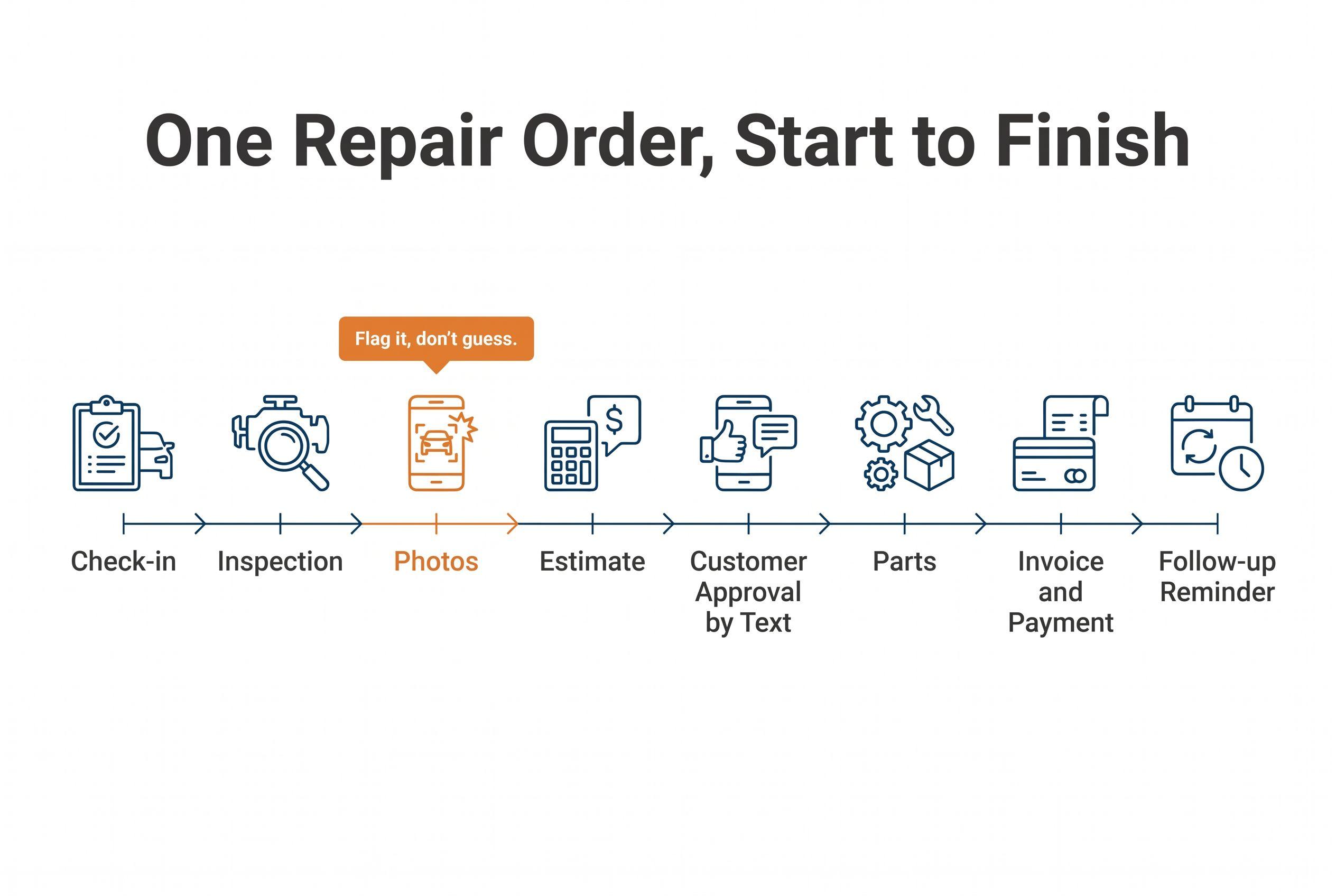
Run the same RO through every product on your list: a 2017 pickup with a check-engine light and a customer who wants a text before anyone touches it.
Check-in, inspection, photos, estimate, the customer's approval by text, parts, the tech's labor, the invoice, payment, and a follow-up reminder. Ask each vendor to show you that exact sequence on a demo with nothing skipped. Don't settle for the slideshow.
The weak spot is almost always the same: photos and the record they belong to. A tech shoots six photos of a leaking water pump. Somebody has to get them onto the right RO, under the right vehicle, in the right order. If that takes any manual step, it'll go wrong on a busy Saturday.
We've built software for exactly that problem in a different trade. (This is a real project. We've generalized the details.) An auction company photographs every lot before a sale, hundreds of photos per auction, and every file had to be renamed by hand to its lot number. The owner called it mind-numbing work. The renaming tool he'd tried got roughly three in four right, and in his business a wrong lot number is worse than no tool at all.
We built him a Windows app. You point it at a folder of photos and it converts iPhone photos to JPG, reads the lot number off the tag in each photo with AI vision, picks the lead photo for each lot and renames everything. Any lot it can't read gets flagged instead of guessed. It also rotates and crops the photos and drafts lot descriptions. On a real sale of a little over 400 photos, renaming went from about seven hours by hand to about fifteen minutes. It went live on real auctions in September, and the owner has come back for more features since.
Why does that matter for your shop? Because "flag it, don't guess" is the rule your RO software should follow too. A photo on the wrong customer's invoice costs you more than a missing one. When you trace the RO, ask every vendor what happens when the system isn't sure.
If none of the products handle your sequence the way your counter actually runs, there's another option, and we lay it out at the end of this post: a free demo of your replacement software before you pay anything.
The five products, each on its own terms
Tekmetric
Tekmetric's Start plan is $179/month billed annually or $199 month-to-month, per shop with unlimited users (pricing page, read November 11, 2026). Hiring a sixth tech doesn't move the bill, and that's the most owner-friendly pricing model in this group. If you run one location with a standard workflow, buy it and stop reading. Just price the tier that actually holds your must-haves.
Shopmonkey
Basic is $215/month billed annually or $239 monthly for one shop, with 3 user licenses included and $20/month for each extra license. There's also a one-time $500 data migration fee (pricing page, read October 27, 2026). For a two- or three-person operation it's a clean fit. It gets worse once you grow, because every service writer and tech you add shows up on the invoice.
Shop-Ware
Startup is $251/month billed annually or $279 monthly, per location, unlimited users (packages page, read October 14, 2026). Unlimited users is a real advantage. Per-location pricing is the catch: it's fine for one shop, but the bill doubles the day you open a second. To be fair, that's not unique to Shop-Ware. Every plan on this list is priced for one shop, so ask each vendor what shop two costs.
Shop Boss
Gold is a flat $199/month with unlimited repair orders and users (pricing page, read November 1, 2026). You get one number that doesn't grow with RO volume or headcount. If your top worry is a predictable bill, it belongs on your shortlist.
Mitchell 1
Mitchell 1 matters most if your techs already live in its ProDemand repair information. That's usually why people search "Tekmetric vs Mitchell 1." We don't have its pricing in our research, so we won't guess. Get a written quote, and ask the same export question you'd ask everyone else.
A word on free auto shop management software: free plans exist, but read the export terms before you put five years of customer history into one. Free that you can't leave isn't free.
Auto repair shop software: three years of rent, side by side
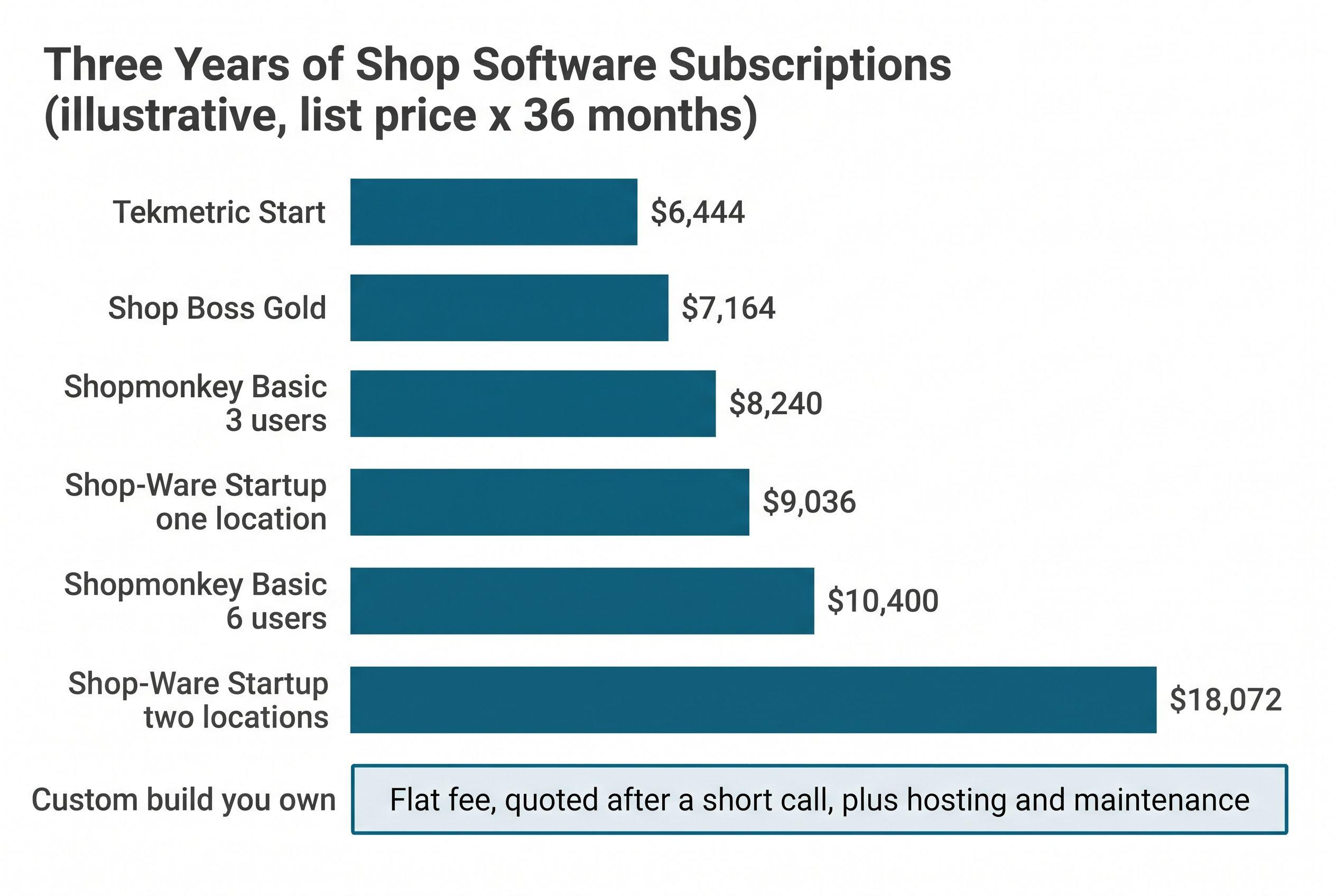
This is the cost of doing nothing. Every figure below is illustrative arithmetic: the published monthly price × 36 months, with no price increases, no add-ons, no payment processing fees. The annual rows assume you commit to (and pay for) a full year at a time, three years running. The month-to-month row doesn't lock you in, which is why it costs more.
| Option | Assumption | 3-year cost |
|---|---|---|
| Tekmetric Start | $179/mo annual, one shop | $6,444 |
| Tekmetric Start | $199/mo month-to-month | $7,164 |
| Shopmonkey Basic | $215/mo annual + $500 migration, 3 users | $8,240 |
| Shopmonkey Basic | Same, 6 users (+$60/mo) | $10,400 |
| Shop-Ware Startup | $251/mo annual, one location | $9,036 |
| Shop-Ware Startup | Two locations | $18,072 |
| Shop Boss Gold | $199/mo flat | $7,164 |
| Mitchell 1 | Written quote | Ask them |
| Custom build you own | Build + migration + hosting + maintenance | Flat fee, quoted after a short call, plus hosting and maintenance |
Shop-Ware gets a two-location row only because its page prices per location in plain words. If the other per-shop plans also repeat for a second shop, their numbers roughly double too. Ask before you assume they don't.
Now the honest part. If you're one shop paying $179 to $199 a month and the product handles your RO the way you work, keep renting. A bill around $6,400 to $7,200 over three years is too small for a custom build to pay back. Don't hire us for that. The same applies if your shop runs on a vendor's whole ecosystem and you can't leave it, or if what you really want is a developer on staff forever.
The math changes as you add locations, add seats, and stack workarounds. Count the extra subscription for texting, the spreadsheet for fleet accounts, and the hours your service writer spends re-keying things. The same arithmetic shows up in what it costs to replace ServiceTitan, where per-seat bills get big enough for the payback math to work.
On the owning side, the build is one number and the ongoing costs are real. Maintenance is a yearly cost you'll pay: dependency updates, changes when Stripe, Twilio or QuickBooks update their APIs, and the small fixes any working system needs. We quote it alongside the flat fee, so it's not a surprise later. Hosting on something like Vercel with a Postgres database is a monthly bill you pay directly to the provider, with no markup from us. Count all three before you decide.
See your software before you pay for it
Tell me what you run today on a short call. I build a demo of your replacement, free, and walk you through it. The price is fixed in writing before you pay anything.
When a shop should own its system
Owning it wins for a shop in a few specific situations:
- Two or more locations on per-location pricing. The two-shop Shop-Ware line above is the clearest example.
- A workflow no product covers. That might be fleet accounts with their own approval chains, a mobile unit, towing dispatch, a tire or parts resale side, or a photo-heavy inspection process you've had to hack around.
- Workarounds that cost more than the subscription. Separate tools for texting, reviews and reminders, all wired together with Zapier, each one billing monthly.
- Data you want in your own hands. Your customer list and RO history sit in your own Postgres database, not someone else's.
That's what custom software looks like in your industry: the boring core rebuilt around how your counter actually runs. Payments run through Stripe, customer texts go through Twilio, invoices sync to QuickBooks, and the software is yours. The customer side works the same way we laid out for client management software you build instead of rent.
Here's how it works with us, in plain terms. You get a first draft you can use two weeks after signing. That draft covers the core workflow, meaning check-in through invoice. The integrations with outside lead times follow it: business texting through Twilio needs carrier registration before it goes live, and the QuickBooks sync gets tested against your real books. Your time goes into a short call, the demo, a short weekly review and a final test pass. The price is fixed in writing, so overruns are our problem, not yours. The code lives in your own repository from day one. On final payment, the contract transfers ownership of the custom code and source to you. We keep only our generic reusable components, and third-party services keep their own license terms. With the source and handoff documentation, any developer can take it over.
No technical person on staff? That's normal for a shop. After launch, when something breaks or an integration changes, you call us, and the maintenance arrangement covers the fixes and updates. If you'd rather move to another developer later, the repo and the docs go with you.
For comparison, here's what the rest of the market charges. Industry roundups put the average custom software project at $132,480 over about 13 months (source). They also report that most projects reviewed on Clutch fall between $10,000 and $49,999. Plenty of that market still bills by the hour, whether it's a US agency or an offshore team. Hourly billing pays people for slow work. A flat fee doesn't.
What we'd pick, by kind of shop
- One location, owner still turning wrenches, under five people: Tekmetric Start or Shop Boss Gold. Unlimited users, one number, done.
- One location, two or three people, no plans to grow: Shopmonkey Basic works. Watch the license count.
- One location, service writer runs the office, techs depend on repair data: Get a Mitchell 1 quote next to Tekmetric's and compare them on the same RO.
- Two or more locations: do the per-location math before you renew. This is where a system you own starts beating rent.
- Any size, with a workflow the products don't touch: trace that RO. If every vendor demo skips the same step, that step is your answer.
Your next steps this week
- Pull your last 12 months of software invoices: shop management, texting, reviews, and anything connected through Zapier. Add them up.
- Export your customer and RO data from your current system and open it. If you can't, you've found your biggest risk.
- Pick one real RO from last week and ask two vendors to run it on a live demo, start to finish.
- Write down the one step your crew does outside the software. That's what you'll want built.
Maybe the sentence you'd say to your service manager sounds like this: "We're paying for two systems and still texting customers from my phone. Let's see what our own would look like before we renew." If so, here's how to settle it. Book a short call and tell us what you run today. We'll build a free demo of your replacement software around your RO and show it to you on Zoom before you pay anything. If you go ahead, it's one flat fee fixed in writing first, a first draft you can use two weeks after signing, overruns are ours, and the code is yours.
P.S. The fastest payback is usually the step you do outside the software. Start there.
See a free demo of your replacement software
Book a short call and tell me what you run today. I build a demo of the replacement for free and show it to you on Zoom. The price is a flat fee, fixed in writing before you pay anything, and you own the code.
Book the callOr answer a few questions for a flat quoteFrequently asked questions
- What is the best auto repair shop software for a small shop?
- For a single location with a standard workflow, a flat per-shop plan with unlimited users is usually best. Tekmetric's Start plan publishes at $179/month billed annually, and Shop Boss Gold is a flat $199/month with unlimited ROs and users. Run one of your own repair orders through each on a live demo before you choose.
- How much does auto shop management software cost over three years?
- At published list prices times 36 months, Tekmetric Start comes to about $6,444, Shop Boss Gold $7,164, Shopmonkey Basic about $8,240 including its $500 migration fee, and Shop-Ware Startup about $9,036 per location. Extra seats, extra locations and add-ons push those numbers up.
- Is there free auto shop management software worth using?
- Free plans exist, but check the data export terms before you put your customer and repair order history into one. If you can't get your data out in a format you can open, the cost shows up later as lock-in.
- Tekmetric vs Mitchell 1: which should I choose?
- Tekmetric publishes per-shop pricing with unlimited users, which makes it easy to budget. Mitchell 1 makes the most sense if your techs already depend on its ProDemand repair information. Get a written Mitchell 1 quote and compare the two on the same repair order and the same export terms.
- When does custom auto repair software make more sense than a subscription?
- When you run several locations on per-location pricing, when your workflow includes steps no product handles, or when the workarounds cost more than the subscription. For a single shop paying around $179 to $199 a month with a standard workflow, keep renting.
What would software built for your business look like?
Tell me what you run today on a short call. I build a demo of your replacement, free, and show it to you before you pay anything.
Part of these guides
Matt Brody
Founder, BuiltInWeeks
I build custom software for small and mid-sized businesses — the kind you own outright instead of renting by the seat. Fixed price, delivered in weeks, source code handed over at the end.
More about how I workKeep reading

ShopVOX Alternative: 5 Sign Shop Options, Priced Out
Most sign shops looking for a shopVOX alternative don't need different software. They need to know which part of their workflow is actually breaking. Here's a checklist, five options compared on public pricing, and three-year math you can redo with your own seat count.
Read more
Client Management Software for Small Business: DIY Cost
A focused client tracker built by me is one flat fee, quoted after a short call; doing it yourself trades cash for your time. I’ll trace one lead-to-follow-up workflow and show where renting, configuring, or owning the software makes financial sense.
Read more
Small Business Helpdesk Software: Build vs Zendesk
I'd buy Zendesk for standard support and build when resolving tickets means fighting your other systems. Here's the workflow, three-year arithmetic, and migration plan I'd use to make that decision.
Read more